
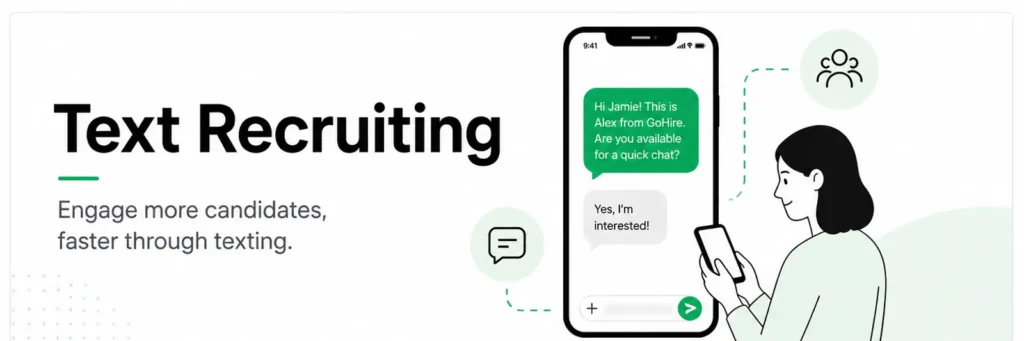
Text recruiting is the fastest way to engage, screen, schedule, and hire candidates in 2026 — and it’s no longer optional for any team managing 100+ applications a month. Text messages are opened within 3 minutes of receipt 98% of the time. Emails sit unread for 48 hours. The candidates you wanted are accepting offers from your competitors while your recruiters are still drafting follow-up emails. Per SHRM, 94% of qualified candidates take the first offer they receive — so whoever engages first wins, and manual phone-and-email processes lose the race every single time.
If your recruiters are still relying on phone calls and email to move candidates through your pipeline, you’re creating friction at every stage of the candidate experience. The best applicants are evaluating your employer brand the moment they wait two days for a response. They’re not waiting. They’re gone. Text recruiting closes that gap by replacing slow channels with one candidates already use — and answer in minutes, not days.
This guide covers everything you need: what text recruiting is, how the full candidate journey works over SMS, the measurable text recruiting benefits, what compliance requires under TCPA and 10DLC, ready-to-use scripts, software evaluation criteria, industry-specific playbooks, and a five-step plan to get started — including text recruiting for small business teams that don’t have a dedicated TA function. If you’re ready to build a complete text recruiting program, this is your starting point.
What Is Text Recruiting?
Text recruiting is a systematic approach to candidate communication that replaces or supplements traditional phone and email outreach with SMS text messaging. People often ask “what is text recruiting” and assume it means a recruiter typing one-off messages from a personal phone — it isn’t. It’s a structured methodology that covers every stage of the hiring funnel, from application through onboarding, conducted primarily over mobile text from a compliant business platform.
The foundation of this approach is the insight that candidates — especially those applying for frontline, hourly, and high-volume roles — don’t check email. They live on their phones. SMS reaches them where they already are, and it generates responses in minutes rather than days. That’s why mobile recruiting has shifted from a nice-to-have to the core channel for any team hiring at scale.
Modern SMS hiring encompasses several distinct functions that work together as a system:
- Apply by Text / Text-to-Apply — Candidates initiate the application process by texting a keyword to a short code or long code. No resume required, no email login needed. They start the process in under 60 seconds from their phone — the cleanest example of keyword opt-in in recruiting.
- Two-Way Messaging — Recruiters and candidates exchange messages in real time through a desktop or mobile platform. These aren’t automated blasts — they’re actual conversations, logged and searchable, that build candidate engagement at scale.
- Automated Pre-Screening — Qualification questions are delivered over text. Candidates answer at their own pace. An AI chatbot or automated workflow routes qualified candidates forward and disqualifies those who don’t meet criteria — without the recruiter touching every conversation.
- Interview Scheduling via Text — The recruiter sends a scheduling invite over SMS — typically a “Text Invite” — and the candidate replies YES to receive available interview slots back in the same thread. The candidate picks a time by replying with the slot number, all inside the conversation. No back-and-forth phone calls, no scheduling assistants, and in most cases no link to open a separate page.
- Broadcast and Campaign Messaging — Recruiters send bulk text messages to large candidate groups: job fair invitations, hiring event reminders, re-engagement campaigns for cold candidates, and status updates at scale.
It is not the same as adding a “send text” button to your existing ATS. It’s a purpose-built workflow that treats SMS as the primary communication channel — not a supplement to email. Every other piece of the hiring stack is built around it.
How Does Text Recruiting Work? The Full Candidate Journey
The question recruiters ask most often after “what is text recruiting” is “how does text recruiting work in practice?” The power of text recruiting becomes clear when you see the entire candidate journey mapped end-to-end. Here’s how a high-performing text recruiting workflow runs from first contact to day one on the job.
Stage 1: Apply by Text
A candidate sees a job posting — on Indeed, a job fair flyer, a QR code on a store window, or a social media ad. Instead of visiting a website and filling out a lengthy application form, they text a keyword (like “JOBS” or “APPLY”) to a phone number or short code. Within seconds, they receive an automated reply that confirms their application and kicks off the pre-screening sequence.
This single step removes the biggest drop-off point in high-volume recruiting. Most candidates on mobile devices abandon web application forms before completing them. A text-to-apply flow captures applicants who would otherwise disappear.
Stage 2: Automated Pre-Screening
Once the candidate initiates contact, an automated conversation asks qualification questions via text. Common pre-screening questions include availability, location or commute distance, work authorization, and role-specific requirements. Responses are collected automatically, candidates are scored, and qualified applicants move forward — often without any manual recruiter intervention.
This is where SMS solves the volume problem. When a recruiter is managing 200 candidate conversations at once, automation handles the initial qualification layer. Only verified, qualified candidates reach the recruiter’s inbox for a live conversation.
Stage 3: Two-Way Recruiter Conversation
For candidates who pass pre-screening, the recruiter picks up the conversation. Using a desktop or mobile platform, they review the candidate’s pre-screening responses, continue the conversation via text, and answer any candidate questions — all without picking up a phone or opening email. Because SMS has a 45% average response rate (compared to 6% for email), these conversations actually happen.
Stage 4: Interview Scheduling via Text
The recruiter sends a Text Invite — a short SMS asking the candidate if they’d like to schedule an interview, ending with something like “Reply YES and I’ll send some available times.” The candidate’s reply is the trigger: a YES pulls open slots from the recruiter’s calendar and sends them back inside the same thread. The candidate replies with the slot number to confirm. Automated reminder texts go out 24 hours and 1 hour before the interview. No-shows drop significantly. Scheduling time shrinks from 2–3 days of phone tag to under 5 minutes of text exchange — without the candidate ever leaving their messages app.
GoHire clients regularly see 92% of qualified candidates self-schedule for interviews within 24 hours of receiving a Text Invite — with no follow-up calls or emails required.
Stage 5: Offer and Onboarding Communication
Recruiting over SMS doesn’t end at the interview. Offer notifications, start date confirmations, onboarding document reminders, and first-day logistics all flow over SMS and MMS where attachments are needed. Because candidates respond to texts 8x faster than email, nothing gets lost. New hire no-shows drop. Onboarding completion rates improve.
The full journey — apply, screen, schedule, offer, onboard — runs over a single channel that candidates actually use. Time-to-offer shrinks from 7–14 days to 24–48 hours. That speed matters because, again, 94% of qualified candidates take the first offer they receive (SHRM). SMS is the only practical way to be that first offer at scale.
Text Recruiting Benefits: Why SMS Recruitment Outperforms Email
The case for SMS hiring isn’t subjective. The performance gap between SMS recruitment and email is documented, consistent, and large enough to change hiring outcomes at scale.
| Metric | Text / SMS | |
|---|---|---|
| Open Rate | 98% | ~20% |
| Response Rate | 45% | ~6% |
| Average Response Time | 3 minutes | 48+ hours |
| Application Completion (mobile) | High (single-step keyword) | Low (form abandonment) |
| Read Without Opening App | Yes (notification preview) | No |
The headline text recruiting benefits employers report most often are higher response rates, faster time-to-offer, lower interview no-show rates, dramatically better candidate experience scores, and recruiter capacity gains of 2–3x without adding headcount.
These numbers don’t mean email has no place in recruiting. Email remains useful for detailed documentation, formal offer letters, and compliance-sensitive communication. But for candidate engagement — the part that determines whether your best applicants stay warm or go cold — text wins by every measurable metric.
Consider what happens to an employer relying solely on email: a candidate applies on Monday, the recruiter emails Tuesday, the candidate reads it Thursday, and replies Friday. By that point, the candidate has interviewed with two other companies. SMS recruitment eliminates that lag entirely. The recruiter sends a text on Monday. The candidate responds within minutes. By Tuesday, they’re scheduled. That’s the competitive advantage employers in high-volume, frontline, and time-sensitive industries are building with text recruiting software today.
 GoHire: Text Recruiting Built for Speed
GoHire’s two-way text recruiting platform lets candidates apply by texting a keyword, get pre-screened by an AI chatbot, and self-schedule their interview — all over SMS. No app downloads. No email chains. 98% of texts are read within 3 minutes.
Text-Based Recruiting Compliance: TCPA, 10DLC, and Opt-In Rules
Text-based recruiting is powerful, but it operates in a regulated space. Before you send your first recruiting text, you need to understand the compliance framework — specifically TCPA, 10DLC registration, A2P messaging standards, and consent requirements.
TCPA: The Telephone Consumer Protection Act
The Telephone Consumer Protection Act (TCPA) governs how businesses can contact individuals via text and phone. For text-based recruiting, the most important requirement is prior express written consent. Before you send any automated text messages to a candidate, you must have clear, documented consent from them to receive those messages.
What counts as valid consent under TCPA:
- A candidate texting a keyword to opt in — for example, “Text APPLY to 55555 to receive recruiting messages from [Employer]”
- A checkbox on an application form with clear disclosure language
- A signed consent form
What does not count as consent:
- Simply having a candidate’s phone number from a resume or application
- Pre-checked boxes or implied consent
- Purchasing a list of phone numbers
10DLC and A2P Messaging Registration
10DLC (10-Digit Long Code) is the carrier-level registration system that governs A2P messaging in the United States. If you’re sending recruiting texts from a local-style phone number, your number must be registered under 10DLC, or your messages will be filtered, blocked, or throttled by carriers before they reach candidates.
Key Compliance Practices for Text Recruiters
- Always collect prior express written consent before sending automated texts
- Include your company name in every message
- Always include opt-out instructions (“Reply STOP to unsubscribe”)
- Register your numbers under 10DLC or use toll-free numbers
- Honor opt-outs immediately and maintain a suppression list
- Keep records of consent for every candidate you text
For a full breakdown of compliance requirements, see our dedicated guide: TCPA and 10DLC compliance for text recruiting.
Recruiting Via Text Message: Templates and Scripts
Initial Outreach / Application Confirmation
“Hi [First Name], this is [Recruiter] from [Company]. We got your application for [Role]. We’d love to chat! Can you answer a few quick questions to get started? Reply YES to continue. Reply STOP to opt out.”
Pre-Screening Response Follow-Up / Text Invite
“Great news, [First Name] — you’re a strong match for [Role] at [Company]. Want to schedule your interview? Reply YES and I’ll send a few available times.”
Interview Reminder (24 Hours Before)
“Hi [First Name], just a reminder — your interview for [Role] at [Company] is tomorrow at [Time]. Reply CONFIRM to confirm or RESCHEDULE if you need a different time.”
Re-Engagement (Cold Candidate)
“Hi [First Name], you applied for [Role] at [Company] a while back. We have openings now and you’re still in our system. Interested? Reply YES and we’ll pick up where we left off.”
Text Recruiting Software: What to Look For
Choosing the right text recruiting software determines whether you’re managing conversations efficiently at scale or drowning in manual message tracking. The features that separate effective platforms from basic texting tools include true two-way messaging, ATS integration, compliant opt-in and opt-out management, template libraries with personalization tokens, automated interview scheduling, and 10DLC-registered numbers with proper carrier compliance.
GoHire was built for exactly this use case. Core capabilities include apply by text / text-to-apply, two-way candidate conversations, AI-powered pre-screening, automated interview scheduling, and broadcast campaigns — all TCPA-compliant. For a detailed look, see our guide to text recruiting software.
Text Recruiting by Industry
Restaurants and Food Service
Restaurant hiring is relentless. High turnover, constant openings, seasonal surges, and hourly workers who rarely check their email make SMS the only communication channel that works reliably. Text recruiting for restaurants covers the specific workflows that work at scale in food service.
Retail
Retail recruiters managing multiple store locations deal with the same challenges: high volume, fast turnover, and candidates who apply from mobile devices and go silent if you don’t respond within hours. Text recruiting keeps candidates engaged across locations without requiring a recruiter at every store.
Healthcare and Caregiving
Healthcare hiring — especially for caregivers, CNAs, medical assistants, and similar frontline clinical roles — is extremely competitive. Healthcare text recruiting lets you screen for certifications, availability, and location over text, and schedule interviews the same day a candidate applies.
Warehousing, Manufacturing, and Logistics
Blue-collar and frontline workers are among the least likely candidate pools to engage via email. They’re on their feet all day, checking phones during breaks. See our guide to text recruiting for blue-collar and frontline workers.
Staffing Agencies
Staffing firms managing hundreds of active candidate placements simultaneously see dramatic recruiter workload reductions with SMS broadcast campaigns, bulk scheduling, and two-way messaging for ongoing placement communication.
Multi-Location and Franchise Employers
Multi-location groups and franchise operators can run separate, location-specific apply-by-text campaigns under one account while corporate maintains visibility and compliance oversight from a central platform.
Text Recruiting for Small Business: Where to Start
Text recruiting for small business teams looks different from enterprise SMS hiring — but the ROI curve is often steeper because every extra hour a small-business owner spends on hiring is an hour they aren’t spending on the rest of the business. The starter playbook: pick one role, use a single keyword posted everywhere, lean on templates, let automation handle the front of the funnel, and choose a platform that handles compliance for you.
Getting Started with Text Recruiting in 5 Steps
Step 1: Get Your Numbers Registered and Compliant
Before you send a single recruiting text, complete 10DLC brand and campaign registration (or toll-free verification). This can take 2–4 weeks for some carriers, so start here first.
Step 2: Define Your Opt-In Process
Map out exactly how candidates will give consent to receive texts. The simplest compliant path is a text-to-apply keyword: candidate initiates contact, which establishes consent automatically.
Step 3: Build Your Template Library
Write 10–15 core templates covering your most common recruiting scenarios: outreach, pre-screening, Text Invites, reminders, status updates, rejections, offers, and re-engagement.
Step 4: Set Up Your Apply-by-Text Flow
Create at least one apply-by-text keyword for your most common open role. Add it to your job postings, career site, social media bios, and physical recruiting materials. Test the full flow yourself before publishing.
Step 5: Integrate with Your ATS and Train Your Team
Connect your platform to your ATS so conversations, pre-screening data, and scheduling events sync automatically. Most teams are fully operational in their first week after a proper setup call. Once running, layer in recruiting automation to reduce manual recruiter touchpoints even further.
Common Text Recruiting Mistakes to Avoid
Sending Without Consent — Never send a recruiting text to a candidate who hasn’t opted in. Build consent collection into every touchpoint before you launch any campaigns.
Using Personal Cell Phones — No opt-out management, no audit trail, no visibility into team performance. Use a dedicated platform with a registered business number.
Generic, Impersonal Messages — Personalize every message with the candidate’s name and the specific role. Generic blasts get deleted.
Over-Texting — No more than one follow-up text per 24-hour period if a candidate is unresponsive.
Not Following Up on Responses — If a candidate replies, they’re on their phone right now. A recruiter who responds within 10 minutes will book the interview.
Why Employers Choose GoHire for Text Recruiting
GoHire was built specifically for employers who hire at high volume in frontline and hourly roles. Unlike enterprise HR platforms that bolt SMS on as a feature, GoHire is text-first by design. Core capabilities include Apply by Text, two-way candidate texting, AI recruiting chatbot, automated interview scheduling, and broadcast campaigns.
GoHire clients consistently see 92% of qualified candidates self-schedule for interviews within 24 hours of receiving a Text Invite, and time-to-offer shrinking from 7–14 days to 24–48 hours. No phone calls. No email follow-up chains.
See How GoHire Automates Your Hiring
GoHire customers fill roles in 24-48 hours instead of 7-14 days — with zero phone calls and zero emails. 92% of qualified candidates self-schedule their interview within 24 hours.
Frequently Asked Questions About Text Recruiting
What is text recruiting?
Text recruiting is the practice of using SMS text messaging to communicate with job candidates throughout the hiring process — from initial outreach and pre-screening through interview scheduling, offer delivery, and onboarding.
How does text recruiting work?
A candidate texts a keyword to a registered business number, gets an automated reply that begins pre-screening, answers qualification questions over SMS, and — if they qualify — receives a Text Invite asking if they’d like to schedule an interview. They reply YES, the platform sends back available slots in the same thread, the candidate picks one, and automatic reminders go out before the interview.
Is text recruiting legal?
Yes — when done correctly. It is governed primarily by the TCPA, which requires prior express written consent, proper 10DLC registration, clear opt-out mechanisms, and compliant message content.
What are the main text recruiting benefits?
A 98% open rate (vs. ~20% for email), a 45% response rate (vs. ~6% for email), a 3-minute average response time, lower interview no-show rates, and a time-to-offer reduction from 7–14 days to 24–48 hours.
What is “apply by text” or “text-to-apply”?
Apply by text lets candidates start the job application process by texting a keyword to a phone number. No app download, no resume required, no email address needed. For a full overview, see our guide to apply by text / text-to-apply.
Can I use text recruiting with my existing ATS?
Yes. Most modern platforms integrate with iCIMS, Greenhouse, Workday, UKG, Dayforce, Oracle, BambooHR, and others. See our guide to text recruiting software for evaluation criteria.
Does text recruiting work for small business?
Yes — text recruiting for small business is one of the highest-ROI uses of the channel. A single owner-operator can run a fully compliant program with one keyword, one number, and a small template library.
What industries use text recruiting most effectively?
Restaurants and food service, retail, healthcare and caregiving, warehousing and logistics, manufacturing, and staffing agencies — any role where the workforce communicates primarily via mobile rather than corporate email.