
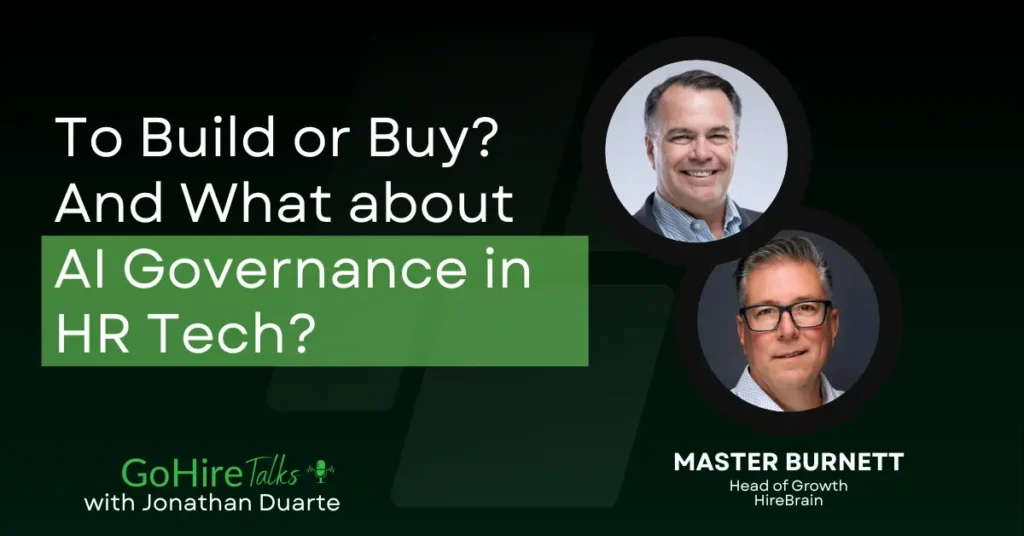
AI governance in HR is the difference between automation that scales and automation that gets your TA leaders fired. On this episode of GoHire Talks, host Jonathan Duarte sits down with Master Burnett, who works on context management and AI governance at Hirebrain — a platform built around what he calls a "system of context" rather than the old system of record. .
What Is AI Governance in HR?
AI governance in HR is the set of rules, ownership, and guardrails that decide how AI tools are allowed to touch hiring decisions — who can deploy an agent, what context it shares across a team, and where a human has to stay in the loop. Without it, individual AI adoption (a recruiter's chat agent, an internal build, a fully automated workflow) creates inconsistency instead of the strategy it was meant to execute.
Key Topics
- What Building vs. Buying Really Means for AI Governance in HR
- What Is AI Governance in HR?
- The Context Crisis: Why AI Chat Agents Create Chaos, Not Strategy
- Why 40% of Internal AI Builds Never Make It to Production
- When Full Automation Backfires: Two Firings and a Lost Offer Letter
- The $28 Million Lesson in Eliminating Talent Acquisition
- From Systems of Record to Systems of Context
- AI Governance in HR Starts With Decision Science, Not Dashboards
- Legacy ERP Data and Why You're Buying Logic, Not a UI
- FAQ: AI Governance in HR
- The GoHire Talks Interview Transcript with Master Burnett
What Building vs. Buying Really Means for AI Governance in HR
Every build-or-buy conversation in HR tech eventually turns into an AI governance in HR conversation, whether anyone names it that or not. Master points to a shift already underway: companies aren't really buying software interfaces anymore, they're buying access to the logic and data sitting underneath them.
"We're now buying the access to the logic and the data," Jonathan said, describing how protocols like MCP (model context protocol) let a system say, "I can't do that, but I can do this," instead of forcing a full custom rebuild every time a process changes.
Master's response cut to the real asset changing hands:
"You're buying the infrastructure."
— Master Burnett, Hirebrain
That reframes the build-vs-buy decision entirely. The question isn't "can we build a chatbot," it's whether your organization has the governance in place to manage what that system touches once it's live — the same governance most internal builds skip.
The Context Crisis: Why AI Chat Agents Create Chaos, Not Strategy
Master's biggest body of work this year isn't a Hirebrain feature — it's a framework he calls The Context Crisis. The problem starts small: a team of recruiters each running the same AI chat agent independently, with no shared memory or scope across them.
"You may have a team of 25 recruiters that are all using chat agents independently. No organizational memory bound across them. No scope definition, no context management at all."
— Master Burnett, Hirebrain
One recruiter's version of an "ideal" interview analysis looks nothing like another's, because the prompts are different and nobody owns the standard. Master is direct about where that leads:
"That doesn't lead to the execution of strategy. That actually leads to chaos."
— Master Burnett, Hirebrain
It's a preview of why that kind of governance can't be an afterthought bolted onto a chatbot rollout — it has to be the thing that gets designed first.
Why 40% of Internal AI Builds Never Make It to Production
A lot of TA and HR leaders are being told to build internal AI solutions rather than buy them. Master has watched that play out across Hirebrain's customer base, and the pattern repeats:
"If we look at our customers who have moved forward with some degree of internal projects, usually within a year they're at about 40% of scope. So they've built about 40% of what they said they could build."
— Master Burnett, Hirebrain
The reasons aren't mysterious — they're structural:
- No resources allocated to ongoing maintenance
- No resourcing for change requests once the business shifts
- No governance built into the solution at all
Internal AI build failures rarely come from bad engineering. They come from treating a governance-dependent system like a one-time project instead of an operating capability that needs continuous ownership.
📋 Related: The Recruiting AI Adoption Playbook
Jonathan built the Recruiting AI Adoption Playbook from interviews just like this one — real implementation patterns from leaders who've already been through it, governance included.
When Full Automation Backfires: Two Firings and a Lost Offer Letter
The starkest example Master shares involves a senior TA leader and their director, brought in under a clear mandate to fix a broken hiring process. Year one went to normalizing process. Year two, they started implementing change — and it included guardrails and human checkpoints.
Eight months into the mandate, the organization let both of them go. The stated reason:
"We asked you to automate and eliminate. And your implementation had guardrails. It had people involved in the process. That was not the goal."
— Master Burnett, Hirebrain
The company then brought in a consultant with "absolutely no organizational capital at all" to design a fully automated, zero-human hiring process — for roles that required physical dexterity to perform. The fallout landed on a candidate who had two different residences and needed to flag which one to be taxed under. There was no way to enter that exception into the process, so her physical offer letter went to the wrong address.
"There was no way for her to recall that to get it forwarded to… essentially what these two had designed is that, yes, we are implementing automation, but there are elements of human interaction that can't be eliminated from the process, at least today."
— Master Burnett, Hirebrain
She didn't accept the offer.
The $28 Million Lesson in Eliminating Talent Acquisition
Master describes a second case: a well-known electronics manufacturer that eliminated its entire TA function three years ago, betting that hiring managers could orchestrate the process themselves.
"In the first year after they implemented this model, third-party recruiting fees were $28 million."
— Master Burnett, Hirebrain
The company was paying outside agencies for the exact function it had just cut internally — with none of the consistency that made the internal function valuable in the first place.
"There you have no consistency in candidate experience. You're dealing with hundreds of contract agencies. Who knows what's actually being articulated to the candidates about the role?"
— Master Burnett, Hirebrain
It's a costly example of what happens when recruiting process automation is treated as a headcount decision instead of a governance decision: the work doesn't disappear, it just gets more expensive and less consistent.
From Systems of Record to Systems of Context
Master joined Hirebrain two years ago when it was, in his words, "a pretty progressive tool that was doing something that nobody else was really touching" — closer to sales enablement technology than a typical HR tool. Over 2025, the platform evolved into what Master calls a system of context:
"We process live information. We categorize and extract the information that's contained in that. We label it, we reposition it, and we export it out into other systems and processes so that we are orchestrating an information flow across systems and tools."
— Master Burnett, Hirebrain
The results Hirebrain customers see are concrete: cycle time reductions of roughly 65 to 70%, quick jumps in internal customer satisfaction scores, and about 70% of the manual administrative work removed from hiring managers, recruiters, and recruiting supervisors alike.
What AI Governance in HR Looks Like in Practice
Nutanix, Hirebrain's largest customer by activity, illustrates the problem context solves. Before Hirebrain, wide variation in how recruiters engaged with hiring managers meant cycle times in some parts of the business stretched to six or seven months. The fix wasn't more headcount — it was consistent recruiting process automation built on shared context about the organization's future-facing hiring needs, not just its historical job descriptions.
AI Governance in HR Starts With Decision Science, Not Dashboards
Master ties strong AI governance in HR back to something older than any tech stack: organizational consistency. He points to NVIDIA as an example of a company where "every person can tell you what the organizational priorities are, and how that informs their decision-making habits," despite rapid growth. Contrast that with Disney in the '90s or Gap in its prime — both consistency powerhouses that later lost their edge.
"It is building a culture of decision science, where the criteria for decision-making is widely understood."
— Master Burnett, Hirebrain
Growth breeds complacency, Master says, and complacency fragments the very context that governance depends on. Tasks get bigger, political capital gets spent, and "the underlying challenges sit" — a dynamic Jonathan says shows up constantly with TA directors and VPs trying to time a change initiative around their own tenure.
Legacy ERP Data and Why You're Buying Logic, Not a UI
Legacy ERP data fragmentation is one of the quieter reasons AI governance in HR is so hard. Master points to Workday specifically:
"The data model that underpins Workday is so hyper fragmented that you may have three functions within, or three departments within the HR function that all leverage the same underlying piece of data, but in Workday it will be stored in three different locations."
— Master Burnett, Hirebrain
Jonathan adds that access itself is gated by country-level security walls, so even a well-designed bot has to clear multiple security gates just to reach the data it needs. Master estimates 60 to 80% of Workday contracts are already losing value as a result, while platforms like ServiceNow expand precisely because they solve for capturing, translating, and storing that data more usably.
The upshot for anyone weighing build vs. buy: the value has shifted from the interface you click through to the infrastructure underneath it. As Master puts it, you're not really buying a UI anymore —
"You're buying the infrastructure."
— Master Burnett, Hirebrain
FAQ: AI Governance in HR
What is AI governance in HR? +
AI governance in HR is the set of rules, ownership, and guardrails that decide how AI tools are allowed to touch hiring decisions — who can deploy an agent, what context it shares across a team, and where a human has to stay in the loop.
Why do internal AI builds in HR tech fail? +
Hirebrain's data shows internal AI projects typically reach about 40% of their planned scope within a year, not because of bad engineering but because teams don't budget for ongoing maintenance, change requests, or governance from day one.
What happens when hiring automation removes humans entirely? +
In one case Master Burnett describes, a fully automated hiring process with zero human checkpoints couldn't handle a candidate's address exception, and her offer letter went to the wrong location — she declined the offer. The two leaders who had built in human guardrails were let go for not fully eliminating people from the process.
Is it cheaper to eliminate an internal TA function? +
Not in the case Master Burnett cites: one electronics manufacturer eliminated its TA function and paid $28 million in third-party recruiting fees in year one for the same work, with no consistency in candidate experience.
What's the real difference between building and buying HR AI tools now? +
Organizations are shifting from buying a user interface to buying access to logic and data, via protocols like MCP (model context protocol). As Master Burnett puts it, "you're buying the infrastructure" — not just a UI.
Want More Conversations Like This One?
GoHire Talks brings on CHROs, VPs of TA, and operators like Master Burnett to talk through what's actually working — and failing — in recruiting automation and AI governance.
The GoHire Talks Interview Transcript with Master Burnett
Catching Up and the State of Enterprise AI Builds
00:00–06:00
Jonathan Duarte: [00:00:00] Hey, Master. How are you?
Master Burnett: I'm good. How are you?
Jonathan Duarte: Good. It's been a long time. I don't even remember the last time we actually saw each other.
Master Burnett: Oh.
Jonathan Duarte: Nearly a decade.
Master Burnett: No, I think we ran into each other at an HR Tech five or six years ago.
Jonathan Duarte: Yeah, all right. Even HR Techs are — they all just bleed together at some point. So —
Master Burnett: Yeah, I seem to remember a conversation with you, me, and Joanna from Wells Fargo.
Jonathan Duarte: Oh, really? There you have it. I was working at Wells Fargo. I was consulting them and built their first AI chatbot for their contact centers.
Master Burnett: Nice.
Jonathan Duarte: And then during COVID, I guess it was, like, late 2020 or 2021, I did a quick stint at Ernst & Young — it was literally like 12 weeks. They reached out five times in six weeks with senior folks on SVPs to try to get me on to help [00:01:00] me build a chatbot for their internal technical support team for the global org, and they wanted to build a chatbot into ServiceNow. And nobody ever asked the question, "Is there an API that we can get access to?" And the answer was no. I was literally on vacation in Hawaii. I had to get up for calls at 5:00 in the morning, and then I'm like — there's no API. They're not gonna give you guys access, and you are in such an old version that the API would never work. And so I just wrote up a brief, I gave it to him, and I'm like, "I don't know what you guys want me to do." And they're like, "Okay."
Master Burnett: Ernst & Young is such a chaotic environment. There's so much tension between domestic and global —
Jonathan Duarte: Oh, yeah…
Master Burnett: — and from lines of business to other lines of business. Yeah. It is — half of the business is stale, doesn't change, routine. The other half of the business is really the Wild [00:02:00] West.
Jonathan Duarte: Yeah.
Master Burnett: They do anything, and everything, and whatever they want at any given point in time. And systems are antiquated, old. There's not a lot of practice-what-you-preach at all —
Jonathan Duarte: Yeah.
Master Burnett: — internally.
Jonathan Duarte: Yeah.
Master Burnett: But yeah, ServiceNow is fascinating to me, Jonathan, just from an ecosystem perspective.
Jonathan Duarte: Yeah.
Master Burnett: The fact that they want to drive automations, but they do absolutely nothing to capture context and information where it originates.
Jonathan Duarte: Yeah. That was my — the thing that blew me away when I was looking at it, and one of my friends was an executive board member at ServiceNow. He sold his company to them and stayed on for six years because he was just bored. And then he was too bored there, so he started another AI company. And he lives up here in Tahoe, and so we get together and he's like, "Dude, just get your fricking enterprise thing done and I will get you into the executive board at [00:03:00] ServiceNow." And I'm like, "Okay. Okay." I gotta just get my head down. But yeah, he would stick around just because he's like, "I don't know what else the hell I'm gonna do. I hang out in Truckee, and I get a paycheck, and — I don't really need to do anything, I show up to the office twice a month."
Master Burnett: I think there's a lot of people who are in that boat.
Jonathan Duarte: Oh, yeah. We have neighbors — another guy on the executive team, EVP of internal products.
Master Burnett: Okay.
Jonathan Duarte: Lives two blocks away. Fly fishes every afternoon. Everyone's living the dream, but it's like the executives who could get away just bailed out. They're like, "I'm up here. I'm not gonna talk about every little nuance of VC and crap that's going on in the industry. I'm just getting my — I'll do my time, get my team doing what we need to do, and forget about Silicon Valley." Check out. Yeah.
Master Burnett: There's a lot of internal products roles being eliminated right now. [00:04:00]
Jonathan Duarte: Yeah.
Master Burnett: Year and a half ago they were surging. And there's just been so much failed delivery and failed expectation —
Jonathan Duarte: Yeah…
Master Burnett: — in the last 18 months that a lot of those roles are starting to slide.
Jonathan Duarte: And I don't know within your business how much tech you guys do, but in ours, we rebuilt, at the beginning of this year, 10 years of code base in six months on Claude Code and released without a single bug. Just rebuilt everything from the ground up. We were building for SMB and I'm like, "No, we gotta re-architect this thing and go enterprise, global, multi-channel, multi-language." So we're gonna release our multi-channel, multi-language product in two weeks from now.
Master Burnett: That's awesome…
Jonathan Duarte: Yeah, then you can text, WhatsApp, Messenger, web chat, email — all those channels covered — and then someone can type something in English, and if the receiver — say I'm sending you a text message, or it's WhatsApp, whatever channel you actually choose — the recruiter just sends the message, the candidate chooses the channel, or the employee chooses their channel. And it could be multiple channels. It could even be on Slack.
Master Burnett: That's awesome.
Jonathan Duarte: Yep. And then if I write to you and your chosen language is Spanish, you read it in Spanish. You respond back and it comes in English, and we store everything for compliance.
The Hardest Year in TA and the Rise of the Context Crisis
06:00–13:00
Master Burnett: Without the user having to do the — it's interesting you bring up compliance because, I would say, in all honesty, 2026 has been probably the hardest year I've ever been in this space.
Jonathan Duarte: Yeah. Yeah.
Master Burnett: And that was because we faced, one, a hiring slowdown — or stagnated, whatever you wanna call it. It's stagnant. There's still hiring taking place, but it's slower than normal. We also faced a chaotic global environment, largely [00:06:00] driven by economic policy.
Jonathan Duarte: Yep.
Master Burnett: And then we had this surge in capability from large language models, which led a lot of organizations to believe they could build solutions internally.
Jonathan Duarte: Yeah, this internal perspective. Yeah.
Master Burnett: Yeah. But then you look at what they put together, and if we look at our customers who have moved forward with some degree of internal projects, usually within a year they're at about 40% of scope. So they've built about 40% of what they said they could build. There are no resources allocated to maintenance. There is no resource available for change requests. And more importantly, they built no governance into the solution at all.
Jonathan Duarte: I wrote this — this is one of the things we'll talk about on the podcast too — is from what… I use the podcast as a marketing tool as well. Unlike what most people think — I invite CHROs and VPs of TA and directors, and people in the industry who I think [00:07:00] are smart and have an interesting sense on what's going on onto the podcast, because they actually, when I invite them, they look me up and they look the company up. They do the research. I don't have to go out and try to build a relationship with them. And if they're interested, they'll come on the podcast, and then I ask at the end, after I've turned off record, I go, "So how are you doing recruiting automation in your candidate gap, engagement gap?" And they're like, "Oh, I think we need to talk about that." And I'm like, "Yeah. What's your calendar look like?" Awesome. So — total reverse marketing.
Master Burnett: We do some curation of inbound activity. I started — my background has always been management consulting, and then I got into tech in 2012. But in my first role in tech, I was more in product strategy and high-level customer success — so, customer advisory.
Jonathan Duarte: Yep.
Master Burnett: And I've always been part analyst, so even when I'm in-house with an [00:08:00] organization, I still stay up to brass on what's going on in the space, and I still write a lot more from an analyst perspective. This year I started doing some research.
Jonathan Duarte: I wrote the Recruiting AI Adoption Playbook — yeah.
Master Burnett: Based on actually a lot of interviews of people on my podcast, just taking quotes. I ask them questions about this stuff, and they say, "Here's how we're implementing it." I'm like, look, these are the people who have already done it. And governance is a big thing, but it seems like it's coming about because the tech is moving so quick, and people are trying to do it internally, but they're now — as you see — they're getting punched in the face with these leaks —
Master Burnett: Yeah.
Jonathan Duarte: — or agents, this scare, the projects — still, what was it? Two years ago, the MIT thing said 95% failed. They actually weren't — it's early, right? But now it's different.
Master Burnett: I talk about this all the time. People say, "Oh, we tried that, and it failed." I'm like — did the [00:09:00] concept fail, or did your implementation of the concept fail?
Jonathan Duarte: Yeah. Yep.
Master Burnett: Probably the biggest piece of work that I've done, not company-related but just industry-related, was — about a year ago I started writing something called The Context Crisis. And that's because a lot of folks were engaging with, mostly, chat agents to accomplish micro tasks within the process with no overarching set of context. So you may have a team of 25 recruiters that are all using chat agents independently. No organizational memory bound across them. No scope definition, no context management at all. So what one person produces as, say, an ideal interpretation of an interview analysis, and another one does the same thing — the prompts are different. And that doesn't lead to the execution of strategy.
Jonathan Duarte: Yeah.
Master Burnett: That actually leads to chaos. And started to [00:10:00] look at what governance — a governance model for context — looks like if you look at context as infrastructure. And that led to a lot of very interesting conversations, but none of them in the HR space. It led to conversations with the document management companies — that are now fully transitioning into enterprise context environments.
Jonathan Duarte: Yeah. Yep.
Master Burnett: It led to some conversations with ServiceNow, which is where I developed the perspective that this is asinine — that you do absolutely nothing to capture information at the front end. And I was still blown away by that.
Jonathan Duarte: Yeah.
Master Burnett: Absolutely no meetings component? Really? Boggled my mind. But then the other thing that kind of surfaced from that work is when I did start to engage HR leaders on context management, AI infrastructure, that's really where I rediscovered something that I remembered back from when I worked with John Sullivan — [00:11:00] which was the excuse changes, but the avoidance of solving the problem never goes away. And so that was fascinating. But to get back to your question, I don't think John is being paid by specific organizations to publish content on governance. But I do think as part of his analyst briefing activity, he's taken on a number of briefings from organizations that are dealing with governance.
Jonathan Duarte: Yeah.
Master Burnett: And that is triggering some capstone thought. He's been doing a lot more of sharing other people's perspectives and contextualizing it for the HR crowd. Yeah. And I appreciate that, because I too — I think the saddest thing that is happening right now in all of our space is that we are continuing to look at applying emerging technology to how we have traditionally done things, instead of rethinking how we could leverage the technology to fundamentally accomplish what we [00:12:00] always wanted to accomplish, but had never been able to.
Jonathan Duarte: That will probably be the context in 18 months. It's just gonna take people to get… they're gonna have to trip over themselves for another 18 months. And I responded to somebody on LinkedIn maybe yesterday, maybe the day before, I forget — that you cannot have AI as a tool in a company that's embedded for automation unless the executive team knows how to use AI. Their AI literacy — once they see the light bulb, then they can say, "No, wait. Let's go on retreat and figure out how to throw away what we've got, and how do we rebuild in this kind of automation?" But they don't get that yet. They're still like, "Hey, you can send an email faster. Great."
Inside Hirebrain: From Sales-Enablement Thinking to a System of Context
13:00–19:00
Master Burnett: There is still a lot of transactional optimization. For me, and this takes us into what I do now at [00:13:00] Hirebrain — Hirebrain, when I joined the company two years ago, was a pretty progressive tool that was doing something that nobody else was really touching. And David didn't know what to call it. And the more and more we looked at it, the more and more I realized it's very similar to what sales enablement technologies do.
Jonathan Duarte: Yeah. Yep.
Master Burnett: And that is — it's looking at the human process, what humans execute along the process, and how do you up-level and make more consistent the human contribution to all of the systems of record that sit in your tech stack.
Jonathan Duarte: Yep.
Master Burnett: How do you orchestrate across those systems so that context and continuity and process and strategy exist? As we dug deeper in, and the product continued to evolve over the course of 2025, we re-architected the platform a little bit, and it became what most technicians would call a system of context. Meaning we process live information — [00:14:00] we categorize and extract the information that's contained in that. We label it, we reposition it, and we export it out into other systems and processes so that we are orchestrating an information flow across systems and tools.
Jonathan Duarte: And making sense of it so those other tools can absorb it…
Master Burnett: So if you have a talent strategy that has been articulated, and you have an employment brand that has been articulated, and you have enterprise objectives that have been articulated, in this day and age, it would be up on the hiring manager to try and incorporate their goals and objectives into redefining a position with a future-facing orientation. Nobody actually does that. We pull out a historical job description and we update it, and there's very little information you can glean about future direction, decisions, accomplishments, et cetera, from a job description. But in the assessment process, you would hope a hiring manager [00:15:00] is assessing with that context in mind. And then we would expect the recruiter to help optimize the positioning of that role given the employer brand in the organization — and to carry that brand out into the market. But there are so many pieces of context that in this day and age are left up entirely to happenstance, where it's left up to the hiring manager to incorporate into their org design. It's left up to compensation to incorporate into job architecture, and there's really no reason for that anymore. If we look at how often we are using technology to capture live signals and then do absolutely nothing with the signal — it's amazing what can be done. So what Hirebrain does now is — we built the meetings component. We've built models to support a variety of different types of meetings that happen inside an organizational environment. And [00:16:00] Hirebrain is constantly analyzing those live signals for where the context model needs to be updated to inform better decision-making, better augmentation, and better up-leveling of human activity.
Jonathan Duarte: So who's your primary clients, and what would they come to you guys usually for? How do they say, "Oh, we have a problem"? What's their problem statement? Which may actually not be the right thing, but — they know they have some problem that you can define for them.
Master Burnett: Sure. We started off in hiring. So the number one use case that still brings people to us is operational inefficiency or operational inconsistency. So if you look at our largest customer, Nutanix, they're not our largest by size, but they're our largest by activity. They've got a number of different divisions. They're in a market that is constantly evolving. And so how do you make sure we are hiring for the emergent future [00:17:00] versus the recent past — that really mirrors a key challenge from their transformation function — is how do we keep that constant future orientation present in how we're hiring and evolving? There was wide variation in the execution of recruiting services. You had some recruiters who felt there was absolutely no need to ever physically engage with a hiring manager, and so hiring managers could just email them a spec and they would start work against that. And then you'd wonder why the cycle time for hiring in that aspect of the business was close to six or seven months —
Jonathan Duarte: Wow.
Master Burnett: So what drives the vast majority of our engagement is — the organization has a talent strategy. They have a defined process. They have inconsistent execution of that process and inconsistent application of strategy. And they want to solve for those two problems. The number one metric that almost always drives some part of that is overall cycle [00:18:00] time and satisfaction. So we typically see cycle time reductions of about 65 to 70%.
Jonathan Duarte: Yep.
Master Burnett: And we see net promoter scores from internal customers ratcheted up to fairly high levels very quickly. But at the same time, and you already know this, adoption of technology is horrendous unless it is doing something for them — something that can get away, that they don't have to do. So the suite of tools that sit on top of the system of context in Hirebrain, they remove about almost 70% of the manual administrative activity all parties in the hiring process have to do, including the hiring manager, the recruiter, recruiting supervisors, employment brand folks. All of that is being done by Hirebrain — applying context that is constantly evolving.
Taylorism, Process Automation, and the Discipline of Decision Science
19:00–26:00
Jonathan Duarte: Yeah, that… You're talking my [00:19:00] language right there. Have you ever heard of Taylorism?
Master Burnett: Taylorism?
Jonathan Duarte: This business of scientific management — I think that's formally what it's called. Taylor did the first analysis of individuals, and this is in the late 1800s, at sewing facilities.
Master Burnett: Oh, time and motion studies.
Jonathan Duarte: Yeah, time and motion studies. So he started that off. And people hated him at the time because he was saying, "No, you're gonna sew this in this order, and inventory pick and pack — we're gonna do that type of thing." And everyone gives credit to Ford for the assembly line. That was all Taylor. He did the whole thing. He just was the facing part of it. Interestingly enough, I was on a call with John Sumners, and we just dove deep into Taylorism, and he goes, "Did you know Jerry Crispin is totally into Taylorism, too?" And [00:20:00] I never knew this until — I think it was now two years ago — I was watching the Oscars, and one of the guys who was in the crowd, he was part of the show — they'd always go back to him and say, "What do you think?" And his wife was my professor at UCLA who taught me Taylorism. And I'm like, "I never realized this, but for my entire career, for 30-plus years, that is all I've done since I graduated — process automation." Started with the first job board, and it wasn't so much a job board — it was we built a software program that companies would put a little, like, AOL disk in their old crappy PC on Windows 3.1, and it would FTP us their job data, and we'd take their job data and put it to multiple job boards. That was it. That's how we started. We were just moving data. It was just process automation. And then Jerry calls me, he goes, "That was the most [00:21:00] fascinating thing of all, of every podcast I've ever listened to." He was like, "I was super involved." And so then we talked about it more, and the two of them — I don't know when it was — they went to, Taylor went to school at a university right by where Jerry lives. So they went to the library, John and Jerry went, and it's all about — I think a lot of what it is, is just process automation. I like to say you can't automate something that you can't write down. It just starts that easy. And if you say, "Yes, we're gonna go do this," what's the outcome and how do you get there? And if you can't put it in a flow diagram and say the if-then, that's step one.
Master Burnett: And I think that's a key point for where we are today, Jonathan. A lot of our process is dependent on information that is never captured, never transformed into a format that can be utilized downstream.
Jonathan Duarte: Yeah.
Master Burnett: And so we are dependent on human actors for [00:22:00] each and every one of those stages.
Jonathan Duarte: 100%, yeah.
Master Burnett: And if you think about it — today, we're here at Zoom, and in most large organizations, and even in small and medium-sized organizations, in almost every meeting where organizational context is being discussed, decisions are being made, there is a digital recorder. There is a participant who is remote. There is a transcription tool. There is something that is being done to capture that signal, whether that is a team stand-up meeting in which we're discussing resource allocation, whether that is a workforce planning conversation, whether that is an intake conversation, whether that is a performance management conversation, or even an exit conversation — somebody who's leaving the organization, [00:23:00] discussing the current state of their work, what challenges they were encountering, what remains to be accomplished. All of those things are real-time signal that inform context about how we manage organizations. And if we look at what the last 25 years of enterprise technology have done, we were clearly in the system of record era.
Jonathan Duarte: Yeah.
Master Burnett: Let's capture fragments of data that we can use to automate simple processes. Calendaring — simple thing. Disposition — relatively simple thing. Outreach — relatively simple thing. But when we look at the orchestration of the overall activity to achieve some targeted outcome, all of that orchestration is still largely dependent upon human execution.
Jonathan Duarte: Yep. Yep.
Master Burnett: And no organization — I shouldn't say that. There are very few organizations who tackle human orchestration incredibly well. [00:24:00]
Jonathan Duarte: Yeah.
Master Burnett: Those that do, we know they are those brands that never seem to falter, that always seem to perform. And they do it in such a way that it is not micromanagement — it's not "I need to sit on top of you" — but it is building a culture of decision science, where the criteria for decision-making is widely understood.
Jonathan Duarte: Decision science — I like that. Yeah.
Master Burnett: And it is — if you go to an NVIDIA, it has some operational hurdles. They grew incredibly fast. It's to be expected. But every person can tell you what the organizational priorities are, and how that informs their decision-making habits. Every person. It is widespread from top to bottom.
Jonathan Duarte: Yep.
Master Burnett: And that is the organizational language that is driving that consistency. When you think back — and organizations lose this all the time — but look back to Disney circa the '90s.
Jonathan Duarte: Yeah.
Master Burnett: Powerhouse of consistency. Gap was a powerhouse of [00:25:00] consistency, and then it just completely dematerialized.
Jonathan Duarte: Yeah.
Master Burnett: And then today it's a massively chaotic environment that is in the process of rebuilding. I think a lot of organizations go through this, where they have these periods of really strong clarity that drive growth. But with growth comes complacency. We start microfragmenting work. We lose that scope of governance. Tasks become gargantuan to achieve. And so somebody who is, "I'm retiring in 12 months," doesn't want to take on that gargantuan task.
Jonathan Duarte: Yeah.
Master Burnett: Or somebody who's been burned politically no longer has the capital to move those tasks forward. And so the underlying challenges sit.
Jonathan Duarte: Yeah. I hear that in TA all the time, right?
Master Burnett: All the time. All the time.
Jonathan Duarte: I think that's probably one of the biggest stressors for a director or VP of TA — is the political capital to make a change. Either [00:26:00] they're too early or they're too late in their career at the company, and so there's a sweet spot where they get the opportunity, and if they do it wrong… and they're worried about doing it wrong. And if they do it wrong and they get a vendor, they don't get it implemented — it's exit. They're onto the next one.
When Automation Removes Humans Entirely — and Why It Backfires
26:00–31:00
Master Burnett: I talked to a TA leader, senior director, two weeks ago. Came into his organization a little less than two years ago. So you know that first year is really about normalizing some process, establishing reputations internally. Sure, you're not gonna come in and in year one fundamentally change everything. But he came in and his boss came in at the same time. They came in under a fairly clear mandate. They started building towards that mandate. Year two ticked off, and they started to implement change, and there was pushback on [00:27:00] that change initiative. And eight months into their tenure, the organization lets both of them go. The rationale? "We asked you to automate and eliminate. And your implementation had guardrails. It had people involved in the process. That was not the goal."
Jonathan Duarte: Wow.
Master Burnett: And so they brought in a consultant who has absolutely no organizational capital at all to design a fully automated, high-volume hiring process with zero human involvement.
Jonathan Duarte: Oh, God.
Master Burnett: And this is an organization in which the roles — the high-volume roles — require physical dexterity. So how do you —
Jonathan Duarte: Do video interviews. Let's go for it.
Master Burnett: How do you select someone [00:28:00] into a role which requires physical manipulation without assessing their ability to physically manipulate?
Jonathan Duarte: Oh my gosh.
Master Burnett: Yeah, and it was an interesting conversation. The decision was very fast and very quick. They let the senior leader go, and three weeks later they let the director go. And I've talked to — just by pure network coincidence — I happen to know somebody who was interviewing for a senior-level role in this organization. And she said her feedback was: you could not ask a question. There was no one to answer a question. If you encountered an exception in the process — and she had her primary residence and her actual residence in two different places, and she wanted to be taxed under one and not the other — there was no way for her to incorporate that information, so her offer went to a location she didn't [00:29:00] physically reside at. Physical offer letter.
Jonathan Duarte: Yeah.
Master Burnett: There was no way for her to recall that, to get it forwarded to… essentially what these two had designed is that, yes, we are implementing automation, but there are elements of human interaction that can't be eliminated from the process, at least today.
Jonathan Duarte: Yeah.
Master Burnett: That wasn't an acceptable response.
Jonathan Duarte: Yeah.
Master Burnett: And she bailed out. It was a sad situation. She did not accept.
Jonathan Duarte: Oh, good. Yeah. It almost sounds like that's Karma trying to run HR, right?
Master Burnett: It is. It is. And you know that's not the only organization we've seen something similar in. Yeah — a well-known electronics component manufacturer, I won't out them, but you have something in your home that has their brand on it — eliminated their entire TA function three years ago. And they put in technology that was intended to allow [00:30:00] hiring managers to orchestrate the hiring process themselves. You already know that's never gonna happen.
Jonathan Duarte: I just wonder what's going on in people's brains when they —
Master Burnett: So in the first year after they implemented this model, third-party recruiting fees were $28 million.
Jonathan Duarte: Yeah, we're — oh. It's still a function, you're gonna outsource it, and you're gonna pay… it's almost like a — that almost seems like a government decision. We want to take this off our books, so we'll put it on a contractor and we'll pay 10 times more, but at least they're not on our books.
Master Burnett: For the same activity. Yeah. The simple truth is — there you have no consistency in candidate experience.
Jonathan Duarte: Yeah.
Master Burnett: You're dealing with hundreds of contract agencies.
Jonathan Duarte: Yeah.
Master Burnett: Who knows what's actually being articulated to the candidates about the role.
Jonathan Duarte: Oh, and try to get retention numbers. Why even bother? They're so bad that even calculating them wouldn't be fun.
Master Burnett: Yeah, it's interesting. I like what I'm [00:31:00] doing. I will say this — this has been a hard year, though. Harder than ever before, not because there isn't recognition of problems, but because this is the first year we had to seriously compete against internal product teams.
The $28 Million Mistake and the ERP Trap
31:00–38:00
Master Burnett: And now, you're eight to 12 months into that, and there's a lot of unmet expectations. And there's organizations that are coming back and starting to re-explore external solutions because there is this recognition — okay, internal product teams are good at gluing some stuff together.
Jonathan Duarte: Yeah.
Master Burnett: They're not good at building from scratch, maintaining it at all.
Jonathan Duarte: Yeah. I was running product teams at Wells Fargo and Kaiser, and product — I had direct access to the call centers, I had direct access to call center leads, to VPs, to the execs going up. But it was about create that, go on. And they could never get that there was maintenance, 'cause they just [00:32:00] think you buy software and it's done, but they don't know what happens in a software company, which is the reason you're paying those license seats — because someone's doing work so it doesn't look like Windows 3.1.
Master Burnett: Constantly evolving.
Jonathan Duarte: Yeah. And they're like, "Oh, we bought it. Now put it in, and you guys go on and build the next thing."
Master Burnett: And they don't understand — I think a lot of them really fail to grasp the sheer number of edge cases that will emerge.
Jonathan Duarte: Oh, yeah. Yeah.
Master Burnett: And the probability of those edge cases emerging.
Jonathan Duarte: Yeah.
Master Burnett: I release a software product and we encounter an edge case once in servicing 10,000 transactions. I'm okay with that. A human can solve that one exception.
Jonathan Duarte: Yeah.
Master Burnett: But if that edge case is happening 2% of the time —
Jonathan Duarte: Yeah…
Master Burnett: — it's too much.
Jonathan Duarte: And I think there's another process to it too. So it's — the humans have to adopt, which you already talked about. They have to get benefit in order to adopt, and some are just gonna be super long stragglers in that process. [00:33:00] And then your business is not going to stay the same way it was when you first designed it. So you bought another business — the software has to get updated to pull in that data from that new business or reconvert and train those new people. And if you hire a software company to do this and you're buying their software, there's probably a plug-and-play consulting group in their organization that will do that, and then you go. But otherwise, that's the internal product team now doing customer support or tech support.
Master Burnett: Tech support with no understanding of the internals of what they are supporting.
Jonathan Duarte: Yeah.
Master Burnett: I think that's also the bigger piece — yes, we have Hirebrain At Your Service, which is — they're not employees of Hirebrain, they are our external service network. But they are all intimately familiar with the architecture of our solution. They are briefed on an ongoing basis about how things are changing or evolving. We have open [00:34:00] discussions about capability. And that is one of the things that I think is holding us back right now, Jonathan — we're in this ERP-driven system-of-record environment. It was quite common for us to deploy technology with an understanding that these processes are gonna stay consistent for at least the next three years.
Jonathan Duarte: Yeah.
Master Burnett: Okay? Three years.
Jonathan Duarte: Yeah.
Master Burnett: Now we're in an environment where the business's necessities change maybe every six to eight months.
Jonathan Duarte: Yep.
Master Burnett: And in most of these older systems, because there are companies that are on systems that have now been deployed 10-plus years, in some cases —
Jonathan Duarte: Oh, yeah.
Master Burnett: You were at — Moss Adams, where there might be some who are still pushing 30 years. Yep. The updates required for them to facilitate an emerging transaction, or to reconfigure around a transaction, on that timeframe, is just prohibitively expensive — and hits upon the edge of capability.
Jonathan Duarte: [00:35:00] Yep.
Master Burnett: And so we're still approaching engineering work given this mental constraint of "my technology has to stay consistent for a period of time." When in reality, most newer solutions can be configured in a much, much shorter, less resource-intensive way.
Jonathan Duarte: Yeah. I think there's two things there. One was Reid Hoffman, when they were building PayPal — he stated, and if anyone doesn't know, he's one of the primary founders of LinkedIn, and Elon, part of the PayPal mafia — they said… I think this quote is from Reid, but he stated: if you give me the opportunity to compete against a bank, I will take it any day. Because they have those structures — they're still working on mainframes that are out there underground in Silicon Valley, in San Jose. They are still working on mainframe code to do the night clearing of batches and stuff like that. Architecturally, they [00:36:00] can't change that quick. And I think the other thing that's really important here is that when somebody buys a Workday or a ServiceNow, they're buying the rules and how data is entered and how it gets put into the right tables, and the exceptions to that. That's what they bought, and to change that is a complete rewiring. And that's why customization of software is so expensive, and then the maintenance is so expensive. But now we're in this era of this MCP, or model context protocol, where you just call it and say, "Hey, I needed to do something, I can't do that, but I can do this." They're like, "All right, sounds good, great, thanks." It breaks down the forged walls of the database and the rules. Because what we're doing, instead of buying the UI now, which [00:37:00] was always the biggest hurdle, we're now buying the access to the logic and the data.
Master Burnett: You're buying the —
Jonathan Duarte: Infrastructure. That's the difference.
Master Burnett: Yeah.
Jonathan Duarte: And so it doesn't matter if it's Workday's rules or ServiceNow's rules — we'll still buy those, because that's the value, and maybe we have to get them twisted around, but we don't need your UI anymore. We need your security. And of course we still need it at the moment, but over time, that depreciates in value.
Master Burnett: And you can totally see that. So if we looked at Workday this year, we're probably seeing 60% to 80% of contracts losing value.
Jonathan Duarte: Workday isn't — and ServiceNow is going up though, isn't it?
Master Burnett: ServiceNow is expanding in terms of its scope.
Jonathan Duarte: Yeah.
Master Burnett: What it solves inside of an organization. Because again, there is a need to capture, translate, and to store data in a way that we can facilitate those transactions.
Jonathan Duarte: Yep.
Buying Logic Instead of a UI, and Closing Thoughts
38:00–45:00
Master Burnett: Yep. [00:38:00] And that's really what ServiceNow has done — they've built a not-so-efficient way to capture that information from end users and to insert it into workflows and processes.
Jonathan Duarte: Yep.
Master Burnett: I would love to see someone come along and eliminate the need for forms. I just think it's wildly inefficient.
Jonathan Duarte: And I think I was listening to — ugh, I can't remember now, who's the… not CEO of Paradox anymore, and not Aaron — Josh. And he was describing, I think on Chad and Cheese, the complexity of the data and getting access to the data in Workday, and why it's such a big hurdle. Because by country, the data's locked down.
Master Burnett: Yeah.
Jonathan Duarte: And so you have to get through security. Say you are multinational and you have data in Germany, or data locked down from Germany, from France, from the US — like, US, nobody really cares. But then you want a bot [00:39:00] to be able to access this thing — it has to trigger three different… go through different security gates to get to the data.
Master Burnett: Different security gates, and at the same time, the data model that underpins Workday is so hyper fragmented —
Jonathan Duarte: Oh, yeah. Yeah.
Master Burnett: — that you may have three functions within, or three departments within the HR function, that all leverage the same underlying piece of data, but in Workday it will be stored in three different locations.
Jonathan Duarte: In ServiceNow, I know between the models — it's even that… I wouldn't say it's that complex, because I don't know the data models, but I know the platform. Say, like, we mentioned in EY — they're on an older version that they just couldn't afford to update, 'cause it was so old, which is a typical ERP problem. And I started my whole IT career building ERPs, JD Edwards software and green screen. And it was like, you get to a point and you just have to sit on your version long enough that then it's [00:40:00] worth it to do the reinstall. So you're basically installing to V1, like Windows 3.1, and then you're waiting 10 more years before you get to Windows 95. And then by the time Windows 95 comes out, the next tool — but you're always behind. I don't think we're gonna see that anymore, but those rules in the database — the rules in the database are usually the issue, but I think we can access them much easier.
Master Burnett: You brought up a point, and this is where I think we're really failing. Because again, we focus on what's easy. Organizations focus on what's easy. So as we talk about AI transformation, the first eight months of 2026 were all about "is your data ready? Is your data ready? Is your data ready?" We need to perform these expensive AI-driven data transformations before you can start to move forward with projects. That's the wrong [00:41:00] starting point. It's never a question of "is your AI ready." That's still thinking about systems of record and evolving —
Jonathan Duarte: It's Y2K stuff, right?
Master Burnett: Yeah, it's about evolving how you do work. It's not about fundamentally rethinking what we're trying to accomplish. Historical data informs context, but you don't operate your business based on historical data. You operate your business based on future-facing objectives.
Jonathan Duarte: Yeah. Yep.
Master Burnett: And so much of the governance conversations that are occurring today with — at Hirebrain, the sponsors of our solution can come from anywhere inside the enterprise. They can be business-line driven, they can be talent acquisition, they can be learning and development, or increasingly, they can be digital transformation projects. We've seen a lot of digital transformation leaders in the last 18 months become fiscal sponsors of the solution. And I've been in a number of conversations where they're talking about governance, and there is no [00:42:00] future-facing component to it at all. It is rules based on how we've done things. It is cleaning up of historical data. It is process evolution to support the technical capability — but not reimagining said process. Does that make sense?
Jonathan Duarte: Yeah. Oh, yeah. That's the biggest ERP trap right there, because when I was — I was very fortunate — when I was, like, 23, I worked at Gateway 2000. Remember the old Gateway computers with the cow boxes?
Master Burnett: I do. Weren't they Utah-based?
Jonathan Duarte: No, Sioux City, Iowa.
Master Burnett: Sioux City, Iowa. I knew it.
Jonathan Duarte: I lived in Sioux City, Iowa's Hilton for a year straight, and worked [00:43:00] on-site, and we rebuilt their ERP from the ground up, every part of the business. So as a 23-year-old, just out of school, I learned finance. I had already done — built out financial management stuff for Aspen Skiing Company a couple years before. And then I saw order processing, sales orders, inventory accounting, I saw manufacturing, and saw all four corners of the business in one year. And I'm like — it was a gift to understand process and data on every piece in one year. I got paid a lot of money to learn this stuff and implement it, but it was unbelievable to be 23 and walk out and just go, "That was easy." Then I went on to Dole Foods, Chevron, and I just… I had meetings. I sold a $12 million contract for consulting when I was 25 to Dole Foods, with the CIO, just because I could answer questions about the [00:44:00] entire business as a 24-year-old. They're like, "Who is this kid?" But the biggest trap was always — they were in such a rush to convert that their whole conversion process was to take the existing broken process and duplicate it, and at some time in the future we might be able to fix it.
Master Burnett: Yeah.
Jonathan Duarte: Yeah. Hey, I've gotta run. I want to say thank you very much, and I want to have another call where we just talk about governance.
Master Burnett: Sure.
Jonathan Duarte: 'Cause I think there's so much, and we can even frame it before we get on a call and say, "Let's talk about these things," 'cause I think there's so much missing, and a more direct conversation about that would be great, because people just… okay, what should we be thinking about governance? Where is it? And our conversational way of doing it, I think, would give people — we can just give them a little PDF after and say, "Hey, here's the steps that you should be considering." If someone wants to reach out to you, how would they reach out?
Master Burnett: I am very easy to find. I am [00:45:00] master@hirebrain.com, or master.burnett@gmail.com, and all of my social profiles are master.burnett.
Jonathan Duarte: All right. We'll put you up there. Thank you so much. So great to catch up with you again.
Master Burnett: Thank you. Nice talking with you as well.
Jonathan Duarte: Okay. Have a great day. Talk to you later. Thanks, buddy. All right.
Guest: Master Burnett — linkedin.com/in/masterburnett
