
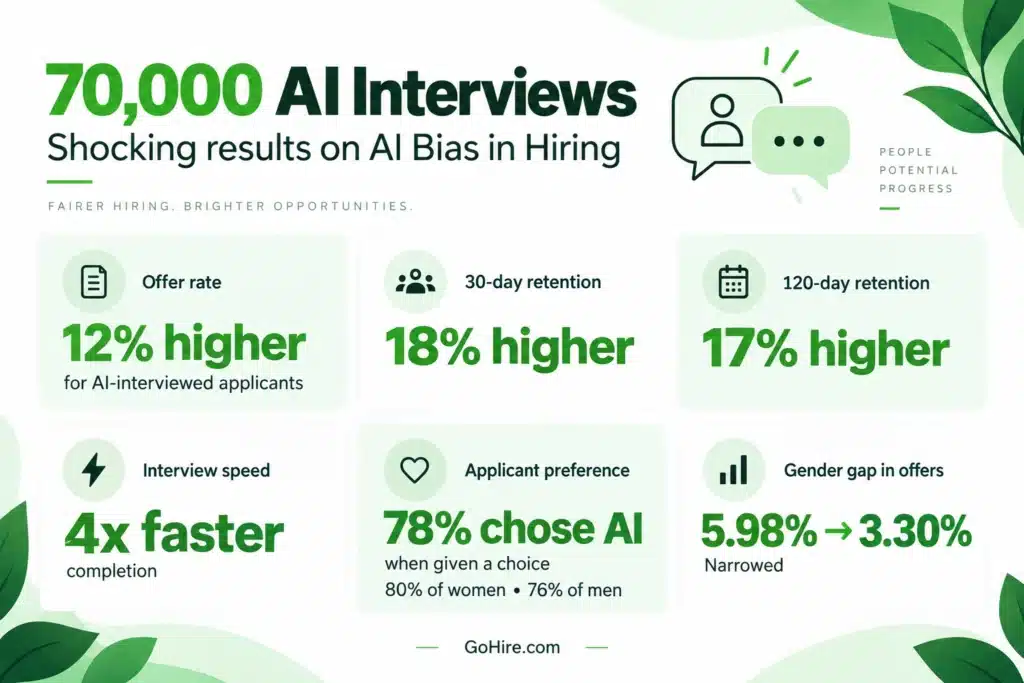
AI interviews are structured, AI-guided conversations that replace or supplement live recruiter interviews, and a new study of 70,000 applicants found they raised offer rates by 12% and cut interview completion time to a quarter of the human baseline. I've built recruiting technology for three decades. This is the first study I've seen that actually proves what high-volume hiring teams have suspected for years.
What Are AI Interviews?
AI interviews use a voice or text-based AI agent to conduct all or part of a job interview, following a structured question set while still adapting to what the candidate says. A human recruiter reviews every interview and makes the hiring decision. The AI runs the conversation, nothing more. That distinction, a machine conducting the interview versus a machine making the decision, is the entire legal and practical difference between AI interviewing and AI screening.
Recruiters already know why this matters. GoHire's own client data shows recruiters lose roughly a third of their week to interview scheduling alone, and the average no-show rate in hourly and frontline hiring runs 53%. Consistency at the first conversation is not a nice-to-have. It is the whole game.
70,000 AI Interviews Later: The Shocking Truth About Bias and Hiring Outcomes
There's a ton of noise about AI interviews right now. For professional and senior-level hiring, most of it is negative, and I'd agree. AI interviewing for those roles is not there yet for most vendors. High-volume hiring is a different game. I've been doing this at scale for years. This study is one of the clearest signals yet that the future already happened.
The study, "Voice AI in Firms" by Brian Jabarian and Luca Henkel, winner of the 2025 Thaler-Tversky Award, tracked 70,000 job applicants randomly assigned to human interviewers, AI interviews, or their own choice of format. Here is what it found.
The Problem Every High-Volume Recruiter Already Knows
Here's the dirty secret most TA leaders won't say out loud: your interview no-show rate has nothing to do with candidate character. 94% of qualified candidates take the first offer that reaches them, and the employer who responds first usually wins the candidate, not the employer with the best job.
A no-show against a blocked recruiter slot costs real time: the interviewer's calendar hour, the context switch, the rescheduling emails. A no-show against an AI interview costs nothing. That asymmetry matters more every quarter, as fake and AI-generated applications climb and recruiters burn hours chasing candidates who were never going to show up to anything, human or automated.
Here's Exactly What Was Tested
Worth being specific about what was actually tested here. The interviews ran through a BPO staffing operation using a voice interviewing platform to conduct phone interviews for entry-level customer service roles, across 43 client accounts including 23 Fortune 500 companies. I'm not naming the tool, because that's not the point. The point is what happened when a large employer let a structured, AI-guided conversation replace whichever recruiter happened to be free that day.
That's a different channel and a different geography than most of the readers here are running. But the roles themselves, high-volume, high-turnover, entry-level, are exactly the roles most high-volume hiring teams in the US are trying to fill faster.
The Core Thesis: Structure Beats Inconsistency
Human recruiters made every hiring decision in every condition in this study. The AI never decided who got hired. It ran the conversation and recorded the answers. What changed was consistency. The AI covered more topics per interview than human recruiters did, 45% versus 38%, while still adapting to what each applicant said. Recruiters got a cleaner signal to work from. That's the entire mechanism behind the offer-rate and retention gains: not a smarter decision-maker, a more consistent conversation.
What This Means If You're Building the Case to Leadership
If you're building the case to your own leadership, here's what this study actually supports, and where you'd be overstating it.
What This Doesn't Prove
This was one vendor, one channel, phone-based voice AI, and one job category, entry-level customer service at a BPO. There's no cost-per-hire data. There's no full time-to-fill data, only the interview-completion piece of it. And the bias finding covers gender specifically, not every protected class. A study this size is rare. Rare isn't the same as universal.
Human-in-the-Loop and the Law
Every automated employment decision tool sits inside a real regulatory framework: EEOC adverse-impact doctrine, NYC Local Law 144, and a growing list of state laws that followed it. None of that changes what this study measured. A person made every hiring decision in every condition tested. The AI ran the conversation. Nobody was rejected by software, and nothing here claims otherwise. No AI system is 100% bias-free, and no vendor running structured interviews, including us, should claim it is.
Where This Leaves High-Volume Hiring Teams
High-volume hiring teams don't need a smarter algorithm. They need a more consistent first conversation with every candidate who applies, whether that conversation happens by text, by voice, or by phone. GoHire's own client data shows what consistency is worth: 92% of qualified candidates self-schedule within 24 hours, and time-to-offer drops from 7-14 days to 24-48 hours once that first response happens in minutes instead of the next business day.
See What a Consistent First Conversation Does to Your Show Rate
GoHire replaces the 18-hour average first response with an 8-minute one, and gives every candidate the same structured conversation regardless of which recruiter is on shift.
FAQ
Does AI reduce bias in hiring? +
In one large study of 70,000 applicants, the gender gap in job offers narrowed from 5.98% to 3.30% when AI conducted the interview instead of a human recruiter. That result is specific to gender and to this study. It does not mean AI eliminates bias across every protected category, and no AI hiring tool should be described as 100% bias-free.
What is structured interviewing? +
Structured interviewing means every candidate is asked the same core set of questions in a consistent way, rather than each interviewer improvising their own approach. It's the mechanism behind AI interviewing's results: consistency, not judgment, is what changed.
Is AI hiring legal? +
Automated employment decision tools are regulated under EEOC adverse-impact doctrine, NYC Local Law 144, and a growing number of state laws. Tools that conduct interviews but leave hiring decisions to a human recruiter, like the ones in this study, sit in a different legal category than tools that screen or reject candidates automatically.
Do candidates prefer AI interviews over human recruiters? +
In this study, 78% of applicants chose an AI interview when given the option instead of a human recruiter, including 80% of women and 76% of men. Preference was measured by applicant choice, not a satisfaction survey.
