
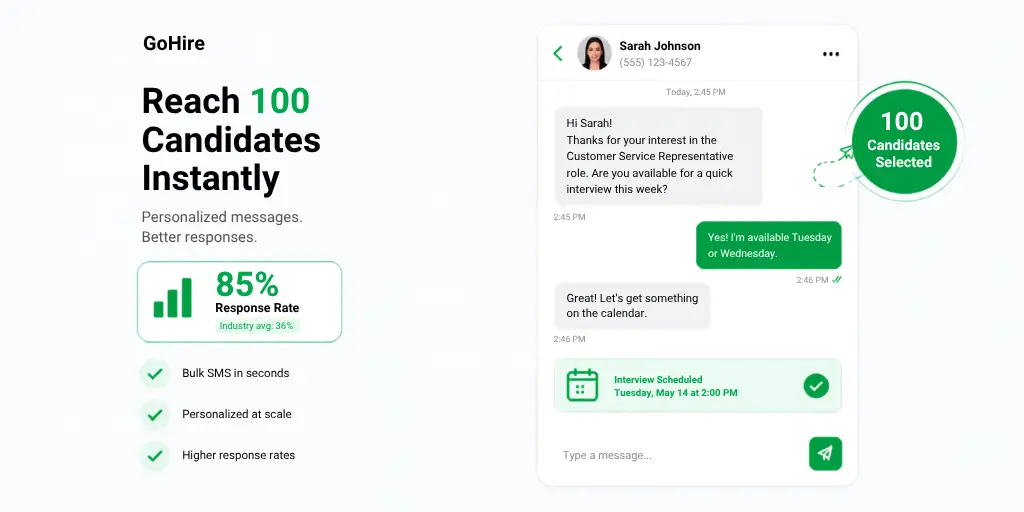
AI text recruiting is a process of adding pre-screening steps via text messaging, to validate a candidates basic employment eligibility, as a way to manage the increased candidate volume problems: when 2–5x more candidates are applying than in previous years and 94% of qualified applicants accept the first offer they receive (SHRM), the recruiter who engages fastest wins.
The hiring bottleneck most recruiters face today isn’t a shortage of candidates — it’s a shortage of time to manually process all of the applicants. AI text recruiting is how the fastest-hiring teams solve that equation — by combining the 98% open rate of SMS with artificial intelligence that screens, responds, and schedules without human intervention at every step.
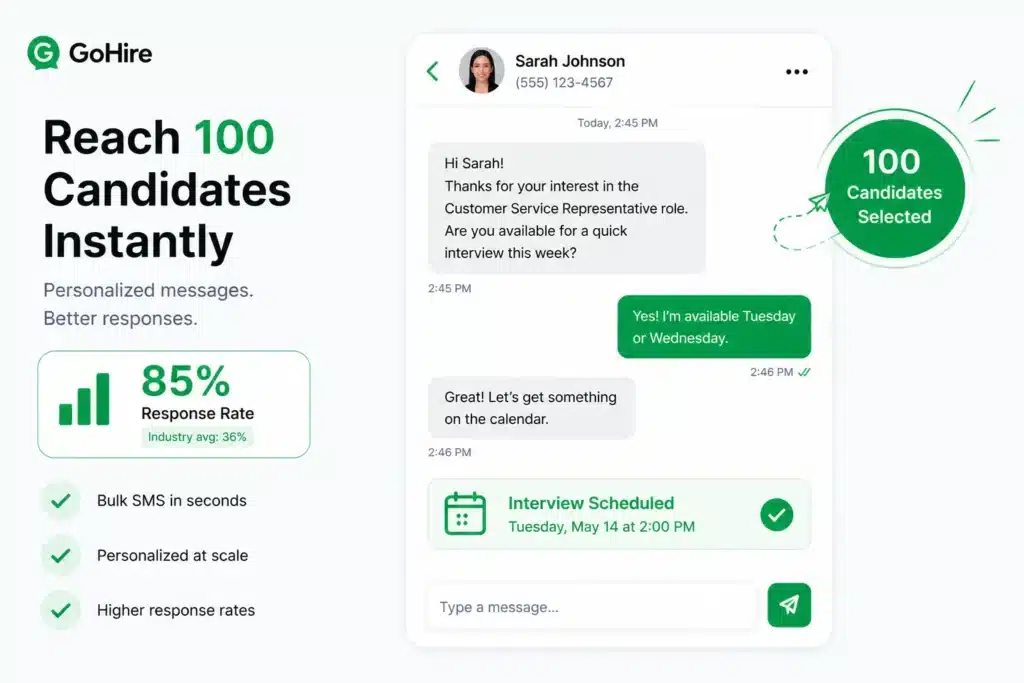


Traditional text recruiting already outperforms email at every stage of the funnel. AI text recruiting goes further: it makes the entire candidate journey — from first application to confirmed interview — run automatically at any hour of the day. A candidate texts to apply at 11 PM. An AI chatbot pre-screens them via conversational SMS exchange within minutes. A Text Invite fires automatically when they qualify. They reply YES and choose an interview slot from the same thread. By morning, the recruiter has a calendar full of pre-screened, self-scheduled candidates — without sending a single message manually.
This guide covers everything you need to know: how the full workflow operates across the candidate journey, what AI actually does to improve text-based hiring, how to generate AI-powered messages that get responses, and how to stay TCPA-compliant while automating candidate engagement at scale.
What Is AI Text Recruiting?
AI text recruiting is the practice of using artificial intelligence — including natural language processing (NLP), machine learning, and conversational AI — layered on top of SMS text messaging to automate candidate engagement, pre-screening, and scheduling throughout the hiring process. It is the convergence of two technologies that each independently outperform traditional recruiting: text messaging (which gets a 98% open rate and responses in minutes) and AI (which scales conversations that would otherwise require human time for every candidate).
To understand this approach, it helps to separate what text recruiting does on its own from what AI adds to it.
Text recruiting without AI uses SMS as the communication channel — candidates apply by text, recruiters message candidates directly, scheduling links are sent over SMS. It is faster and more effective than email, but it still requires a recruiter to write messages, review applications, and trigger the next step in the process for each candidate. At moderate volume (20–50 candidates at a time) that is manageable. At high volume — 100, 500, or 1,000 concurrent candidate conversations — it becomes a bottleneck.
Layering AI onto SMS recruiting removes that bottleneck. Natural language processing lets an AI chatbot understand what a candidate is saying — even imperfect spelling and abbreviations — and respond in a conversational way that feels human. Machine learning allows the system to improve its screening accuracy over time, identifying patterns in which candidates advance and which don’t. Conversational AI manages the entire pre-screening dialogue autonomously, asking qualification questions, collecting answers, and routing candidates based on their responses — all over SMS, 24/7, without any recruiter involvement until a candidate is verified and scheduled.
AI Text Recruiting vs. Basic Text Recruiting
The difference is most visible at scale. In a basic text recruiting workflow, a recruiter manually reviews each application, decides who to advance, and sends a scheduling message. With AI-powered SMS hiring, those decisions and messages happen automatically. A rules-based automation layer handles disqualification routing. An AI chatbot handles the conversation. A natural language processing engine ensures the dialogue flows naturally even when candidates respond in unexpected ways.
The result is a workflow where recruiters step in only when a candidate has already been screened, engaged, and self-scheduled — eliminating the 60–70% of recruiter time currently spent on mechanical tasks and directing it toward the high-judgment work that actually requires a human being.
How AI Text Recruiting Works: The Full Candidate Journey
The power of AI text recruiting is visible end-to-end. Here is how a complete AI-powered text recruiting workflow runs from a candidate’s first touchpoint to their confirmed interview.
-
Step 1: Text-to-Apply and Instant AI Engagement
The candidate sees a job posting — on a job board, a “Now Hiring” sign, a QR code, or social media — and texts a keyword to a phone number. This is the text-to-apply entry point that eliminates the web application drop-off problem: 92% of people who click “Apply” never finish an online job application (SHRM), but candidates who text a keyword are already engaged and have opted in to two-way messaging.
The moment they text in, the AI chatbot takes over. It sends an immediate, personalized acknowledgment — no waiting, no delay — and begins the pre-screening conversation. This is where NLP and conversational AI are most critical: the chatbot must understand the candidate’s responses (which often include typos, abbreviations, or partial answers) and continue the dialogue naturally. A well-designed AI text recruiting system handles this seamlessly, keeping the conversation flowing rather than forcing candidates to use rigid, form-like responses.
For mobile recruiting, this entry-point distinction matters enormously. Frontline and hourly candidates don’t check email, don’t use desktop computers, and won’t complete a 12-field web application on a phone browser. A keyword-opt-in text to apply is the only friction-free entry point that works for this audience at scale.
-
Step 2: AI-Powered Pre-Screening Over SMS
After the candidate opts in, the AI conducts a structured pre-screening conversation over text. This is not a form delivered via SMS — it is a conversational AI dialogue that collects qualification data through a natural back-and-forth exchange. Common pre-screening questions address availability, work authorization, minimum age requirements, location or commute tolerance, and role-specific qualifications.
The AI evaluates each response in real time. Candidates who meet all criteria are automatically tagged as qualified and moved into the scheduling workflow. Candidates who disqualify on any criterion receive a respectful, automated disposition message — also generated and sent by the AI — without any recruiter involvement. This pre-screening layer is where AI text recruiting delivers its most dramatic efficiency gain: a recruiter who previously spent 10 minutes per candidate on phone screens can now have the same qualification information gathered automatically for every candidate who applies, regardless of volume or time of day.
GoHire’s GoBe AI chatbot handles this pre-screening conversation entirely over SMS, operating 24/7. Candidates who apply at midnight get screened immediately, not when the recruiter arrives in the morning.
-
Step 3: AI-Generated Text Invites and Self-Scheduling
When a candidate passes pre-screening, the AI triggers a Text Invite — a personalized scheduling message sent automatically to the candidate. The message follows the response-trigger model that defines best-practice AI text recruiting: “Hi [Name], great news — you qualify for [Position] at [Company]. Ready to schedule a quick interview? Reply YES and I’ll send some available times.”
When the candidate replies YES, the platform automatically sends three available interview time options in the same SMS thread. The candidate replies with their choice — 1, 2, or 3 — and the interview is confirmed immediately, with automated reminders scheduled for 24 hours and 1 hour before the appointment. No scheduling links, no calendar apps, no phone calls. The candidate’s reply is the action — not a click.
GoHire customers using this AI automation text recruiting workflow consistently see 92% of qualified candidates self-schedule within 24 hours of receiving the Text Invite.
💬 GoHire: Text Recruiting Built for Speed
GoHire’s two-way text recruiting platform lets candidates apply by texting a keyword, get pre-screened by an AI chatbot, and self-schedule their interview — all over SMS. No app downloads. No email chains. 98% of texts are read within 3 minutes.
AI Powered Text Recruiting vs. Traditional Text Recruiting: What Changes
AI powered text recruiting isn’t just faster than traditional SMS hiring — it changes what is structurally possible at scale. Here is how the two approaches compare across the dimensions that matter most for high-volume hiring teams.
| Dimension | Traditional Text Recruiting | AI Powered Text Recruiting |
|---|---|---|
| Pre-screening | Recruiter conducts manually (10 min/candidate) | AI chatbot conducts automatically, 24/7 |
| Response time to new applicants | Hours to days (depends on recruiter availability) | Seconds (AI responds instantly, any time) |
| Volume capacity | Limited by recruiter headcount and working hours | Unlimited — AI handles all simultaneous conversations |
| Message generation | Recruiter writes each message or uses static templates | AI generates personalized messages dynamically |
| Candidate routing | Manual review and decision per candidate | Automated by rules-based logic and AI scoring |
| Interview scheduling | Recruiter sends scheduling link and follows up | AI sends Text Invite, candidates reply YES, auto-confirmed |
| Operating hours | Business hours only | 24/7 — AI never sleeps |
| Consistency | Varies by recruiter, workload, and fatigue | Every candidate receives identical quality of engagement |
This approach doesn’t eliminate the recruiter from the process — it elevates the recruiter to the stages that require human judgment: evaluating culture fit, building relationships, negotiating offers, and closing strong candidates. Every mechanical step that precedes those moments is handled by AI.
How AI Improves Text Recruiting: 6 Key Capabilities
The phrase “AI text recruiting” covers a wide range of capabilities. Here are the six specific functions where artificial intelligence makes the most material difference to text-based recruiting outcomes.
1. Natural Language Understanding for Conversational Screening
The most fundamental AI capability in text recruiting is natural language processing (NLP) — the ability to understand what a candidate is communicating even when they don’t follow a script. A candidate who responds “yeah works 4 me” to an availability question should be treated the same as one who types “Yes, I’m available on weekends.” NLP-powered SMS hiring handles both correctly, without forcing candidates into rigid response formats that damage the candidate experience and drop completion rates.
2. 24/7 Candidate Engagement Without Recruiter Involvement
High-volume employers hiring for restaurant, retail, healthcare, and warehouse roles face a structural timing problem: most candidates apply outside of business hours. In a traditional SMS recruiting workflow, those candidates wait until the next morning for any response — by which point many have applied to competing employers and lost interest. An AI-powered platform engages every candidate immediately, regardless of when they apply. The pre-screening conversation, qualification routing, and Text Invite all fire automatically within minutes of application — even at 11 PM on a Saturday.
3. Personalized Messaging at Scale
AI text message generation for recruiters makes true personalization at scale possible. Rather than static templates that address every candidate identically, the AI generates messages that reference the candidate’s name, the specific role they applied for, the location they’re interested in, and their individual pre-screening responses. Personalized messages generate higher response rates than generic ones — and in SMS hiring, response rate is the single most important driver of pipeline throughput.
4. Consistent, Bias-Reduced Screening
One of the less-discussed benefits of AI text recruiting is consistency. When a human recruiter screens 80 candidates in a day, decision quality degrades over time — later candidates receive less careful attention than early ones, and implicit bias affects which candidates get advanced. AI-powered SMS screening applies the same criteria to every candidate, every time, with no variance for fatigue, mood, or implicit association. This supports more equitable hiring outcomes and reduces the risk of disparate impact in candidate screening — an important consideration given the EEOC's technical guidance on assessing adverse impact in AI-driven employment selection tools, which applies the same four-fifths adverse-impact standard to algorithmic screening as to any other selection method.
5. Machine Learning Optimization Over Time
Unlike static template-based automation, AI powered text recruiting systems can learn from outcomes. Machine learning models analyze which candidate profiles advance, which pre-screening answers correlate with successful hires, and which message variants generate the highest response rates — then adjust the workflow accordingly. Over time, the system becomes more accurate at identifying qualified candidates and more effective at engaging them.
6. Human-in-the-Loop at Every Critical Stage
Effective AI-powered SMS hiring is not fully autonomous — it is designed with human-in-the-loop oversight at the stages where human judgment is most important. The AI handles the mechanical workflow. Recruiters see a curated inbox of pre-screened, self-scheduled candidates. Every automated message can be reviewed, overridden, or responded to directly by a recruiter at any point. This human-AI collaboration model is what separates well-designed automated SMS hiring from full automation that removes human accountability entirely.
AI Text Message Generation for Recruiters: Templates and Examples
AI text message generation for recruiters encompasses everything from initial application acknowledgments to pre-screening conversations to Text Invites. Here is how AI-generated messages work at each stage — along with examples that follow the response-trigger model GoHire’s platform uses.
Initial Application Acknowledgment
When a candidate texts to apply, the AI generates a personalized acknowledgment instantly. The message confirms receipt, sets expectations, and moves the candidate into the pre-screening flow. A well-designed AI-generated acknowledgment looks nothing like a confirmation email:
“Hi [Name]! Got your application for [Position] at [Location] — thanks for reaching out. I have a few quick questions to see if it’s a good fit. Ready? Reply YES to get started.”
The candidate’s YES triggers the pre-screening sequence. No link, no form. Their reply is the action.
Pre-Screening Questions
AI text recruiting systems generate pre-screening conversations dynamically based on the role’s criteria. Each question flows naturally from the previous response. Examples for a restaurant hiring workflow:
“Are you available to work weekends? Reply YES or NO.”
“Great. Are you 18 or older? Reply YES or NO.”
“Last question — can you get to [Location] by bus or car? Reply YES or NO.”
If the candidate answers YES to all three, the AI immediately moves to the Text Invite. If they answer NO to any disqualifier, the AI sends a personalized, respectful disposition message — also AI-generated — and closes the conversation gracefully.
Text Invite Scheduling Message
The Text Invite is the single most important AI-generated message in the recruiting workflow. It must be warm, personal, and action-oriented — and it must use a response trigger rather than a scheduling link:
“Great news, [Name] — you’re a great fit for [Position]! Ready to schedule a quick interview? Reply YES and I’ll send some available times.”
When they reply YES, the AI sends:
“Here are some available times — just reply with the number of your pick: 1) Tuesday 10 AM, 2) Tuesday 2 PM, 3) Wednesday 11 AM.”
Their reply confirms the interview automatically. This is how AI sms recruiting achieves the 92% self-scheduling rate GoHire customers see consistently.
AI Automation in Text Recruiting: The End-to-End GoHire Workflow
AI automation text recruiting is the full system that runs when every stage of the hiring funnel — apply, screen, schedule, confirm, remind — is connected and automated. Here is how GoHire’s AI text recruiting platform runs this end-to-end workflow for high-volume employers.
A candidate sees a “Hiring Now” sign at a restaurant location and texts “JOBS” to the number on the sign. GoHire’s platform captures their mobile number and consent immediately — this keyword opt-in establishes the two-way messaging relationship and satisfies TCPA consent requirements for informational recruiting messages. The GoBe AI chatbot begins the pre-screening conversation within seconds.
The chatbot, powered by conversational AI and NLP, conducts the pre-screening exchange. It understands the candidate’s responses even when they’re informal or abbreviated. Three questions, answered in under two minutes. The candidate qualifies. The AI generates and sends a personalized Text Invite. The candidate replies YES. Three available interview times appear in the thread. They pick one. Confirmed.
Twenty-four hours before the interview, GoHire automatically sends a reminder text. One hour before, another reminder. The recruiter’s calendar shows a confirmed, pre-screened candidate with no phone tags, no email follow-ups, and no manual scheduling required from the recruiting team. With GoHire’s Apply by Text, this entire flow starts with a single text message from the candidate.
For employers running this AI automation text recruiting workflow across multiple locations, GoHire routes candidates to the correct location’s calendar automatically — a single toll-free number and QR code can power recruiting for every site, with candidates sorted by location at the pre-screening stage. GoHire’s recruiting automation platform connects the full workflow from application through onboarding, tracking every candidate and interaction in a single system.
The performance data from this workflow is consistent: time-to-offer drops from 7–14 days to 24–48 hours. 92% of qualified candidates self-schedule within 24 hours. Response rates on AI-generated Text Invites run above 80%. None of these results require additional recruiter headcount — they require the right platform deployed correctly.
TCPA Compliance and AI Text Recruiting: What Recruiters Need to Know
AI text recruiting operates on the same legal framework as all text-based candidate communication. The Telephone Consumer Protection Act (TCPA) governs how employers can use automated messaging to reach candidates — and violating it carries real financial exposure. Understanding TCPA compliance is not optional for any employer using AI sms recruiting at scale.
Consent Requirements for AI Text Recruiting
The TCPA distinguishes between two categories of consent. Prior express consent covers informational messages — job application updates, interview confirmations, scheduling reminders. When a candidate texts a keyword to apply, that keyword opt-in constitutes prior express consent for informational recruiting messages. Prior express written consent is required for marketing messages — promotional texts encouraging candidates to apply when they haven’t initiated contact.
For most AI text recruiting workflows — where the candidate initiates the conversation by texting a keyword — prior express consent is established at the moment of opt-in. GoHire’s platform captures and logs that consent automatically, creating a timestamped record for every candidate interaction.
10DLC Registration and A2P Messaging
Text recruiting at volume requires registration under the 10DLC (10-Digit Long Code) framework, which governs A2P (Application-to-Person) messaging in the United States. 10DLC registration tells carriers that your texts are legitimate business communications — not spam — which improves deliverability and protects your sender reputation. Unregistered A2P messaging is increasingly filtered by carriers, meaning candidates may never receive your messages at all.
GoHire’s platform handles 10DLC registration as part of onboarding, ensuring every client’s text recruiting workflow is carrier-compliant from day one. Texting numbers are registered under the employer’s brand, with use cases documented and approved before any candidate messages are sent.
Opt-Out Mechanisms and STOP Keyword Compliance
Every AI text recruiting workflow must honor opt-out requests immediately and permanently. TCPA requires that recipients be able to opt out by replying STOP (or STOP, STOPALL, UNSUBSCRIBE, CANCEL, END, or QUIT) and that opt-out requests be honored within 10 business days — though best practice is immediate opt-out processing. GoHire’s platform processes STOP responses automatically, removing the candidate from all future messaging immediately and maintaining an opt-out log.
Human-in-the-loop oversight is also recommended for reviewing AI-generated messages before they are sent at scale — particularly for new message types or updated pre-screening flows — to ensure tone, accuracy, and compliance before deployment.
Short Code vs. Long Code in AI Text Recruiting
Employers using AI text recruiting at high volume have two primary options for their SMS infrastructure: short codes (5–6 digit numbers capable of very high throughput) and long codes (standard 10-digit numbers registered under 10DLC). Short codes are ideal for large-scale broadcast campaigns. Long codes — particularly toll-free numbers registered under 10DLC — are the standard for conversational AI text recruiting workflows, where two-way messaging and personalization are more important than raw throughput. GoHire uses toll-free long codes for all client recruiting workflows, supporting both high-volume broadcast and one-to-one conversational messaging within the same platform.
See How GoHire Automates Your Hiring
GoHire customers fill roles in 24-48 hours instead of 7-14 days — with zero phone calls and zero emails. 92% of qualified candidates self-schedule their interview within 24 hours.
Schedule a Demo →Frequently Asked Questions About AI Text Recruiting
What is AI text recruiting?
AI text recruiting is the practice of using artificial intelligence — including natural language processing, machine learning, and conversational AI — combined with SMS text messaging to automate candidate engagement, pre-screening, and interview scheduling. It layers AI capabilities on top of text recruiting’s core advantage (98% open rates, responses in minutes) to handle the volume of conversations that manual hiring cannot scale to. The result is a workflow that engages every candidate immediately, screens them automatically, and self-schedules interviews without recruiter involvement at each step.
How does AI improve text recruiting over basic SMS recruiting?
Basic SMS recruiting uses text messaging as a communication channel but still requires recruiters to write messages, review applications, and manually trigger each next step. AI text recruiting automates those steps. A conversational AI chatbot handles pre-screening dialogues autonomously, natural language processing understands candidates’ responses even when informal, machine learning optimizes routing decisions over time, and AI text message generation creates personalized messages for every candidate at scale. The practical difference: basic text recruiting is faster than email; the AI-powered approach is fast enough to engage hundreds of candidates simultaneously, 24 hours a day.
What is the GoHire AI text recruiting workflow?
GoHire’s platform starts the workflow when a candidate texts a keyword to apply. The GoBe AI chatbot immediately begins a conversational pre-screening exchange over SMS — asking qualification questions, understanding the candidate’s responses via NLP, and routing qualified candidates to the next step automatically. Qualified candidates receive a personalized Text Invite asking them to reply YES to schedule an interview. Their YES triggers the platform to send three available time slots in the same thread. When they choose a time, the interview is confirmed automatically. Automated reminders fire at 24 hours and 1 hour before the interview. Recruiters see a full calendar of pre-screened, self-scheduled candidates without manually sending a single message.
Is AI text recruiting TCPA compliant?
Yes — when implemented correctly. TCPA compliance requires that candidates provide prior express consent before receiving automated messages (keyword opt-in establishes this), that A2P messaging is registered under 10DLC, that opt-out requests via STOP are honored immediately, and that message content is informational rather than marketing in nature. GoHire’s platform is built with TCPA compliance as a foundational feature — consent is captured and logged at opt-in, 10DLC registration is handled during onboarding, and STOP responses trigger immediate opt-out processing automatically. Human-in-the-loop review is also available for new message types before they deploy at scale.
What is AI text message generation for recruiters?
AI text message generation for recruiters is the capability of an AI system to dynamically create personalized SMS messages based on candidate-specific data — name, role applied for, location, pre-screening responses — rather than using static templates. AI-generated messages achieve higher response rates than generic templates because they feel personal and contextually relevant. In the GoHire platform, AI generates the initial acknowledgment, pre-screening questions, Text Invite, scheduling confirmation, and reminders for every candidate automatically, with no recruiter input required for each individual message.
How does artificial intelligence text recruiting handle candidate drop-off?
Candidate drop-off in recruiting is primarily caused by slow response times and friction in the application process. Artificial intelligence text recruiting addresses both. The AI responds to every candidate immediately — there is no waiting period that gives candidates time to accept competing offers. The conversational SMS format has far less friction than web applications or email chains, so more candidates complete the process. Automated reminders reduce interview no-shows. And for candidates who don’t respond to the initial Text Invite, the system sends follow-up reminders at scheduled intervals — eliminating the need for recruiters to manually chase non-responders.
Can AI text recruiting work without an existing ATS?
Yes. GoHire’s platform functions as a standalone system — it captures applications, runs pre-screening, manages scheduling, and logs all candidate interactions internally, without requiring a separate ATS. For employers who have an ATS, GoHire integrates via API to sync candidate data bidirectionally. But for small and mid-size employers who don’t have an ATS, GoHire provides all the candidate management capabilities needed to run a complete text recruiting workflow from a single platform.
What is AI SMS recruiting and how is it different from AI chatbots for recruiting?
AI SMS recruiting and AI chatbots for recruiting are closely related but not identical. AI-powered SMS hiring refers specifically to the use of SMS (text messaging) as the channel through which AI-driven candidate engagement happens. AI recruiting chatbots are one component of that system — the conversational AI layer that conducts pre-screening dialogues and manages the candidate conversation. In GoHire’s platform, the GoBe AI chatbot is the chatbot component, and the overall system includes chatbot pre-screening plus AI-generated Text Invites, scheduling automation, reminder messaging, and broadcast campaigns — all over SMS.
Related Resources
AI text recruiting sits at the intersection of two GoHire pillars. These guides cover the broader topics that power every AI text recruiting workflow:
- Text Recruiting: The Complete Guide to Hiring with Text Messages — The foundational guide to building a compliant, high-performance text recruiting program
- Apply by Text — How candidates start the AI text recruiting journey with a single keyword text
- AI Recruiting Chatbot — How GoHire’s GoBe chatbot handles pre-screening and scheduling over SMS, 24/7
- Recruiting AI — The complete guide to AI in talent acquisition: screening, matching, analytics, and ethics
- Recruiting Automation — How automated workflows eliminate manual tasks and reduce time-to-offer to 24-48 hours
- AI in HR — The wider view of how artificial intelligence is changing talent acquisition and HR operations beyond text recruiting
With high-volume hiring we needed tech to interact with candidates at the top of the funnel by answering FAQs and gathering candidate contact information. Our GoHire text messaging chatbot does this while also providing a nice "human-centric" touchpoint for candidates.

Ready to hire faster with AI text recruiting?
GoHire’s two-way text recruiting platform lets candidates apply by texting a keyword, get pre-screened by an AI chatbot, and self-schedule their interview — all over SMS.
Schedule a Demo →