
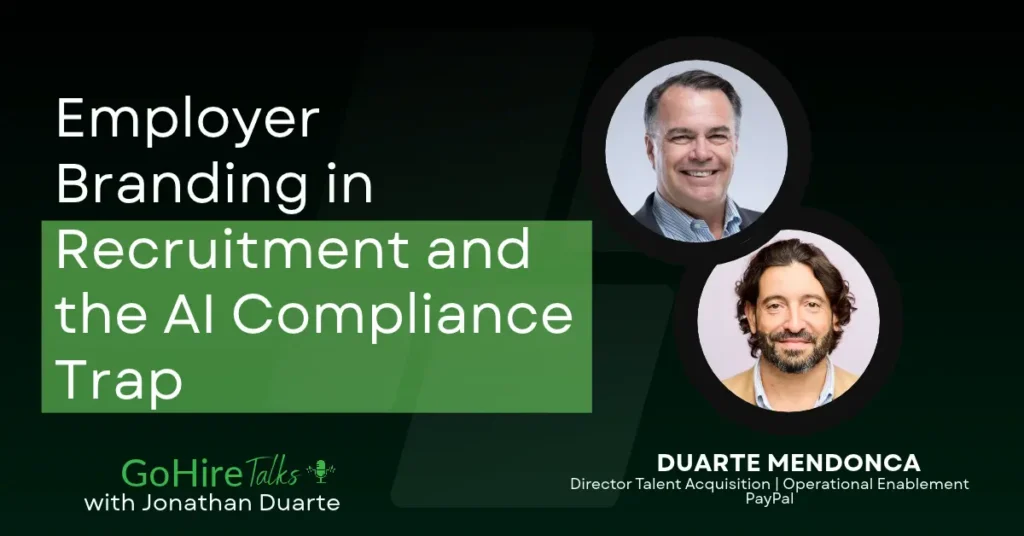
Employer branding in recruitment now starts inside ChatGPT, Claude and Gemini, says Duarte Rodrigo Mendonça, a talent acquisition director with more than a decade in healthcare recruiting. Candidates ask an AI what it's like to work for you before they ever apply. And the AI tools you hire with now face five different state compliance questions.
In this episode:
- What Duarte wants TA leaders to know
- Learn the business before you recruit for it
- Why candidates ask the AI first
- How to improve employer brand when third parties tell your story
- AI matching and the 52 pickup problem
- Five states, five compliance questions
- One workflow instead of five
- About and contacting Duarte
- FAQ
- Full interview transcript
Employer Branding in Recruitment: What Duarte Rodrigo Mendonça Wants TA Leaders to Know
Duarte Rodrigo Mendonça didn't choose recruiting. It walked onto his sales team. He was working in the mortgage business when a new colleague, sitting out a one-year non-compete, started talking about placing people for a living.
I was flabbergasted that someone can earn money by placing people from hiring.
Duarte Rodrigo Mendonça, Director Talent Acquisition - Operational Enablement
His first recruiting job was as a 1099 contract recruiter for that same colleague. Then came a little over a decade in healthcare, followed by digital e-commerce, hospitality and now the product organization at PayPal. At FTD he walked into an ADP rollout that was struggling. He had just presented at an ADP conference on using the system as a CRM, and his team had been the first ADP partner to go live with a bidirectional LinkedIn feed.
Jonathan introduced him as one of the most data-driven people to come out of a sourcing background. Jonathan once had 12.5 million pages ranking in Google's top 10 and sold that job traffic to Indeed. He still said Duarte "literally just reframed my whole job search conversation."
That reframe is about employer branding in recruitment and who controls it once an AI answers the candidate first. The second half of the episode covers recruitment compliance for AI hiring tools: what five states are asking, where vendors fall short, and the one workflow Duarte would build instead of five.
Learn the Business Before You Recruit for It
Duarte's view is that recruiting is recruiting, whatever the industry. You build relationships, and you treat the data like a supply chain. The part that changes is how well you understand the people you're hiring for, and he went further than most to learn it.
When his first health system was opening a heart hospital in South Florida, he went into the operating room.
I watched an open heart surgery. I sat in an ablation. I really learned what these nurses were going through and doing day to day that I became somewhat of an expert in the field so I can actually position the opportunities and roles appropriately.
Duarte Rodrigo Mendonça, Director Talent Acquisition - Operational Enablement
He also spent time in the emergency room ("I have wild stories") and shadowed a licensed practical nurse through a night shift on a medical-surgical floor. Jonathan tied it to Jerry Crispin, who has told him he used to go work alongside employees because "unless I know what you do, there's no way for me to support you." Duarte had met Crispin for the first time two weeks earlier, at a dinner in New York.
The Heart Institute story
The payoff came in Texas, when Duarte interviewed to lead a talent acquisition team. Walking past the Heart Institute, he asked if he could go in. The director happened to be coming out, they got talking, and he could speak to the equipment.
She's like, "Are you a nurse?" Said, "No." And so she went behind after meeting me to my future boss and said, "You need to hire him. How does he know as much as he does about nursing?" So I think that's what helped me differentiate myself from other people, is investing the time to getting to know who my clients are and who my stakeholders and partners are to be able to serve them.
Duarte Rodrigo Mendonça, Director Talent Acquisition - Operational Enablement
At the end of the day, I think recruitment isn't just about hiring, it's about solving business problems.
Duarte Rodrigo Mendonça, Director Talent Acquisition - Operational Enablement
The same habit shapes how he thinks about employer branding in recruitment. You can't describe a job accurately to candidates if you've never watched someone do it.
Why Employer Branding in Recruitment Now Starts Inside the LLM
Employer branding in recruitment used to mean Glassdoor ratings, a careers site and some employee videos. Duarte says the job search itself has moved. Candidates open ChatGPT or Claude and describe the job they want in plain language.
They're asking like, "I'm looking for a job in New York that's hybrid and doesn't require me to go in the office more than three days a week." And the LLMs are servicing up those employers, and that's where people are starting their search.
Duarte Rodrigo Mendonça, Director Talent Acquisition - Operational Enablement
The next question is almost always about the employer. Duarte cited several figures from memory during the episode. He put zero-click searches at about 60%, meaning the candidate decides from the AI's answer without visiting your site. He recalled a figure of 86% of candidates researching an employer before they apply. And he said 95% of the LLM citations come from one question: "What's it like to work at X?"
So I would suggest it's 10 times more important because you have two things that are happening. You're having third parties going ahead and being aggregated 'cause they have markup schema.
Duarte Rodrigo Mendonça, Director Talent Acquisition - Operational Enablement
Volume raises the stakes for employer branding in recruitment. From 2015 to 2018, Duarte said, TA teams worked to lower the barrier to apply because applications took 30 to 45 minutes. The pendulum has swung. Candidates now use AI to rewrite resumes and apply to many jobs at once, and he hears of 200-plus and 300-plus applicants per opening. With that much noise, the candidates you want are making up their minds before they ever reach your ATS.
The employer brand recruitment question candidates ask next
Jonathan's reaction came from his SEO years. Search used to be "what and where," the query that built Indeed. Now it's a conversation, and the AI decides which company comes up next and what it says about it.
These LLMs want you to spend more time, right? So they're adjusting to make sure they're asking that natural next question that they believe would trigger you to engage further.
Duarte Rodrigo Mendonça, Director Talent Acquisition - Operational Enablement
They're leading the conversation. So what are you doing to control that narrative?
Duarte Rodrigo Mendonça, Director Talent Acquisition - Operational Enablement
That changes the employer brand recruitment job. Duarte's point is that you're not trying to pull new people through the door. You're making sure the people who find you understand why they'd choose to work for you. Jonathan added the other half: give candidates enough information that the wrong fits opt out on their own.
Employer brand and recruitment for frontline vs. professional roles
Jonathan asked whether this matters as much in hospitality and frontline hiring as it does for product managers. Duarte said AI job search shows up more in corporate professional roles today, and the frontline numbers aren't huge yet. People in every kind of job still look employers up and ask what it's like to work there, though, and the AI serves the same sentiment to all of them. He still called employer branding in recruitment more important than ever.
Jonathan had assumed employers were backing off employer brand and recruitment marketing because application volume was so high. Duarte's answer turned that around.
How to Improve Employer Brand When Third-Party Sites Tell Your Story
Duarte's answer to how to improve employer brand starts with where the AI gets its information, because employer branding in recruitment is now partly written by sites you don't control. Glassdoor matters again after a few quiet years. Reddit mattered early because its content was easy for these models to read and had upvotes behind it.
Markup schema, it's so important. Glassdoor has relevancy again, these third-party rating systems. It's just easier for them to digest, and so that's why then it's being served up.
Duarte Rodrigo Mendonça, Director Talent Acquisition - Operational Enablement
It's very easy for these LLMs to ingest the data and then that's what's served up to these candidates versus your own brand. And so I think it's even more important for employers to be proactive and engaged about making sure that their brand is what's being served up on these LLMs.
Duarte Rodrigo Mendonça, Director Talent Acquisition - Operational Enablement
He pointed to Profound, which he said had just raised a large round to help marketing teams position companies in AI answers, and argued that employer brand teams need the same discipline. He also named two HR vendors moving in this direction. Built In has a tool that gives employers a score for what AI says about them, and Talentify is working on AI answer visibility too.
A Claude-built checker for employer branding in recruitment
Duarte built his own version with Claude. Type in an employer's name and it shows what percentage of the answers come from third-party sources across Perplexity, Claude, Gemini and ChatGPT. It pulls the real source material, runs the top 10 questions candidates ask about an employer, and recommends where the gaps are.
This will help recruiters obviously know what's being said out there in the market, especially if we need to attract people that might have gone through a reduction or a transition or new leadership.
Duarte Rodrigo Mendonça, Director Talent Acquisition - Operational Enablement
A five-minute check you can run tonight
You don't need his tool to see the problem. Duarte's homework for every listener is three prompts:
I think everyone should take a moment this evening listening, go to ChatGPT, go to Claude, and ask, "What's it like to work at your company?" And then ask next, "What else should I know?" And then ask, "What are the questions that people are asking about my company?" And then you'll see what they're asking about your company. It will blow your mind.
Duarte Rodrigo Mendonça, Director Talent Acquisition - Operational Enablement
Jonathan said he'd probably build a Claude tool for listeners. When Bryan Chaney joined GoHire Talks to talk employer brand strategy about four weeks earlier, AI answers never came up. That's how fast this moved.
Your employer brand shows up in the first text, too
Candidates judge you by how fast you answer. GoHire replies by text in seconds, asks the pre-screening questions your team wrote, and offers interview times. Your recruiters decide who moves forward. In GoHire client data, 49% of frontline candidates scheduled their interviews after business hours.
AI in Recruitment and the 52 Pickup Problem
Jonathan's sharpest line of the episode was about AI resume matching. Matching resumes against a job description, he said, is like playing 52 pickup. Throw the deck, and every vendor picks the cards up in a different order, unless you know how to stack them.
It is a black box, and I think what's also just dangerous if we're leveraging the job description when we know how poorly those are written in general or how generic they are.
Duarte Rodrigo Mendonça, Director Talent Acquisition - Operational Enablement
Then Duarte added drift. Anyone who has recruited long enough has watched a role change between the intake meeting and the final interview, as the team anchors on what the hiring manager really wants.
So then how do we... how can we say we can successfully leverage AI to make or stack rank resumes and hiring decisions?
Duarte Rodrigo Mendonça, Director Talent Acquisition - Operational Enablement
He isn't against AI in the recruiting process, and our guide to recruiting AI covers the tools he and Jonathan discuss. Duarte uses AI as a thought partner before the conversation, to prepare for intake and calibration meetings, pressure-test his own thinking and dig deeper with hiring managers. After interviews, he uses it to consolidate debrief notes (with data privacy handled through his own MCP or anonymized data) and to check whether interviewers actually used the scorecard and interview guide. Where they didn't, that's a training conversation about signal over noise.
I love where AI's taking us. Now there's the whole piece of making hiring decisions. That's another story.
Duarte Rodrigo Mendonça, Director Talent Acquisition - Operational Enablement
Recruitment analytics after the duct tape
Jonathan described most TA tech stacks as bailing wire, duct tape and the MacGyver skills of a good operations person. He asked whether MCP servers, and ATSs like Ashby and Greenhouse opening up their data, are finally freeing recruitment analytics.
I think this is a superpower with the LLMs being able to take these large data sets and extract and slice information. I've used it to be able to create regression models, forecasting capacity models, and pull all that in.
Duarte Rodrigo Mendonça, Director Talent Acquisition - Operational Enablement
His warning is about homegrown tools. If you build your own, know how the algorithm works and what changes behind the scenes, especially anywhere near a hiring decision. Use talent acquisition analytics to help people make better decisions, he said, not to drive the decision outcome. His line for AI in recruiting process design is simple: help people prepare and review, and leave the decision with them.
Recruitment Compliance: Five States, Five Different Questions
Recruitment compliance is where Duarte sees TA teams getting caught. The same AI tool can raise a different legal question in every state where you hire, and many teams don't know which questions apply to them. He expects a lot more to come out in 2027.
It could be the same tool. There's five different questions that you need to be asking. New York is asking prove it. Illinois is asking, did it discriminate? California is asking, did the candidate get a say? Do they have an opportunity to opt in, opt out? Colorado is asking if there was a human in the loop or what the appeal was. And then Connecticut is who owns the decision.
Duarte Rodrigo Mendonça, Director Talent Acquisition - Operational Enablement
Here's how his five questions line up with the rules on the books as of October 2026. This is a summary, not legal advice, so confirm the details with your counsel.
| Jurisdiction | Duarte's question | What the rule says |
|---|---|---|
| New York City | Prove it. | Local Law 144 requires a bias audit within one year before using automated employment decision tools, a public summary of the results, and notice to candidates 10 business days before use (NYC DCWP). |
| Illinois | Did it discriminate? | HB 3773, effective January 1, 2026, bars AI that has a discriminatory effect on employment decisions, bans zip codes as a proxy for protected classes, and requires notice (Epstein Becker Green). |
| California | Did the candidate get a say? | Civil Rights Council rules on automated-decision systems took effect October 1, 2025. Employers keep that data for four years, and anti-bias testing can support a defense (Mayer Brown). |
| Colorado | Was there a human in the loop, and what was the appeal? | SB 26-189, signed May 14, 2026, replaced the original AI Act with a narrower automated decision-making law. It requires notice of use and disclosure within 30 days of an adverse outcome, effective January 1, 2027 (AI Compliance Atlas). |
| Connecticut | Who owns the decision? | This is Duarte's framing of where the state is heading. Check current status with counsel. |
The federal floor hasn't changed. The Uniform Guidelines on Employee Selection Procedures used by the EEOC apply to any selection procedure, software included, and set out the four-fifths rule for spotting adverse impact.
Outside the US, the EU AI Act lists AI used for the recruitment or selection of people among its high-risk categories (European Commission AI Act Service Desk).
Let's not even get into the EU AI Act and obviously these tools being classified as high risk just out of the gate, and you have to prove why it's not in the AEDT.
Duarte Rodrigo Mendonça, Director Talent Acquisition - Operational Enablement
Which AI hiring tools count as automated employment decision tools?
Many TA teams don't know. Duarte cited a figure of 74% of people bringing their own AI into work. Not every organization has locked down who uses AI, when, and with what data, and that's before you get to disclosure and human-in-the-loop requirements.
People are not understanding the way in which they're deploying these tools can be classified as an AEDT that's an autonomous employee decisioning tool.
Duarte Rodrigo Mendonça, Director Talent Acquisition - Operational Enablement
New York City's law covers automated employment decision tools, and how you deploy a tool matters as much as what it does.
Enforcement in New York has been light so far, which isn't the same as safe. A December 2025 audit by the New York State Comptroller found the city received only two complaints, while auditors identified at least 17 instances of potential non-compliance.
What to ask your AI hiring vendors
Duarte has been having these conversations with vendors directly. His advice is to ask about explainability and the bias report, and then dig. Jeff Pole made a similar case on an earlier episode about the audit questions to put to recruiting AI vendors.
I've seen some vendors using synthetic data, so they're not even using real candidate data. They're using synthetic data in order to pass these bias reports because they haven't had enough, 'cause their tools are so new to the market.
Duarte Rodrigo Mendonça, Director Talent Acquisition - Operational Enablement
- Can we export the data and run our own independent bias audit?
- Was your bias report run on real candidate data or synthetic data?
- How would we explain a ranking or recommendation to a candidate who asks?
- Where does a person review the output, and can that person overturn it?
One Recruitment Compliance Workflow Instead of Five
Duarte's practical advice is to stop designing five different compliance programs. Build for the common denominator instead.
Focus on the most common denominator. And instead of building out five different compliance tools, focusing on building out one workflow that focuses on inventory every single tool that you have that uses AI.
Duarte Rodrigo Mendonça, Director Talent Acquisition - Operational Enablement
His workflow has five steps:
- Inventory every tool in your hiring process that uses AI, including the ones recruiters brought in on their own.
- Disclose it. Tell candidates where and how AI is used.
- Keep a human in the loop who can actually overturn a call.
- Test the outcomes.
- Keep the records.
Keep the human in the loop. That can actually overturn a call. Like that's another thing that's gonna be very important is how are you showing and not making sure this is not a rubber stamping tool.
Duarte Rodrigo Mendonça, Director Talent Acquisition - Operational Enablement
Jonathan tied it to John Sumser's current focus on governance, a word most TA leaders hear without knowing what to do with it. "If you wanna know what governance means, it's exactly what Duarte just said," Jonathan said. "This is the checklist."
Deb Paul made a similar case about treating every AI agent like your newest hire. The Recruiting AI Adoption Playbook walks through governance as one phase of the rollout.
InfoSec now sits at the front of the buying team
Duarte thinks vendors are focused on the problem they solve and skip the question every buyer has to answer next.
What they're not talking about is how do you get this approved by your info sec team, your data privacy team, your legal team? All those people are there. So yes, you could have this sexy tool that does all these great things, but what about the compliance? What about the data privacy? What about auditing and reporting, extracting the data, ensuring there's human in the loop?
Duarte Rodrigo Mendonça, Director Talent Acquisition - Operational Enablement
Jonathan expects the shift to show up at HR Tech. The buying team isn't only the VP of TA anymore. InfoSec is up front, and compliance comes before functionality. "If you can't get through info sec, it doesn't really matter what your tool can do."
Adoption isn't waiting. SHRM's 2025 Talent Trends research found AI use in HR tasks climbed to 43% in 2025, up from 26% in 2024, while 69% of organizations still struggle to fill roles. For the data-privacy side, see our post on AI privacy and compliance in HR.
How you hire is part of employer branding in recruitment, too. GoHire's position is simple. Software never makes a hiring decision. Your team writes the pre-screening questions, sets the criteria, sees every answer (including from candidates who didn't match) and decides who moves forward. Our recruiting automation runs the repetitive steps so recruiters spend their time on those decisions.
About & Contacting Duarte Rodrigo Mendonça
Duarte Rodrigo Mendonça is Director Talent Acquisition - Operational Enablement, with more than a decade in healthcare recruiting and experience across digital e-commerce, hospitality and product organizations. He calls himself a process-over-technology person who believes in a solid foundation and being human-led. He builds his own AI tools with Claude, sometimes after midnight, and posts regularly on LinkedIn about LLMs and AI in hiring. He doesn't have a newsletter yet.
Everyone can connect with me on LinkedIn. I'm open to connections, happy to chat live about what I'm seeing happening, whether it's LLMs or the use of AI.
Duarte Rodrigo Mendonça, Director Talent Acquisition - Operational Enablement
Frequently Asked Questions About Employer Branding in Recruitment
How is AI changing employer branding in recruitment? +
Candidates now ask ChatGPT, Claude and other AI tools what it's like to work for an employer before they apply. The answer they get is built largely from third-party sources like Glassdoor and Reddit, so employers have to manage what those sources say, not just their own careers site.
How can I check what AI says about my company as an employer? +
Duarte Rodrigo Mendonça suggests asking ChatGPT and Claude three questions: what it's like to work at your company, what else a candidate should know, and what questions people ask about your company. Then compare the answers to how you describe yourself.
How do you improve employer brand when third-party sites shape the AI answer? +
Start with the sources the AI reads. Review sites with structured data, like Glassdoor, are easy for AI tools to digest. Be proactive about your reviews and ratings, make your own content clear, and check regularly which sources the answers cite.
What are automated employment decision tools? +
Automated employment decision tools is the term New York City's Local Law 144 uses for software that substantially helps make employment decisions. Employers using one there need a bias audit within a year before use, a public summary of results and candidate notice 10 business days before use.
What are the five state questions Duarte describes for recruitment compliance? +
In his framing, New York asks you to prove it, Illinois asks whether it discriminated, California asks whether the candidate got a say, Colorado asks whether there was a human in the loop and an appeal, and Connecticut asks who owns the decision.
What should one AI compliance workflow for recruiting include? +
Inventory every AI tool in the hiring process, disclose AI use to candidates, keep a human in the loop who can overturn a call, test the outcomes and keep the records. One workflow built this way covers the common ground across state rules.
Keep Your Recruiters in Charge of Every Decision
GoHire handles the texting, pre-screening questions and interview scheduling. Your team sets the criteria and makes every call, with a record of every answer.
Employer Branding in Recruitment: The GoHire Talks Interview Transcript with Duarte Rodrigo Mendonça
From Mortgage Sales to Recruiting (00:00)
Jonathan Duarte: [00:00:00] Hey, welcome everyone. Got a great guest today. This is gonna be the first of a Duarte versus Duarte. Welcome Duarte Mendonca who is a fellow Portuguese of ancestry, and we are gonna talk about how to go from different areas of recruiting verticals and industry-wise.
And Duarte is a, I would gather, probably one of the most data coming from a sourcing background data folks. Duarte, give give me, a little history. How'd you get into recruiting to where you are today? Give me the five minutes of 20 years in the space.
Duarte Rodrigo Mendonça: Yeah. I did not choose recruiting, as I think many other folks did not.
It walked onto my sales team. And the reason why I say that, I was actually in the mortgage business and I had a gentleman who had a one-year non-compete who had joined the team, and he started talking about recruitment. I was [00:01:00] flabbergasted that someone can earn money by placing people from hiring.
And eventually my first foray into recruitment was working for him as a contract 1099 recruiter. That then translated into working in healthcare for a little over a decade. And through that I've had the opportunity to work in digital e-commerce, hospitality, and now product organization at PayPal.
Why Duarte Moved Beyond Healthcare (01:00)
Jonathan Duarte: Wow. And each, each one of those couple years in, and what was the difference bes- between those like, say healthcare and then going into FTD and then hospitality? What are the... I would gather, what's, how'd, why'd you even decide to switch?
Duarte Rodrigo Mendonça: I was spending quite a bit of time in healthcare.
I wanted to expand and test what I had learned in healthcare and other areas because I truly do believe recruiting at the end of the day is recruiting. Focusing on re- relationships treating the data like a supply [00:02:00] chain. I believe I used my sales experience. That helped me focus on that data, on the transaction, while being human-led in the relationship.
So I really just wanted to challenge myself. I also was spending quite a bit more time on the operations side, in particular with technology, and so my first foray in diving out of healthcare was with a digital e-commerce, FTD, and because they had implemented ADP and they were struggling. I had just recently presented at an ADP conference on technology and how we were using it as a CRM.
While we were using it, we were the first of their partners to go live with the bidirectional feed with LinkedIn, so really just trying- ... to focus on getting ahead of things. So it was just to get an opportunity outside of healthcare. I thought I proved myself. I became a student first. I view myself as being autodidactic.
I had to learn healthcare. I had to learn everything that happened. We were opening up a heart hospital with my first healthcare system in South Florida, so I watched an open heart surgery. I sat in an [00:03:00] ablation. I really learned what these nurses were going through and doing day to day that I became somewhat of an expert in the field so I can actually position the op- opportunities and roles appropriately.
Wow. I g- I gotta
Learning the Business: Jerry Crispin and the Heart Institute (03:00)
Jonathan Duarte: say, that is almost if I was in, if I was gonna interview a recruiter for my company I would ask them exactly like what have you done in the business? What have you... So I'm sure you've heard of Jerry Crispin. Jerry Crispin told, t- has told me several times, and he goes, "I just, I would go in and do stuff.
I'd go, in with the workers and do the stuff with them at," and I forget. I think it was at Johnson & Johnson. And people were like, "You're a recruiter," or, "You're in HR. Why are you here?" And he goes, "Because unless I know what you do, there's no way for me to support you."
Duarte Rodrigo Mendonça: Completely agree. Completely agree.
Being led first. And I just met [00:04:00] Jerry for the first time about two weeks ago at a dinner in New York Oh, great ... ple- pleasure to get to know him. But completely. I spent time in our emergency room. I have wild stories from my experience in the emergency room. Oh my gosh. I shadowed as a licensed practical nurse and spent a night shift working on one of our medical surgical floors.
But that just gave me insight to be able to speak to them, and I remember when I went to Texas to interview for an opportunity there to lead a talent acquisition team, we were walking by the Heart Institute and I asked if I can go in and just see it. And as we were walking in, the director was coming out, and we started a conversation, and I was able to speak to the equipment.
She's like, "Are you a nurse?" Said, "No." And so she went behind after meeting me to my future boss and said, "You need to hire him. How does he know as much as he does about nursing?" So I think that's what helped me differentiate myself from other people, is investing the time to getting to know who my clients are and who my stakeholders and partners are to be able to serve them.
At the end of the day, I think recruitment isn't just about hiring, it's about solving business [00:05:00] problems. Yeah. And the better that you understand how they operate, the more closely that you can work with them to solve those problems.
AI Matching and the 52 Pickup Problem (05:00)
Jonathan Duarte: You mean like a AI matching agent can't do all that?
Had
Duarte Rodrigo Mendonça: to throw that in there.
Listen. I hear you, but this is where if you think about it, you can accelerate your learning process exponentially by having someone that can be a thought partner with using AI to make sure that you're asking the right questions, be a straw man to pressure test yourself, to also d- help yourself deep dive better in the calibration or intake session.
I love where AI's taking us. Now there's the whole piece of making hiring decisions. That's another story.
Jonathan Duarte: Yeah. I I was just talking to another po- on a, recording another podcast, and the whole idea of AI resume matching based on job descriptions, I just... I'd never heard of anyone talk about this, and it just came out of my mouth and I go, "This is, that's exactly what it is."
It's like playing 52 pickups, with a card deck where you just throw it, [00:06:00] and everyone's gonna pick it up in a different order. I go, "That's AI matching for most vendors, unless you know how to, stack them."
Duarte Rodrigo Mendonça: Yeah. It is a black box, and I think what's also just dangerous if we're leveraging the job description when we know how poorly those are written in general or how generic they are.
Y- drift. I think everyone that's been doing this long enough- Yeah ... you have a hiring manager, you have a job description, and as you interview and further anchor onto what they're looking for, there's drift. It changes. So then how do we... how can we say we can successfully leverage AI to make or stack rank resumes and hiring decisions?
TA Tech Stacks, MCP Servers and Recruitment Analytics (06:30)
Jonathan Duarte: Yeah. All right, so let me ask you, since you're very technical with data, and I think it's probably one of the biggest areas that leaders have issues with, TA leaders have, which is they have a tech stack that, is botched together. ... Bailing wire and duct tape and MacGyver skills of a good [00:07:00] operations person is probably the best that most companies have at this point.
What have you seen... What, where do you see that going now that we have MCP servers tools like Ashby and Greenhouse are really opening up their systems to get the analytics? How have you seen it change in the last 10 years? And are the ana- the analytics still trapped, or are we seeing like a future of how we can actually get these systems to work together and actually see every step of the funnel in a way that works?
Duarte Rodrigo Mendonça: Yeah I think this is a, a superpower with the LLMs being able to take these large data sets and extract and slice information. I've used it to be able to create regression models, forecasting capacity models, and pull all that in. I think everyone now has information at their fingertip they can use.
What I think the challenge is going to be is making sure when you're building out your homegrown tools, how the algorithm [00:08:00] is working, what's changing behind the back scene, especially if you start talking about it when you're referencing hiring decisions. Really just trying to focusing on it where we can use it to augment, to reduce automation or to, again, help us make better decisions, not drive a decision outcome.
But yes, completely. Being able to extract large data sets and create tools and artifacts is amazing. It's fantastic. And then what... Where have you seen it come,
Healthy Friction and LLM Job Search (08:00)
Jonathan Duarte: In the last the last 24 months has been radically changing, but, so from your time in healthcare up to the last, f- four years, what were you trying to patch together the first AD- when you were, at your first talk about ADP, what was the talk about then?
'Cause now it must have been it's almost like tying your shoes back then.
Duarte Rodrigo Mendonça: It is a different problem. I think at that point in stage it was about the barri- the reducing the barrier of entry- ... making it easier for candidates to apply. I [00:09:00] think early stages in that 2015 to 2018 we were still trying to make it easier.
People were spending- Oh, yeah ... 30, 45 minutes. You di- weren't getting your top candidates, making it too easy. The pendulum has swung. I think where we are today is there's not enough healthy friction in the process where people are able to use AI to modify their resumes- Yeah ... also to apply to multiple positions.
So how do we know who's real and who actually has the experience that they suggest they do? So there's a lot more noise in the system. That has changed. So equalizing how many people are coming into the system, yes, we want more. What we've seen certain surveys saying 200 plus. Other people are telling me they're seeing 300 plus level amount of candidates coming in.
The challenge now has shifted as to how do we appropriately measure who is qualified, how do we make hiring decisions well, and then how do we make the employer brand findable with LLM sitting in front? So I think what has shifted is before, you wanted to be on Glassdoor, you wanted to have those ratings, that kind of fell off the map for [00:10:00] a couple years, but it's back on the ra- radar, especially with people going to LLM to search a job board and identifying who you are.
I think it's 60% zero point click. So people are getting information about your employer brand from one of these LLMs and making a decision from there instead of investigating further.
Employer Brand for Frontline and Professional Roles (10:00)
Jonathan Duarte: Wow. And that and you're talking, now from management roles where it's important in employer brand like why would I wanna be a product manager, Company X versus Y and that industry, et cetera.
Do you see employer brand in the hospitality and frontline workers still being very important as much as it is in the, in the product and management side of things?
Duarte Rodrigo Mendonça: Can you qual- qualify that question again? Are you suggesting like i- is the brand still import- important?
Jonathan Duarte: Yeah. Is it in the frontline is the brand that important compared to the management roles where you're looking at, you're looking professional level people who need to fit the culture more...
I would say more so [00:11:00] than I would say frontline workers.
Duarte Rodrigo Mendonça: Fair enough. I, I think it's still relevant as people start adopting more. The numbers aren't huge. You see it more in the corporate professional roles than maybe on the frontline roles on using AI to search for jobs. But people are searching employers and like what's it like to work at that, at the employer.
I think it's almost certain statistics. I think Penn had referenced 86% had researched the employer before they apply and they're asking the LLM, and that's servicing, serving up a sentiment around the employer. So I would suggest it's 10 times more important because you have two things that are happening.
You're having third parties going ahead and being aggregated 'cause they have markup schema. Again- Yeah ... Glassdoor. You have your plus reviews. It's very easy for these LLMs to ingest the data- Yeah ... and then that's what's served up to these candidates versus your own brand. And so I think it's even more important for employers to be proactive and engaged about making sure that their brand is what's being served up on these [00:12:00] LLMs.
Take a look at what Profound as an AI is doing. They just had a huge raise, and they're using it in the marketing space to make sure that companies are positioning themselves appropriate on these LLMs. I think it's equally important for employers on the employer brand side. Yeah. It's interesting too because I thought-
Jonathan Duarte: The thought process was people were backing off of employer branding because the number of candidates was getting so high, so they're mostly focusing on how do we figure AI? But I think that, I think you bring up a great point is that before a candidate would have to go to Glassdoor or would have to, they would have to make that step, and now it's just built in.
They can just go into Claude or ChatGPT, they can find out what... In fact, they [00:13:00] don't even ask. They just say, "Hey, I'm look- I'm thinking about this role," and it says, "Hey, this company's better than this company," for whatever reasons by reviews. Completely.
Duarte Rodrigo Mendonça: Th- they're asking like, "I'm looking for a job in New York that's, hybrid and doesn't require me to go in the office more than three days a week."
And the LLMs are servicing up those employers, and that's where people are starting their search. So the way people are searching jobs has dramatically changed. But then they're naturally gonna ask, "What's it like to work at X?" Yeah. 95% of the LLM citations are coming from "what's it like to work at X?"
'Cause they want to understand that. So naturally, yes, maybe the employer brand positioning is different in the sense we're not looking to attract and bring new people into the door, but it's to make sure that people are choosing why they would come to work for us.
The LLMs Are Leading the Conversation (13:30)
Jonathan Duarte: Yeah, I think I... It goes to a point, and I'm a big SEO guy I had in 2007 12.5 million pages in the top 10 in [00:14:00] Google.
Oh, wow. Yeah. And I ended up selling all that traffic to in- Ronnie and Paul at Indeed. So I built out that job distribution stuff, and it was basically just, it was just printing money.
Duarte Rodrigo Mendonça: Yeah ...
Jonathan Duarte: but I see that same thing now, and that's why it just blew my mind, is that because the LLMs know that next step, that next question, when they...
when you do ask something like that, they're bringing back the data beforehand, and because it's a conversation, before it'd be a human would then have to say, "Oh, I wonder if I should work for this company or this company." But that gets aggregated back in that next set of paragraphs that ChatGPT will respond back and say, "Oh, and by the way, they're hybrid, they're, these things."
And then it says, "Would you like me to tell you about this? Would you like me..." So that conversation is... That just bl- that just compl- you ju- literally just reframed my whole job search conversation. 'Cause it's [00:15:00] not about going to ZipRecruiter or Indeed and asking for what and where, which is what made Indeed in the first place.
It's now the conversation, and the LLMs are dictating that, about what company will work for you. And I'm a big believer in I don't know what the best... I know there's a phrase for it, but giving people enough information that they opt out of your company- If it's not a fit for them too. So you gotta be clear- Correct
about who you are.
Duarte Rodrigo Mendonça: Correct. A- and these LLMs want you to spend more time, right? Yeah. So they're adjusting to make sure they're asking that natural next question- Yeah ... that they believe would trigger you to engage further. So these LLMs- They're talking to you ... are leading the conversation. Correct. They're leading the conversation.
So what are you- Yeah ... doing to control that, that narrative? So like talking about diving deep, so I built my own tool using Claude and basically assessing. So I can go in, I can type the employer name, and it's gonna give me what percentage is being sourced third [00:16:00] party, on PerplexaLeague, on Claude, on Gemini, on ChatGPT.
Wow. So you can see your own score, and it's providing recommendations of where you have gaps. It's pulling real source material, so here's what they could see. I have running the top 10 questions that candidates will ask on an LLM, and so it's providing all that feedback. So you can see from either a marketing perspective or an employer brand perspective how you might need to adjust your positioning, and this will help recruiters obviously know what's being said out there in the market, especially if we need to attract people that might have gone through a reduction or a transition or new leadership.
These things are being served up in real time, so relevancy is really key right now as
Built In, Talentify and Checking Your Own Employer Brand (16:30)
Jonathan Duarte: well. Wow, that is... Wow, and I was just sitting with Carrie Corbin. I don't know if you've met her. She's out of Dallas, and she's been in recruiting and recruitment marketing for a long time. We just got to reconnect last week and she was blowing my mind about employer brand, that it's just changing so rapidly.
And then this is... And [00:17:00] specifically about, getting the correct data into the LLMs I just... And I'm so close to this stuff, it's almost like I just turned a corner and there's a whole nother area that has, is just radically changed in the last nine months literally.
Duarte Rodrigo Mendonça: Yeah. Built In is doing a great job.
They have a tool now that they're providing bui- building out like what is saying. They provide you a score. Talentify I think is also... Or Tale- Talentify I think it is- Yeah ... also doing the same thing around the AEO and what's happening in there. But it's really transformed. I think everyone should take a moment this evening listening, go to ChatGPT, go to Claude, and ask, "What's it like to work at your company?"
And then ask next, "What else should I know?" And then ask, "What are the questions that people are asking about my company?" And then you'll see what they're asking about your company. It will blow your mind. I think
Jonathan Duarte: you, we're gonna, I'm gonna put... I'm gonna, I'll probably make a [00:18:00] Claude tool and put it at the bottom of this podcast so everyone should see it because it, it should be something that everyb- everybody in employer branding may not even know 'cause they're not technical like you are.
And they're not certainly- a- LLMs have changed so quickly that it's still... If you're still doing the employer branding and rope, we have to do this, we have to do this. I had Brian Chaney on I don't know, three or four podcasts ago, and we had- we didn't jump into this stuff at all, and that was only four weeks ago, and he was speaking at RecFest.
Crazy.
Duarte Rodrigo Mendonça: Yeah. Yeah. Yeah. It is different. Markup schema, it's so important. Glassdoor has relevancy again, these third-party rating systems. It's just easier for them to digest, and so that's why then it's being served up. That's why, again, also Reddit was so popular in early stage- ... dates with these LLMs because the information's digestible.
It's up ranked so they can have validation behind the scenes. So yeah definitely something to take a look at.
AEDT Traps, Explainability and Bias Audits (19:00)
Jonathan Duarte: Wow, I had no idea we were [00:19:00] gonna be talking about that today. That... Now my whole brain I may just... I may have to go on vacation and just figure this out again. I have to go back and do my own summit on what's- Yeah
happening in the space. So the, And what, what kind of shifts do you see with the tech now that is I would say positive for TA leaders and recruiters versus where other people are getting caught? What are those things that you guys have... W- obviously you're very technical. Where are you seeing people not really understand where the tech is or maybe getting caught in traps, if you will?
Duarte Rodrigo Mendonça: I think people are getting caught in traps right now not really understanding all the new regulation that's coming out.
And I know a lot of people are talking about using AI to rank candidates. I think it's what statistics 74% of individuals are bringing their own AI into the workforce. So- Yeah
not every organization is as mature as [00:20:00] other ones in locking down who's using it, when they're using it, data privacy issues, disclosure issues, human in the loop, and then having a ranking tool. People are not understanding the way in which they're deploying these tools can be classified as an AEDT that's an autonomous employee decisioning tool.
And I think we're gonna see a lot more come out of that in 2027. You're starting to see more emphasis on guardrails, regulation, data privacy. People are talking about explainability, and that's coming up more and more. It's not a black box. How do we explain the decision that's being made? What I'm seeing from the vendor side, not everyone is fully understanding the importance of employers being able to run an independent bias audit, being able to export that data.
And so conversations I've been having with a lot of vendors is making sure that they're mature, up to date. And the other thing that I would say for those taking a look at these tools is ask about the explainability, ask about their bias report. Take a look and deep dive. I've seen some vendors using synthetic data, so they're not [00:21:00] even using real candidate data.
They're using synthetic data in order to pass these bias reports because they haven't had enough, 'cause their tools are so new to the market. So it's- Yeah ... really important to make sure that you're investing, getting, asking the right questions. And that's where I would suggest the most risk is around these automation, automate- autonomous employee decisioning tools and how they're being deployed, making sure that you have human in the loop and explainability.
There's so much goodness that comes out of it, though, using it early stage. Like for me, one of the area of opportunities is to go into that intake or calibration meeting with the hiring manager and using the AI tool to help prompt and dive deeper, and then put a packet together. Also helping- with a debrief to consolidate all the interview notes. Obviously, focusing on data privacy, whether you have your own MCP or you're anonymizing it, making sure that you're doing all that, but that'll... can help you identify trends on what's happening. If you have a scorecard and you can go ahead and use that to see if people are actually using the scorecard and the interview guide.
Are they missing areas [00:22:00] of opportunity then to go back and train the interview on making sure they're focusing on signal over noise and staying on target? So many good things happen coming out of AI.
Five States, Five Questions (22:00)
Jonathan Duarte: Yeah, that... I think you just gave any TA leader the checklist that we'll put in the show notes anyways.
But it all comes down to, and John Sumser's talking about this right now, the word governance. And governance probably doesn't mean a lot. It means... people really don't know it. It... If you wanna know what governance means, it's exactly what Duarte just said. Like, all the... this is the checklist.
And no one's talking about those yet in detail. The conversation's just starting. So thank you very much. It, it- Yeah ... sounds like you've been deep involved in this. This isn't something you just learned last week, but it, I think it's a-
Duarte Rodrigo Mendonça: No.
Jonathan Duarte: Yeah ... clarification of your data that you've been working on for years.
Duarte Rodrigo Mendonça: Yeah. I think people need to think about this. It could be the same tool. There's five different questions that you need to be asking. New [00:23:00] York is asking prove it. Illinois is asking, did it discriminate? California is asking, did the candidate get a say? Do they have an opportunity to opt in, opt out?
Colorado is asking if there was a human in the loop or what the appeal was. And then Connecticut is who owns the decision. And so again, same tool, five different questions, and you need to understand there's so many different regulation that's happening on how you're assessing and deploying and using a tool.
Let's not even get into the EU AI Act and obviously these tools being classified as high risk just out of the gate, and you have to prove why it's not in the AEDT. So a lot happening around from a compliance governance perspective. Yeah, I would gather if a TA leader's
Jonathan Duarte: like sitting on their hands about this stuff, n- no joke.
It's understandable. Unless you can afford the research to stay on top of it, and you can tr- you have trusted partners or a consultant who's helping you yeah, it's a minefield. No wonder why people are not buying a lot of this stuff too.
Duarte Rodrigo Mendonça: Yeah I think some people are hitting pause [00:24:00] and w- what's happening maybe for some of these vendors is they're focusing on, yes, a problem that they're solving.
What they're not talking about is how do you get this approved by your info sec team, your data privacy team, your legal team? All those people are there. So yes, you could have this sexy tool that does all these great things, but what about the compliance? What about the data privacy? What about auditing and reporting, extracting the data, ensuring there's human in the loop?
These are things that I think if vendors start focusing on more, and they will have to more seriously here in the immediate near future, they'll be able to navigate these conversations much more easier and hopefully get people to buy into the tools that they have in place.
InfoSec Joins the Buying Team (24:30)
Jonathan Duarte: Yeah, I think the buying team has completely shifted, and I think that's what will probably come up at HR Tech in a couple weeks, which is it is not just the VP of TA or talent acquisition team and HR, it is info sec up front.
And we're gonna start seeing a lot more of that. "Here's your tool. Great. That's [00:25:00] awesome. We're not even gonna talk about your functionality first. Let's just talk about your compliance, and then we'll find out can you actually solve the problem." 'Cause if you can't get through- Yeah ... i- info sec, it doesn't really matter what your tool can do.
Duarte Rodrigo Mendonça: Yeah. You can't get pa- privacy, right? Like what data's in there, the disclosures. I think my observation and from what I've learned thus far is people need to stop designing five different programs. Focus on the most common denominator. And instead of building out five different compliance tools, focusing on building out one workflow that focuses on inventory every single tool that you have that uses AI.
You need to do that. You need to then focus on disclosures, telling candidates on what they're doing. Keep the human in the loop. That can actually overturn a call. Like that's another thing that's gonna be very important is how are you showing and not making sure this is not a rubber stamping tool.
Test the outcomes and then keep the records. Yeah. Wow. That is... This is about probably the fastest,
Connecting With Duarte (26:00)
Jonathan Duarte: 30 [00:26:00] minutes of someone trying to figure out AI compliance for recruiting. Just amazing. So I'll let you go on this, this one. I'm sure there's gonna be a lot of follow-up. Encourage people to reach out to you on LinkedIn as well.
And this has been fantastic and great to see another Portuguese on the show
Duarte Rodrigo Mendonça: Thank you. Appreciate it, Jonathan. It was a pleasure speaking today.
Jonathan Duarte: Yeah,
Duarte Rodrigo Mendonça: and- And yes, everyone can connect with me on LinkedIn. I'm open to connections, happy to chat live about what I'm seeing happening, whether it's LLMs or the use of AI.
I'm a big process over technology person, so I believe having a solid foundation is important, and then obviously being human-led. Yeah. And he po- Dorothy pos- posts a lot on LinkedIn. Great insights. So definitely we'll de- definitely make sure people get to follow you. Do you write a...
Do you have a newsletter or anything as well? I do not. I've had that as an objective for the past two to three years, but I'm usually so [00:27:00] consumed by my work day-to-day.
Jonathan Duarte: Yeah.
Duarte Rodrigo Mendonça: I I nerd out. The other evening my wife came down and said, "What are you doing?" And it was after midnight, and I'm promoting with a vibe coding and building out another tool.
And I want to try to get to it, but my focus is actually on the work itself.
Jonathan Duarte: Yeah. Yeah. Awesome. And I think so I would like to say thank you on behalf of our audience, because the work you're doing and just that you geek out on that stuff to get the job done i- is way better than me having a whole bunch of people who just talk about nonsense about what other people have talked about.
You're the one doing the work, so thanks for sharing that with us. Appreciate it. Appreciate it. Thank you again. All right. Thanks again.
Duarte Rodrigo Mendonça: Bye.
Jonathan Duarte: Thanks for spending your time here with GoHire Talks and listening to our guests. My intention has always been to create incredible content to help you in your career in recruiting, marketing, business, and leadership. We appreciate all of [00:28:00] the insights and feedback you provide. If you've got guests you'd like us to have on the show, please let us know.
Again, thank you for all your support
