
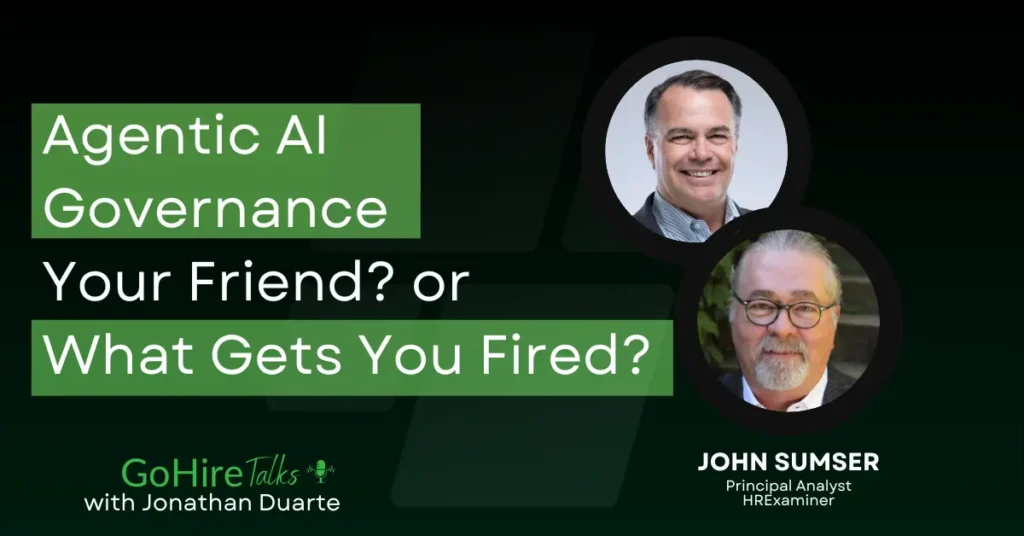
Agentic AI governance means one named person owns every AI agent in your company: who can shut it off, who can change it, who tests it and who gets blamed when it breaks. John Sumser, Principal Analyst at HRExaminer, says most HR teams don't have that yet, and the liability lands on the employer anyway.
In this episode:
- What John wants TA leaders to know
- One owner, not a committee
- AI agent governance is decision governance
- Guardrails, soft governance and the liability shift
- How to test AI agents
- AI agent reliability math
- Start with an AI use case inventory
- Hiring fraud runs both ways
- About and contacting John
- FAQ
- Full interview transcript
Agentic AI Governance: What John Sumser Wants TA Leaders to Know
Jonathan calls John Sumser one of his earliest mentors in HR tech. John is the Principal Analyst at HRExaminer, and he has written 12 articles on AI governance in HR, with more on the way. Jonathan brought him onto GoHire Talks because the market looks stuck. Mid-market and SMB teams are rushing to buy AI interviewers. Enterprise teams are holding back, mostly for governance reasons, and still writing the same Indeed check with no accountability, as Jonathan put it.
John didn't see the slowdown as a problem. He called it "extremely prudent" for people not to be buying anything right now, and said the pause isn't limited to recruiting or interviewing tools, because it's across the board. Nobody knows how AI is going to shake out, so companies are trying to figure out how to adopt it without blowing up the business. You need that answer before you commit.
Why enterprise AI governance is slowing AI buying
Jonathan had written a recruiting AI adoption playbook about six months earlier, with a chapter on governance. His idea was an AI COEE, a Center of Execution and Excellence, because handing everyone a license and saying "go do it" doesn't produce results. He pointed to Zapier, which he said has an AI rubric every employee has to pass to get hired, and to companies running internal AI hackathons so everyone gets better with the tools. He was just as clear that he wasn't telling anyone to go buy an AI interviewer.
John agreed, then went further. He doesn't think the "give everyone an AI account" era will age well.
The idea that everybody needed to be good at AI and everybody needed to have an account is gonna be the sock puppet of our time.
John Sumser, Principal Analyst, HRExaminer
His reasoning is that organizations don't work by letting everyone do whatever they feel like. He expects someone to take charge of AI, and if companies aren't careful, that someone will be finance. If you want to build something, you'll put together a proposal with a calendar, a schedule, a goal, a view of what good looks like and a cost estimate, then try to get on the priority list. That's what finance does to contain a budget. In John's words, the days "when everybody does everything to everybody all the time" are rapidly closing. That's enterprise AI governance arriving whether HR shapes it or not.
One Owner, Not a Committee: Who Is Responsible for AI Mistakes
Jonathan pushed back on finance running it alone. He thinks the CISO and the CIO should run governance with the CHRO and report up. John's answer was that a committee means nothing will ever happen. He said every governance system needs "one throat to choke, the one belly button to push," or you don't have governance at all. You have "some sort of negotiated free-for-all."
That doesn't mean ignoring the security, IT and HR expertise around the company. John's point was that program management already solves this. Companies have good tools and techniques for pulling pieces of expertise from different departments and applying them to one problem. He doesn't see why AI would be any different. So the answer to "who is responsible for AI mistakes" should be one name, supported by the experts, never a group that can each point at the others. That single owner is the backbone of agentic AI governance.
Jonathan's addition was training. The goal is to move people from "the willy-nilly everyone has a whole bunch of tokens" to using AI for a real benefit. John thought it was still too early to tell, and offered an example of where he thinks the real gains are.
Reorienting how decisions get made
John described a small startup he likes (he wasn't sure he could name it on the show) that takes the friction out of decision-making. Its test case is job descriptions. Normally four or five people meet, everyone has an opinion, someone chases every opinion afterward, and a decision lands a week later. This tool collects everyone's preferences up front, then produces a document showing where everyone agrees and where "the bones of contention" are. The conversation goes straight to the disagreements, and the cycle gets shorter.
John bet that the idea "from out of nowhere" in a meeting comes from the places people disagree, not where they agree. For him this is what the next wave of AI is about: reorienting existing processes for better output. He also warned that it's hard to get people who are locked into a role and a picture of how the world works to do that.
What AI Agent Governance Actually Means: Decision Governance
Jonathan admitted he didn't learn the word governance, as it applies to technology, until he worked at Wells Fargo, and not in recruiting. He suspects most people in HR outside compliance don't know what it means. John gave the simple version.
Governance is a clear understanding of who's allowed to do what the limits of their authority are, what they're responsible for, and who gets held accountable for it.
John Sumser, Principal Analyst, HRExaminer
Bring AI into a company and that definition reaches every decision an individual worker makes. That's why John sometimes doesn't call it AI governance at all. He calls it decision governance: who's allowed to make the decision? Without an answer, you get what most companies have today. Everyone is building some kind of AI thing, there's no testing regime and no approval process, and competing agents are "doing stuff to the company's valuable data without anybody understanding what's going on." That's the case for AI agent governance in one sentence, and it shapes the build or buy question for AI governance in HR tech.
Jonathan joked that it sounds like talking to your CPA. John took the comparison seriously. One way he's heard it put is that accounting is the dashboard of governance. In finance you know who can sign for something, what their limits are and what the budget is, and that lets work get done. AI is harder, he said, because accounting looks backward at what happened. In AI governance, you have to look forward and plan for the things that will go wrong. That forward-looking part is where agentic AI governance gets hard.
Big companies, startups and regulated industries
Asked how many companies have even the start of a governance system, John said it depends on size. Very large companies already have data governance and financial governance, and they're applying the same principles to AI. Under about 2,000 people, he sees a new approach coming that starts with complete control of the data layer, then complete control of who can do what with it.
For existing companies, John expects this to be hard, because governance changes how people do their jobs, and people resist that. A startup that installs governance from day one just treats it as "the way we do things around here." He sees a real advantage coming for small companies.
Jonathan's experience fits the regulated-industry pattern. He worked on conversational AI at Wells Fargo about nine years ago and later led conversational AI at Kaiser Permanente, where he could talk guardrails with VPs from the start because of HIPAA, and FINRA rules at Wells Fargo. John said governance is real in regulated industries like healthcare, energy and finance because the foundation of governance is compliance. First you have compliance, then you layer what you will and won't do on top of it. Our post on AI compliance in HR covers the privacy side of that foundation.
Guardrails, Soft Governance and the Liability Shift
Jonathan mentioned a group of AI founders he belongs to in Silicon Valley who are building ways to govern AI inside platforms, so software follows certain rules before the code even goes in. John's response was that this is guardrails, and he'd just been reading that 99% of guardrails can be hacked. He didn't cite the source on the show, so treat the number as his reading, but his reasoning holds up on its own: AI is probabilistic, and you can't put binary questions in front of a probabilistic system and expect it to obey. "There's always a way to beat the guardrail, which means they don't work," he said, and the market needs a different approach. Guardrails can be one layer of agentic AI governance, never the whole thing.
Who can shut the agent off?
Jonathan asked for real examples of governance issues. John answered with a list of questions every HR team should be able to answer for every AI agent:
- Who has the authority to shut the agent off?
- Who has the authority to modify it?
- Who gets blamed when it goes rogue?
- Who trains it, and who maintains it?
- Who tests it? He called testing probably the biggest one.
If those questions have no named answer, you don't have agentic AI governance. You have a tool running loose with a login.
The Linda problem: soft governance
Jonathan brought up an old John line about corporate culture: if everyone at your company wears lederhosen and a new hire shows up in a clown suit, does the new hire have to switch to lederhosen? John said corporate culture is all about keeping things the same, which is one of the big problems when you put AI processes into a company. People don't like someone changing who has power and who can make a decision.
Part of the reason is that much of governance is word of mouth. The policy says $30 in meals without a receipt, but in practice you can get to $50 before anybody barks. When things are growing, first-line supervisors don't have time to police it. Workflows work the same way. A process might have 10 steps, but everyone knows you skip step three and step seven, and when step five breaks, you go see Linda. Linda doesn't have the answer, but she knows the person in purchasing who knows the person at the vendor who has the code. Set up an agent that doesn't know about Linda and it won't work. Jonathan added that it will just keep pumping out bad data. Good agentic AI governance maps the Linda steps before an agent goes live.
Liability moves to the employer
Jonathan described paying an engineer for two hours instead of paying himself for a month to build the same thing with a bag of Lego. John said there's a more basic problem that makes AI different from anything before it.
Liability for the tool passes from the vendor's hands to the employer's hands the moment that the employer tailors the tool to their environment.
John Sumser, Principal Analyst, HRExaminer
And you can't hold an AI accountable for anything. It's a machine. So, John said, people are being assigned authority over agents, and their performance review becomes "them plus their tool." That's normal for a carpenter, plumber or mechanic, but new for most office jobs. Putting a person in front of the machine is the only way to build accountability into the system. This is John's view, not legal advice, so run your own setup past counsel.
It also explains his frustration with vendors who claim they can do governance for you. Silicon Valley runs on the idea that it's the customer's problem once the product leaves the factory, he said. "They can't." Jonathan has reached a similar conclusion after talking with Bob Pulver about AI literacy and governance: hiring a third party to certify a tool you're buying is like the credit rating agencies before the 2008 crash, paid by the same people they rate. Jeff Pole's episode on not getting burned by recruiting AI vendors covers what to check before you sign.
Keep a person accountable for every hiring step
GoHire texts candidates, asks the pre-screening questions your team writes, and books interviews for the people your recruiters choose. Every workflow has a named owner on your team, and every hiring decision stays with a person.
How to Test AI Agents Before They Touch Candidates
Testing is where agentic AI governance stops being a policy and becomes work. John's view of AI in HR right now is that "engineering tools" have been handed out to everybody.
He compared it to giving everyone in the world a bag of 5,000 Lego pieces and telling them to build something. Most people can't. Some can build a kit if they follow the instructions. The people who can design with the tools are called engineers. And recruiters, he said, often go into the profession because they don't like math. If you want AI to work in your company, you'd better like math yourself or have a colleague who does, because the answers here aren't black and white. They're probability distributions and shades of gray.
Jonathan shared a practical first step he's heard from TA leaders. One bought an AI matching tool for resumes, then went back and compared its results against what the human interviewers had concluded. Was this what we would have done, and would it work? John called that a start, then laid out what real testing looks like. He's stopped saying "agents," because nobody knows what the word means anymore, and calls them AI instances.
Build the AI testing setup first
If you build an AI instance and put it into your company, John said, you need to test it thousands of times before it goes into the field. You build the instance, then build a testing setup around it, and he promised the testing will cost more than the instance. Then you run it 3,000, 5,000, 10,000 or 100,000 times and get a picture of every kind of error it makes. You classify those errors.
His reason is variability. John said that if you ask a large language model the same question 1,000 times, you'll get at least 80 different categories of answer, each with its own distribution. He didn't cite a study for that number, so treat it as his estimate. Some of those answers are exactly right. The trouble is in the middle.
John described it as standard deviations. Inside the first standard deviation, the answers vary but are right. Out at the third, you get the errors that blow the system up, and those are easy to spot. The second standard deviation is the dangerous one: "not quite right, but not bad enough to be wrong." Those small differences slip past the people watching, add up over time, and pretty soon the system is doing something other than what you thought. His example: instead of using your existing skill definitions, it makes one up and uses that.
Jonathan has seen this in his own builds. He'll notice an output that doesn't look right, ask the AI what it used, and get back some version of "I forgot to follow your instructions." John said that's the core misunderstanding: people think large language models are designed to follow instructions, and they're not. Jonathan has seen teams use a second model to check the first one's work. Either way, you have to know what good looks like, including the steps your team quietly skips when everything's fine.
AI Agent Reliability Math: Why Chained Agents Break
John closed with reliability. Some vendors claim their AI instances are 99% reliable, but he said there isn't much evidence for that, and 90% to 95% is where most land. Here's the math he wanted every TA leader to see.
At 95% reliable, an AI instance makes 50 fatal errors every thousand runs. Run it across 10,000 resumes and that's 500 fatal errors. Then it gets worse, because agents pass work to each other. Jonathan's instances drop data into shared databases where the next one picks it up, so if step three skips something, the bad data reaches Rosie at step five.
John's point is that hand-offs multiply the failure rate. The straight multiplication is harsher than the rough figures he gave on air: two 95% steps in a row are about 90% reliable, three are about 86%, and ten are about 60%. By the time 10 or 12 steps pass information along, John said, "it basically doesn't work." That's why AI agent reliability has to be measured on the whole chain, not on each tool's sales sheet, and any agentic AI governance plan has to account for it. Our recruiting automation guide covers how to design hiring workflows so a person checks the hand-offs that matter.
John's fix is the same as before. Build the test process, then run it regularly so you understand how the system makes mistakes, because the one thing you know for sure is that it will.
Start an AI Governance Program With an AI Use Case Inventory
Asked whether he'd consult with companies on building governance, John said it's early for that. Then he gave what he called a week's worth of consulting advice in one sentence: build a registry of every AI instance in your organization. That AI use case inventory is the first real step in any AI governance program. For each instance, record:
- Who built it
- Who is responsible when it breaks
- Who maintains it
- What it's supposed to do
- What other systems it interacts with
At minimum, you'll know what you're starting with. Jonathan said he'd already done this for his own work in Claude Cowork, because he has about 30 agents or instances running, some on schedules, and couldn't remember which one did what.
An agentic AI governance checklist for TA leaders
Pulling John's advice together, here's the order he'd work in:
- Inventory every AI instance your team uses, including the ones individual recruiters set up on their own.
- Name one owner for each, with the authority to shut it off and change it.
- Write down what good output looks like, including the unofficial steps your team relies on.
- Build a testing setup and run each instance thousands of times before it touches candidates.
- Measure reliability across the whole chain of hand-offs, then re-test on a regular schedule.
Deb Paul made a similar case for treating every AI agent like your newest hire, and our post on AI implementation and change management covers the people side John warned about.
John's reason for being "obsessed" with governance is simple: without it, this stuff blows up. The job is to make the tools safe for the organization and for the people using them. Jonathan expects someone in the next three years to stand up and say you can't just buy these tools, and that a TA or HR leader can start now by saying "we're not putting stuff in until we know what it's gonna do." John's version was even shorter.
Know what you got. Know what it does. Don't put it in till you know it won't hurt anybody.
John Sumser, Principal Analyst, HRExaminer
Jonathan's last word: that's what you'll get sued on anyway.
Where GoHire stands on human decisions
GoHire's position lines up with John's. Software never makes the hiring decision. Your team writes the pre-screening questions, owns each workflow, sees every response and decides who moves forward. That's the practical meaning of agentic AI governance in a recruiting workflow, and it's how we think about recruiting AI in general. AI agents in HR should make recruiters faster, with a person accountable for every step.
Hiring Fraud Runs Both Ways
Earlier in the conversation, Jonathan asked John about Jonathan's own recent article on the $6.3B stolen through a fake job interview. John said he's tired of single stories being used to explain fraud, and asked a question back: who commits more fraud in the hiring process, candidates or employers?
Jonathan's answer was employers. Candidates have more to lose individually, but he's had recruiters, including some in state government, tell him they already know who they're going to hire and only post the job to show they looked. John said the $6.3B case was an employer-side problem, "an interviewer frenzy," and asked who's building tools for candidates to find out whether the employer is the fraud.
His questions for any employer: how many age discrimination suits have you settled, which major employment cases have you lost, and how likely is it that the job description matches the job? Jonathan doubted most employers could answer the last one. He suspects much of today's job description text is copied from postings that ran on Monster in 1998. John agreed there are a lot of them. Candidates are being accused of making things up, John said, and it's time employers were held accountable too. It's the same accountability he wants from agentic AI governance, pointed at the employer.
About & Contacting John Sumser
John Sumser is the Principal Analyst at HRExaminer, where he writes a newsletter on HR technology that goes out at least once a week. He's currently writing an ongoing series on AI governance in HR, and he told Jonathan he isn't done yet. For more from John on GoHire, read recruiting AI chatbots, text recruiting and John Sumser.
- Connect with John Sumser on LinkedIn
- HRExaminer and the weekly newsletter
- John's series: Getting Started #1, HR AI Governance
Frequently Asked Questions About Agentic AI Governance
What is agentic AI governance? +
It's a clear answer, for every AI agent you run, to who's allowed to do what, the limits of their authority, what they're responsible for and who's held accountable. John Sumser calls it decision governance: who is allowed to make the decision.
Who is responsible for AI mistakes in hiring? +
The employer, and a named person inside it. John says liability moves to the employer, away from the vendor, once the employer tailors the tool, and since you can't hold an AI accountable, the person assigned to the agent answers for its results.
Do AI guardrails replace governance? +
No. John argues that AI is probabilistic, so there's always a way to beat a guardrail. Guardrails help, but you still need an owner, a testing process and an approval process for every agent.
How do you test AI agents before using them in recruiting? +
Build a testing setup around each AI instance and run it thousands of times before it goes live. Classify every kind of error, pay special attention to small drifts that look almost right, and re-test on a regular schedule.
Why do chained AI agents fail more often? +
Error rates multiply at every hand-off. Two steps that are each 95% reliable are about 90% reliable together, three are about 86%, and ten are about 60%.
Where should an AI governance program start? +
With an AI use case inventory. List every AI instance in your organization with who built it, who is responsible when it breaks, who maintains it, what it's supposed to do and what systems it touches.
Put a Person in Charge of Every Hiring Workflow
GoHire texts candidates, runs your team's pre-screening questions and schedules interviews. Your recruiters own every workflow and make every hiring decision.
Agentic AI Governance: The GoHire Talks Interview Transcript with John Sumser
Everest, a Hard Year and Why Buyers Are Waiting (00:00)
Jonathan Duarte: [00:00:00] Hey, everyone. We've got a great guest today, someone you probably know very well, John Sumser, I would say probably one of my earliest mentors in the space for a lot of reasons.
And John's been talking a lot about AI governance in recruiting and how it's all gonna work in HR. So John, welcome to the show.
John Sumser: Hey, Jonathan. Thanks for having me on.
Jonathan Duarte: it's been a... It was a year that I summited Everest Base Camp as of tomorrow
John Sumser: Oh, really?
Jonathan Duarte: Yeah.
John Sumser: I think I knew that, but I don't think I knew that.
Jonathan Duarte: Yeah And the most important part was my girlfriend, we had to helicopter her off because her oxygen was at 32%. Oh. When we, when, once we got to the top.
John Sumser: Jesus.
Jonathan Duarte: Wow. Yeah. So she had water in her lungs. We got her back and saw her this weekend.
John Sumser: Awesome.
So how are you?
Jonathan Duarte: Good. I think [00:01:00] 2026 was a hard year. We weren't able to sell a lot. I think there was a lot of crazy stuff going on in the space with AI and and I wanna talk a lot about your governance stuff. I think there's a lot of people trying to get fast with AI interviewers. ... And that's, it's probably all in the mid-market and SMB, but the enterprise is still sitting on the wings on this stuff because of a lot of governance reasons and things.
But they've been slow on buying other products, and there's, they're still just writing the Indeed check with no accountability. So it's the same old same for the last 20 years .
John Sumser: Well-
I think that it is extremely prudent for people not to be buying anything right now. Yeah. And what you're seeing in the marketplace isn't just in recruiting, and it isn't just [00:02:00] in, in interviewing tools. It's across the board.
Things are too uncertain and how this AI thing is gonna shake out is not at all guaranteed. And so people are sitting on their hands trying to figure out How do we do this without blowing up the business?
Jonathan Duarte: Yep. Yep.
John Sumser: R- right? And you really need to know the answer to that question before you,
Jonathan Duarte: Make the commit
move
John Sumser: ahead.
An AI Center of Excellence and the Sock Puppet of Our Time (02:45)
Jonathan Duarte: Yeah. Yep. Yeah, I see . And you know what I've gone over your, your 12 articles on governance. And, ... I wrote, I think it was six months ago, a recruiting AI adoption playbook, and one of the chapters was on governance. And I think and this is gonna...
why I actually wanted to interview about this stuff, because I wrote this thing. I think we should have an AI COEE, which is the Center of [00:03:00] Execution and Excellence, because people need to know how to execute it, which instead of, oh, we have this AI tool, you have a license, go do it, and nothing's getting done correctly or we're not getting results.
But teams aren't putting in... there are a couple great examples of Zapier that is doing AI. They have a rubric that every employee has to pass to, in order to get a job in the company. ... They don't have to be experts. They just have to have, show that they're inquisitive and they have been using the tools.
And then there's other companies that are doing internal like AI hackathons to better everyone in the company on using the tools. And I think those are critical for adoption of the tools. But I'm not, at the same time, I'm not saying- Yeah ... go get, go buy an AI [00:04:00] interviewer, and I don't think anyone should be buying one personally.
John Sumser: Yeah, me too. I think that looking back five years from now-
Jonathan Duarte: Yep ...
John Sumser: the idea that everybody needed to be good at AI and everybody needed to have an account is gonna be the sock puppet of our time.
Jonathan Duarte: Those little puppets, yeah. From the old AI old dotcom b- day, right?
John Sumser: Yep. Yep. Because l- listen-
Organizations don't work by having everybody run around doing whatever the fuck they feel like doing.
Jonathan Duarte: Yeah.
John Sumser: They just, they don't. They don't. Yeah. And so what's gonna happen is somebody, and if we're not careful it'll be finance-
Jonathan Duarte: Yeah ...
John Sumser: is gonna be in charge of AI. And if you want to do something, you're gonna have to put a proposal [00:05:00] together-
With a calendar, and a schedule, and a goal, and a view of what good looks like-
...
John Sumser: And a cost estimate.
Jonathan Duarte: Yep.
John Sumser: And you're gonna have to take that to somebody somewhere and see if you can get on the priority list, because the organization will work to contain its budget.
Jonathan Duarte: Yep.
John Sumser: That's what finance does, right?
Yeah. And so these, these days when everybody does everything to everybody all the time, they are rapidly closing.
One Throat to Choke (05:45)
Jonathan Duarte: Yeah. I agree with that. I actually think there's a lot of merit in that, but it shouldn't just be finance. I think it should be the CISO and the CIO with the CHRO that run governance, and they report up- Yeah,
John Sumser: yeah, but if you make it a committee-
Jonathan Duarte: Yeah, it can't be too
John Sumser: much
Jonathan Duarte: nothing- It's gotta
John Sumser: be- ... nothing will ever happen.
Jonathan Duarte: Yeah.
John Sumser: There has to [00:06:00] be... This is the thing about governance in general.
Jonathan Duarte: Yeah. Yep.
John Sumser: There has to be somebody who is the one throat to choke, the one belly button to push, or you don't have governance. You have some sort of negotiated free-for-all. And so there's no question that there's expertise around the organization-
Jonathan Duarte: Yeah
John Sumser: that needs to be applied to this, but we have perfectly wonderful program management tools and techniques that allow you to take bits and pieces of things from different places in the organization and apply them to the problem.
Jonathan Duarte: Yep.
John Sumser: I don't know why this would be any different.
Jonathan Duarte: Yeah I don't... The only thing I think that is gonna be the training areas is really get people engaged in instead of the willy-nilly everyone has a whole bunch of tokens, to how do you use this to get a benefit?
[00:07:00] And
Taking the Friction Out of Decisions (07:00)
John Sumser: I think it's probably too early to tell still.
Jonathan Duarte: Yeah. Yeah.
John Sumser: It's probably too early to tell. I'll give you an example. One of my favorite little tiny startups is taking the friction out of decision-making.
Jonathan Duarte: Okay.
John Sumser: And so they do... What the... One of the things that AI is great for is if you can lay out a workflow, you can move the parts around inside of the workflow to make it work better, right?
Which you can't do if it's just people or if it's just software. But with AI, you can rearrange things. And if you've got a decision to make and there are four or five people in on the decision... Their trial ground, by the way, is job descriptions. You go to the meeting, everybody's got an opinion.
You have to follow up on all the opinions, and you get to a decision a week later.
Jonathan Duarte: Yeah.
John Sumser: Their approach is you get all of the preferences of all of the players up front. You produce a [00:08:00] document that says, "Here's where everybody agrees, and here's where the bones of contention are." And you focus the conversation on the bones of contention, and you shorten the cycle time.
Jonathan Duarte: Yeah. Wow.
Interesting.
John Sumser: Very interesting. And so you can do that any place where there's a decision, you can take the input/output thing and invert it so that the output is the input and get really interesting results out of it. Yeah. That's how you go about solving the larger problem of how do we m- make decisions about this shift.
Jonathan Duarte: Yeah. That's a, that's an interesting thing. I know we'll... I wanna follow up more on that because I think it's even helpful within a small team. And the one iteration is some people come up in a meeting with something you just never thought about because it's, it, something connects. How does it, how does that tool help in that kind of sense?
John Sumser: You know what? I bet you a million bucks, there's [00:09:00] probably studies about it too, I don't know, but I bet you a million bucks that idea from out of nowhere that comes up in a group-
Jonathan Duarte: Yep ...
John Sumser: doesn't come from the places where everybody agrees.
Jonathan Duarte: Oh, yeah. Yep.
John Sumser: And so what this tool does is it showcases where the disagreements are and who disagrees with whom about what.
Jonathan Duarte: Yeah.
John Sumser: So that you go tackle that. '
Jonathan Duarte: Cause it sounds like if - someone brings up a use case that someone wasn't thinking about, but they had already made up their mind, like they were, "Hey, I'm not for this because of this," and the other person's for it, and then they, once they justify their case, the other person can, "Hey, yeah I agree with you.
So I guess we're in agreement."
John Sumser: Yep.
Jonathan Duarte: Yeah.
John Sumser: Yep. So anyhow, I'm not sure I can talk about that startup in the show, but- Yeah ... it's the kind of thing the reason I mentioned it was that's the kind of thinking that the next wave of AI is really gonna be about is-
[00:10:00] Yeah ...
John Sumser: reorienting existing processes for better output.
And it's really hard to get people who are hooked into a role and a picture of how the world works to do that stuff.
Jonathan Duarte: Oh, yeah. Wanna talk a lot about the governance, what kind of even sparked your jump into it. 'Cause I know, writing 12 articles is a quite of a lot of time, and I'm sure you had a lot of conversations and interest in it.
And then- And
John Sumser: I'm not do- and I'm not done yet. No.
Jonathan Duarte: Oh, well- there's
John Sumser: a bunch more.
Jonathan Duarte: Oh I assume that until people are actually listening and doing, you're gonna be on this for a long time. You may be the AI governance in the HR tech space for the next five years at this point.
John Sumser: Good. Now all I gotta do that, all I gotta do is find somebody who will send me a check.
Who Commits More Hiring Fraud? (10:45)
Jonathan Duarte: I wouldn't be too surprised, if this... The you probably saw the article I wrote at, you heard about the, 6.3 billion that was
John Sumser: stolen. So [00:11:00] let's talk about, let's talk about that for a second- Yeah
'cause that's something we might wanna talk about.
Jonathan Duarte: Yeah.
John Sumser: W- you asked me to make some noise about that, and I sent you a cryptic response. So- Yeah.
Jonathan Duarte: Yeah. I was gonna ask you about that.
John Sumser: I am so tired of people giving me single stories and telling me that tells me something about fraud.
Jonathan Duarte: Yeah.
John Sumser: Right?
I'm just... I don't buy it. Yeah. I don't buy it. And in this particular case-
Jonathan Duarte: Yep ...
John Sumser: it gets at the one thing that I think is missing from all of the conversation about fraud.
And so here's the rhetorical question: Who do you think commits more fraud in the hiring process, candidates or employers?
Jonathan Duarte: Candidates have more to lose. I- candidates have more to lose individually, but I think it's the, the HR teams who, break all the rules. And I've had recruiters, say, even working for state government say "Listen, we already know who we're gonna hire, but we need to put this DEI posting out [00:12:00] on the internet to prove that we, we're looking for someone."
So I think it's the employer. And they have, their own reasons, but candidates have their own reasons too, but I think the employers are the biggest ones.
John Sumser: So who is ... because this $6.3 billion S- embezzlement-
Jonathan Duarte: Yep ...
John Sumser: that's an employer problem. Yeah. That's an interviewer, that's an interviewer frenzy.
So who is building projects for candidates to discover whether or not they have a fraud on their hands? And once I see that's going on-
Jonathan Duarte: Yeah ...
John Sumser: then I'll go, oh, this fraud thing might be interesting. But as long as the target is candidates who are just doing whatever it takes to get a job-
Jonathan Duarte: Yeah
John Sumser: and there's nothing new about that.
Jonathan Duarte: Yeah.
John Sumser: I I don't think it's gonna be interesting. I don't think it's gonna be interesting, and it's about goddamn time that employers were held accountable. I wanna know, if I wanna [00:13:00] come to work for you, how many age discrimination suits have you settled?
I wanna know what are the major court cases that you lost in employment-related stuff.
Jonathan Duarte: Yeah.
John Sumser: I wanna know how likely is it that the job description matches the job?
Jonathan Duarte: They wouldn't even know, and would not be able to answer that.
John Sumser: 'Cause that's what they're, that's what they're accusing candidates of doing.
Jonathan Duarte: Yeah.
John Sumser: Making shit up.
Jonathan Duarte: I'm sw- I swear there... I- this would be a interesting thing if AI could actually do this, is maybe Jeff Taylor's got some old data sitting around to see how many job descriptions that are sitting from Monster in 1998 are still, 80, 80% of the text is still being used.
John Sumser: There are a lot of them.
Jonathan Duarte: [00:14:00] Yeah. There are a lot of them. Copy, paste, copy, paste, copy, paste, changes a couple sentences. That's about it.
John Sumser: Yep.
What Governance Means (14:00)
Jonathan Duarte: Oh, wow. Yep.
So tell us what's going on in the world of governance after you've been writing about it
In my experience now 30 years working in HR tech, I only learned the word governance as it relates to recruiting or even technology, when I was working for Wells Fargo, and not even working in recruiting. And so how... I don't even know that most people in HR, other than compliance teams, might even know what governance means.
So what does it mean,
The, the
John Sumser: sim- ... at the high level? The simple definition is governance is a clear understanding of who's allowed to do what the limits of their authority are, what they're responsible for, and who gets held accountable for it, right? Yeah. That's... it's that. And when you [00:15:00] look at bringing AI into an organization, that means that you have to think about the decisions that individual workers make.
And so sometimes I don't think about it as AI governance at all, but I think about it as decision governance. Who's allowed to make the decision?
Jonathan Duarte: Yeah.
John Sumser: And there's a ton of places where that matters. But in the absence of that, you get the chaos that we have today, where everybody is running around making some kind of AI thing.
There's no testing regime in place. There's no approval process in place. And you get these competing agents doing stuff to the company's valuable data without anybody understanding what's going on. And that's why you need governance.
Jonathan Duarte: Yep. And as, as we've talked, and anyone who's probably already starting to hear this, it sounds like we're talking to our CPA which pretty much is the case.
It is the part of how to run a business but do it [00:16:00] effectively and know who's in charge.
John Sumser: Yep, yep. And, we have... Governance isn't all written down.
Governance is... R- so one of the ways I've heard it put is accounting is the dashboard of governance.
And that means that in the finance world, you know who's got authority to sign for something.
You know what their limits are for signing for that. You know what the budget is. You know all these things, and that allows you to get work done.
With AI- You have to be doubly vigilant because in the accounting world, what you do is you look backwards and you see what happened.
In AI governance, you have to look forward and plan for the things that will go wrong.
Jonathan Duarte: Yeah.
John Sumser: And that's where the hard part of it is.
Big Companies, Startups and Regulated Industries (16:45)
Jonathan Duarte: Yeah. And it's even... Yeah, and then and from your research so far of acc- companies, if you've talked to individuals, if you've talked to HR teams or CIOs, [00:17:00] what's, what have you researched and found, like, how many companies have governance, even the beginnings of a governance system in place?
John Sumser: So it depends on the size of the company.
The really big companies have data governance, they have financial governance, and they're applying those principles to AI governance. So they know how to set up systems like this that run all the way through the organization.
When you get out of the big ones, so you're under 2,000 people-
Jonathan Duarte: Yeah ...
John Sumser: there's a whole new world coming along that begins with control, complete control of the data layer.
Jonathan Duarte: Yeah.
John Sumser: And then complete control over who can do what with the data layer. And we're just starting to learn about it, but I'll tell you, if you're an existing company, this is gonna be really hard.
Yeah. Because governance will change the way that [00:18:00] people do their jobs, and when you change the way that people do their jobs, they resist.
Jonathan Duarte: Yeah. Yeah.
John Sumser: Now, if you're a startup and you install governance from day one, it's just the way we do things around here.
Jonathan Duarte: Yeah.
John Sumser: And so there's a real advantage coming for small companies.
Jonathan Duarte: Yeah. I've worked with I'm in a group of AI founders in Silicon Valley, and- ... there's some incredibly smart people who are coming up with ways to govern AI within platforms and have access. And so when software is built and when it's used, it already adheres to certain rules- Well- ... before the code even gets in.
Guardrails Can Be Hacked (18:45)
John Sumser: So guard- you're talking about guardrails. Yeah, to build
Jonathan Duarte: the guardrails inside.
John Sumser: And I was just reading this morning- What percentage of guardrails can be hacked?
[00:19:00] 99% of guardrails can be hacked.
Jonathan Duarte: Yeah.
John Sumser: So because it's all probabilistic, right?
You can't put binary questions in front of a probabilistic system and have it expect to do it.
So there's always a way to beat the guardrail, which means they don't work. And we are in the market for a different approach.
Jonathan Duarte: Yeah. Yeah, and it's, I think the other side of where what I learned from go- governance and I was even, when I was working at Wells Fargo because we were doing conversational AI early 10 years ago or I guess it was nine years ago no one really knew what it was.
Now, Then when I moved to Kaiser Permanente and was leading their conversational AI I could speak to governance, to the VPs right off the bat about- ... "Hey, here's the guardrails we need," and that's what we implemented. H- it's a HIPAA compliant process and then you had [00:20:00] FINRA and all the rest at Wells Fargo.
So these were really big companies but I had never heard people talk about this in smaller companies.
John Sumser: So governance is real in regulated-
...
John Sumser: Industries. Yeah. So healthcare, energy, finance, I don't know what else. They have enough regulation in their environments so that governance is part of it because the foundation of governance is compliance.
And so first you have to have compliance, and then you have to have the other stuff that we will or won't do laid on top of the compliance thing.
Jonathan Duarte: Yeah.
John Sumser: And those industries live and breathe compliance.
Who Can Shut the Agent Off? (20:30)
Jonathan Duarte: Yeah. So let's talk... Now we talked about the, the nitty-gritty of it.
What would be an example, say, of s- say system errors or even, say, reliability of, is the tool doing what we think it's supposed to be doing? Or I know you made some [00:21:00] comments of human in the loop, which may not be so great because a human may not be able to disregard what the AI is saying, or may not be able to com- combat it.
So what are some real-life examples of things that people would say, "Oh, okay, that would be a governance issue"?
John Sumser: So first governance issue, who has the authority to shut the agent off?
Jonathan Duarte: Perfect. Perfect
John Sumser: Governance issue.
Who has the authority to modify the agent?
Jonathan Duarte: Yeah.
John Sumser: Governance issue, who gets blamed when the agent goes rogue?
Jonathan Duarte: Yep.
John Sumser: And who trains it? Gover- who trains it.
Jonathan Duarte: Yep.
John Sumser: Who maintains it.
Jonathan Duarte: Yep.
John Sumser: And who tests it, and testing is probably the biggest thing here. Yeah. One of the, one of the things I think about AI in HR is what we really have right now are [00:22:00] engineering tools that have been handed out to everybody.
Jonathan Duarte: Yeah.
John Sumser: So it's like everybody in the world got issued a bag with 5,000 Lego pieces in it and got told go build something."
And most people can't build something from a bag of Lego blocks. Some people could build a Lego kit if they follow the instructions closely. But the people who can actually design and use tools, they're called engineers.
Jonathan Duarte: Yeah.
John Sumser: And they, the distinct difference between engineers and HR people recruiters in particular, is you go into these professions because you don't like math.
Jonathan Duarte: Yeah.
John Sumser: And if you're gonna be successful with AI in your organization, you better either like math yourself or have a really good colleague who likes math, because the answers to these questions are not [00:23:00] black and white. The answers to these questions are probabilistic distributions and shades of gray.
Lederhosen, Linda and Soft Governance (23:15)
Jonathan Duarte: Yeah. Yep. Again, I you s- your quote, and I swear this is gonna be one of the big ones out of this is the Lego piece. But I have to remind the audience, this is one of my favorite quotes from you about corporate culture. And I think we just had a phone call, this is probably maybe even as much as 10 years ago, and we were having a conversation about corporate culture and you said it, let, it, correct me if I'm wrong, but it was something along these lines.
Corporate culture is like this, is if you hire someone and everyone in your company wears lederhosen lederhosen, and then some- you hire someone new and they wear a clown suit, and they come in the organization, is that person supposed to now wear a lederhosen, or are they supposed to be accepted for their clown suit?
That's corporate [00:24:00] culture. Does that sound about
John Sumser: right? That's corporate culture. That's about right. That's right. That's about right. I remember the lederhosen Example I was using for a while. But corporate culture, that's one of the interesting things is corporate culture Is all about keeping things the same.
And it's one of the big bugaboos when you go install AI processes in existing organizations with cultures that want to stay the same.
Jonathan Duarte: Yep.
John Sumser: They don't like somebody coming and monkeying in with who's got power and who doesn't have power, who can make a decision, who can't make a decision.
Jonathan Duarte: Yeah.
John Sumser: Now, that's largely because in other areas, governance is word of mouth in a lot of places, right?
Yeah. So the policy is you can only put $30 worth of meals on your expense account without a receipt.
Jonathan Duarte: Yep.
John Sumser: [00:25:00] But the practice is you can get all the way to 50 before anybody barks. I've got
Jonathan Duarte: one for you.
John Sumser: In places where things are good and things are growing first-line supervisors don't have the time or the energy to monitor that stuff.
They only monitor that stuff when things are broken.
Jonathan Duarte: Yeah. Yep.
John Sumser: Right? When things are going well... It's like workflows. A workflow might have 10 steps in it, but everybody knows you don't do step three or step seven. They're just there for looks. And when you get to step five and you can't make step five work, everybody knows you go see Linda.
And Linda doesn't have the answer, but Linda knows the person in purchasing who knows the person in the vendor who has the code that solves the problem, right? Yeah. And that soft governance- ... you cannot do that step without Linda's permission.
Jonathan Duarte: Yeah.
John Sumser: Yeah. Soft governance is [00:26:00] one of the things that gets pressed pretty hard when you do this stuff.
'Cause if you set up an agent and it doesn't know about Linda-
Jonathan Duarte: Yep. It's just gonna- ... it isn't gonna work ... keep pumping the bad data out. Yep.
John Sumser: Yep.
Jonathan Duarte: That, that's, those are, these are some amazing analogies, and this is why I wanted to have you on because I knew you'd be able to speak to... we talk about the nitty-gritty of what it is, and then it's really functionally like what's going on that in somebody's daily workload that would define where governance would sit in.
And I also, I think it's important that people realize what John's talking about with Linda is really about the use cases that we're talking about AI. If you give the Lego blocks to everyone in your company and go say, "Build stuff"- But you're not an engineer, and, like I could probably make a nice little...
y- you give me a month and I could make [00:27:00] a, an airplane if I had all the time in the world. But it doesn't make sense to pay me a month to do something that someone who's got the instruction who's an engineer and great at using Lego blocks to build an n- to build an airplane who can do it in two hours.
Now, he might be more expensive, he or she, but they can get it done in two hours, and they can ask me what they want, wings and stuff like that.
Liability Passes to the Employer (27:15)
John Sumser: Yeah. Yeah. So there's a fundamental problem here, right? And this is what makes AI different from anything we've seen before. Rule one is- Liability for the tool passes from the vendor's hands to the employer's hands the moment that the employer tailors the tool to their environment.
Jonathan Duarte: Yep.
John Sumser: But you [00:28:00] cannot hold an AI accountable for anything.
For anything. It's a machine. What are you gonna do? Turn it off? It's not like a person that you can co- it's nothing like having a person on the job. So what is happening is people are being assigned authority over agents, and when you go look at their performance review, it's them plus their tool.
And that isn't any different than a carpenter or a plumber or an auto mechanic, but- ... but the idea that your job performance rating includes the tool 'Cause that's the only way you can build accountability into the system, is put a person in front of the machine. That's gonna change things around, because you have to be responsible for the outcome of the tool that you use.
Jonathan Duarte: Yeah. That's... How do you think that's [00:29:00] gonna work? A- and have you talked to people who have used it? I could think of my own th- things, but, I build them, so I'm accountable for them anyways.
John Sumser: If you are a vendor of those things, you're not accountable for them after the customer gets them.
Jonathan Duarte: Yeah.
John Sumser: But that's, that Silicon Valley is based on that idea. Yeah. That it's the customer's problem once it leaves the factory.
Jonathan Duarte: Yeah.
John Sumser: And so lots of people are struggling to figure this out, but you have all this weird stuff the vendors are claiming that they can do governance for you.
Jonathan Duarte: Yeah.
John Sumser: But-
Jonathan Duarte: You know what?
John Sumser: But they can't. They can't. They can't.
Jonathan Duarte: Just, just- Because- I gotta tell you this. So I have come to the conclusion, I talked to Bob Pulver about this, anyone who hasn't met him, a, an, an auditor, if you will, in AI space [00:30:00] and recruiting in HR tech that it is impossible to hire a third party to govern your purchase of a tool because they're almost like the credit the credit companies during the credit default swap bailout in 2008.
They're just paid by the same people they're getting credit ratings from, so it's not to their advantage to say your software doesn't work, 'cause then they just go to another crediting agency.
The Trough of Disillusionment and Fire (30:30)
John Sumser: I think it's, I think it's so early that we're seeing these, we're seeing these things firsthand, but I don't know.
We are at, you know the Gartner graph that shows the trough of disillusionment?
Jonathan Duarte: Yeah, yep.
John Sumser: You're from California. The trough of disillusion is more like an irrigation channel. It's [00:31:00] wide and deep, and it takes three or four years to get across the trough of disillusionment.
Jonathan Duarte: Yep.
John Sumser: We're about there. Now, what happens you were there for the dotcom-
Jonathan Duarte: Oh,
John Sumser: yeah ... return, right? Yep. So we had the trough of disillusionment that lasted four years maybe.
Jonathan Duarte: Yep.
John Sumser: And then people started coming out the other side with interesting stuff that was different than it was in the '90s.
Jonathan Duarte: Yep.
John Sumser: We're about to hit that. We're about to hit that, and what happens in the trough is people stop spending money. Because you can't have every kid on the block having the same bag of Lego blocks and no instructions. And so people go, "Oh. Oh, yeah, th- we're an organization. We don't do that."
Jonathan Duarte: Yeah.
John Sumser: And that'll stop stuff. On the other side, what will pull us out of that is governance.
'Cause this is i'm gonna give you another one. This is when [00:32:00] man first discovered fire.
So you discover fire. It's fire. You bring it home, and you put it in the middle of the village, and you put some more wood on it, and it's warm.
You can sit around it. You can cook on it. It's very cool, but it's outside. And so somebody gets the bright idea of bringing fire into the house, and burns the house down. And then that same somebody rebuilds the house, says, "Oh, the problem was I didn't have something hard that won't burn underneath." And so he brings a rock in, sets the fire on top of the rock, and kills everybody in the house with carbon monoxide poisoning.
This is how you learn about technologies, right? And if you are a smart business person-
...
John Sumser: You let somebody else be in charge of burning their house down.
Jonathan Duarte: Yeah.
John Sumser: Right?
Jonathan Duarte: Yeah I think the analogy is great because i- when [00:33:00] you're looking at a business, even as if you're a manager and you're building your own agents or you have someone really smart who does have the ability to build agents, just create your own compliance process.
I've heard some great TA people doing this, which is we bu- we bought a AI matching tool for candidate resumes, 'cause that's where a lot of people are spending time and energy at this point to speed up the process, but she would go back and review all the candidates, the resumes, all the interviewers, all the human interviewers, and just do a gut check of is this what the AI came up with?
Is this what we would have done normally? And would it work?
Test Harnesses and Error Distributions (33:00)
John Sumser: And so that's a start.
But if you wanna understand... i'm gonna stop calling them agents, because nobody knows what that means anymore. So I [00:34:00] call them A- AI instances. If you're gonna build an AI instance and put it in your organization, you need to test it, and you need to test it thousands and thousands of times before you let it out into the field.
And what you do with... so you build the AI instance, and then you build the test harness to sit around the AI instance.
Jonathan Duarte: Yeah.
John Sumser: And I promise the test harness will cost more than the AI instance cost.
Jonathan Duarte: Yeah.
John Sumser: Then you run that thing three, five, 10, 100,000 times, and what you get is a picture of all of the kinds of errors it'll make.
Jonathan Duarte: Yeah.
John Sumser: Then you go look at all those kinds of errors and you classify them. Do you know that if you ask a large language model the same question 1,000 times, you'll get a minimum of 80 different answers?
Jonathan Duarte: 1,000 questions and you'll get 80 different answers?
John Sumser: 80 different answers.
Jonathan Duarte: Yeah, so was that 8, that's [00:35:00] 8%?
Or,
John Sumser: No. 80 different categories of answer.
Jonathan Duarte: Oh,
John Sumser: okay. Got it. 80
Jonathan Duarte: different...
John Sumser: 8 across it so 80 different answers that, that have various distributions associated with it.
And some of those answers are exactly right.
It's but a little math here. So if it's a normal distribution of failure, the first standard deviation is right.
There's variation in there, but it's inside of the first standard deviation is right. The second standard deviation is not quite right, but not bad enough to be wrong. So this is where things slip by people who are watching it. And then out at the third standard deviation, you have things that blow the system up.
Jonathan Duarte: Yeah.
John Sumser: The biggest problem is that second standard deviation where little tiny bits of nuanced difference accumulate over time. And if you're not [00:36:00] watching it and you don't understand what's happening, pretty soon the system will be doing something other than you thought it was doing.
Jonathan Duarte: Yeah. So instead of making airplanes, it's making trains?
John Sumser: Instead of using your existing skill definition for saws, boards- ... it makes one up and uses that.
Jonathan Duarte: Yeah. Yeah, and I see that even in the instances I've set up where I have to go back and I see it and I go, "That doesn't seem right." And then I ask it- ... What did you use? And it's oh, yeah, I forgot to follow your instructions.
I, I forgot.
John Sumser: Yeah. Yep. Yep, this is a problem. People think-
That, that large language models are designed to follow instructions, and they're not.
Jonathan Duarte: Yeah.
John Sumser: They're not. They're not.
Jonathan Duarte: And
John Sumser: if- If you want them to follow instructions, that's what's in the first layer of design. And those follow [00:37:00] instruction things, which people call guardrails, right? Yeah. Don't really work very well
Jonathan Duarte: It's certainly not- Right
on the same model.
Yep. So I've seen other people use different LLMs to catch the errors on the original one in different ways, and that's again, it just goes back to what you said before, is you have to know what good looks like. You have to know that, in step three and five, you can't skip those.
Those are in our, if you will, our manual processes when everything's good, and we- we're sending thousands of resumes through these things every day, and no one's complaining. Yeah, you're skipping stuff, but you are skipping stuff
John Sumser: Yeah. It's gonna be, it's gonna be fascinating to watch this evolve because examining work at the level that we're talking about examining work, we [00:38:00] used to do it.
We used to do it in the last half of the 20th century. The Dictionary of Occupational Titles was always built on field examination of the work. So you couldn't get a job in there until a team of PhDs went out and watched somebody do the job for a while.
We haven't had that for 25 years, and so much of what people talking about what a job is or isn't has to do with administrative detail rather than the work itself.
And there's a gap between the way people say the job is supposed to be and the way the job actually is.
Recruiters get crap for that all the time, that the job description and the actual job don't have anything to do with each other. But that's where the interesting stuff is. The difference between the way we actually do it and the way it's supposed to be done is where judgment comes [00:39:00] from.
Start With an AI Registry (39:00)
Jonathan Duarte: Yeah. Yeah. All right we'll wrap it up h- in a sec. How can people... let me ask you this. So I know you're doing a lot of consulting now. And we defined out where I think in this governance you can probably really help companies even, start off this. Is that something that you're looking to do, is try to jump in with companies and consult them on how to build a governance structure, how to build it within AI and HR?
John Sumser: I think it's early for that. If I were to give, if I were to give a week's worth of consulting advice in a sentence-
...
John Sumser: It's build a registry of every AI instance in your organization. And in that registry of every AI instance in your organization, who built it, who's responsible when it breaks, who maintains it, what is it supposed to do, what other systems does it interact with?
All that, so you at least know what you're starting with. And-
Jonathan Duarte: That that's [00:40:00] amazing advice, and here's why. I've actually done it within Claude Cowork already for my stuff, 'cause I couldn't even keep track of it. And I've got- ... I've got probably 30 agents or instances running, some on schedule or some aren't.
I'm like, "Wait, which is doing what?" I don't even remember.
Reliability Math and Making AI Safe (40:30)
John Sumser: And so let's have one last little talk about-
Jonathan Duarte: Yeah ...
John Sumser: reliability.
So some places will claim that their AI instances are 99% reliable, but there's not much evidence of that. So 90 to 95% is where they mostly are.
Jonathan Duarte: Yep.
John Sumser: If you've got a 95% reliable AI instance-
It makes 50 fatal errors every thousand runs.
Jonathan Duarte: Yep.
John Sumser: And so let's say you're evaluating 10,000 resumes. That's 500 fatal errors and 10,000 and-
Jonathan Duarte: Yeah ...
John Sumser: 10,000 [00:41:00] resumes, right? And-
It gets worse because agents work together. I'm sure your 30 agents talk to each other
Jonathan Duarte: I have them all using similar databases. They don't actually talk, but they drop data, and then somebody else picks it up and goes to the next step. So in your process, once they go to three, and if they skip it or the data in three doesn't work, it gets to Rosie at number five, but it's already exploited.
John Sumser: Yeah. So when you do that, when you pass stuff off between them, you multiply the failure rate. So if it's 95% in one and 95% in the next one, the combination of the two of them is about 92%. The third one makes it 89%, and by the time you get out to 10 or 12 things that pass information between each other, it basically doesn't work.
Jonathan Duarte: Yeah.
John Sumser: Right? And you have to watch... I think that what [00:42:00] you have to do is build the test process and then exercise that test process very regularly to make sure that you understand how the system is making mistakes, because the one thing that you know is that it's gonna make mistakes. It's gonna break.
Jonathan Duarte: Yep. Yep. Yeah. That's excellent advice. In fact, I gotta go... I'll go back in my own stuff, and I can go 12 hours, sit behind the computer and just build this stuff, which I unfortunately do quite a bit. But as same, as the same side, I don't have a lot of I don't have a lot of legalities on the back end 'cause they're my own internal systems not stuff that we're putting into production for other companies that would use them.
But it's a great learning lesson, for sure. And I- Yeah ... I'd say anyone who's in TA, if you're using even Claude Cowork or you're using your own Replit or Lovable Solutions- ... have you built a tool to check it [00:43:00] side by side? That's the- ... that's the first question. Go through your inventory, and I'll list that inventory out, specifically what you said.
What's it supposed to do? Is it getting the job done? How many you got? What's their output? I'll get that list that you just spouted off, which was great and put it in there. And then where's the best place for people to reach on? Is it on LinkedIn and follow you on HR Examiner?
John Sumser: Yeah. I'm on LinkedIn, and it's /johnsumser. And hrexaminer.com is where the newsletter lives. It's at least once a week.
Jonathan Duarte: Yeah.
John Sumser: The reason that I'm obsessed with governance right now is in the absence of governance, this stuff blows up. What you have to do is make the tools safe for the organization, safe for the people who are using them, and that's called governance.
Make it safe.
Jonathan Duarte: Yeah.
I think that's critical now, and I think I- what's gonna be interesting, I think, in AI [00:44:00] and HR over the next three years is who's gonna stand up and actually be willing to take the bullet on you can't just buy these tools, you have to put the governance in? And it's gotta come down from the board up top, but that doesn't mean someone, a VP or TA leader or HR leader can't put their foot in the ground now and say, "We're not putting stuff in until we know what it's gonna do."
John Sumser: Yep. That would be a good rule.
Jonathan Duarte: Yeah.
So simple, right? Really.
John Sumser: It
Jonathan Duarte: would be
John Sumser: a good rule. The best stuff is simple, right?
Jonathan Duarte: Yeah.
John Sumser: Know what you got. Know what it does. Don't put it in till you know it won't hurt anybody.
Jonathan Duarte: Yeah. B- 'cause that's what you're gonna get sued on anyways.
John Sumser: Yep.
Jonathan Duarte: Yeah. Awesome. Thanks again as always.
Always great quotes that I'll probably be thinking of for the next 15 years again, John.
John Sumser: Let's do this before 15 years, . So I can load you up with some [00:45:00] more.
Jonathan Duarte: All right, buddy. Great to see you
John Sumser: again. Thanks for having me on. Yeah. All right. Bye-bye. Good to see you, Jonathan. Bye-bye.
Jonathan Duarte: Thanks for spending your time here with GoHire Talks and listening to our guests. My intention has always been to create incredible content to help you in your career in recruiting, marketing, business, and leadership. We appreciate all of the insights and feedback you provide. If you've got guests you'd like us to have on the show, please let us know.
Again, thank you for all your support
