
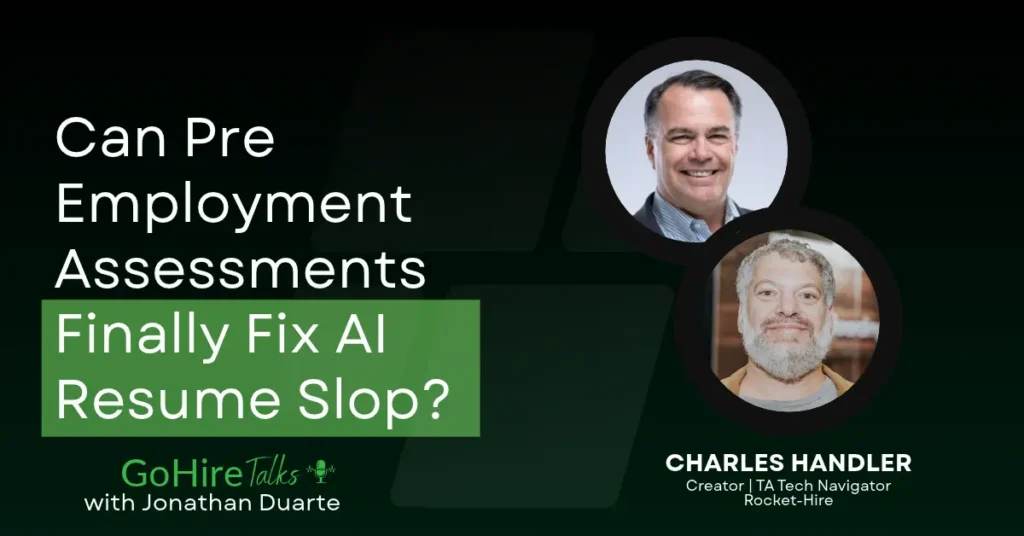
A pre employment assessment, by Dr. Charles Handler's definition, is "any time you look at a signal from an applicant and make a judgment about their suitability." Handler is an industrial-organizational psychologist who has rated more than 500 hiring tech vendors. By his count, about 70-some percent have no scientist behind the scores they sell.
In this episode:
- What Charles wants TA leaders to know
- Why every fit score is an assessment
- Assessment for hiring starts with the job
- Where assessments pay off
- Assessing AI skills instead of banning AI
- 52 card pickup and phantom AI use
- Work sample tests and job simulations
- The compliance rules that haven't changed
- About and contacting Charles
- FAQ
- Full interview transcript
Pre Employment Assessment and AI Resume Slop: What Dr. Charles Handler Wants TA Leaders to Know
Jonathan and Dr. Charles Handler met through ERE more than 20 years ago. Charles runs Rocket-Hire and has spent his career helping enterprise employers choose and audit hiring assessments. Jonathan brought him on GoHire Talks for one reason: AI-written resumes have flooded the apply process, and a lot of TA leaders now believe they need to add friction back in. Jonathan's view going in was that a pre employment assessment is one of the most natural ways to do that, and it doesn't have to be expensive.
Charles started by pointing out how little the core problem has changed since they met.
You still had more applicants than you could evaluate yeah, so things are different, but in some ways, they're the same. And the biggest way is you've still got more noise as a recruiter that you gotta go through. And it's more noise even than ever, but you still need to get good signal from your candidate. That's what it's all about.
Dr. Charles Handler, Founder & President, Rocket-Hire
His worry is that a lot of applicants today aren't really candidates, and every recruiter is overwhelmed. The question for the rest of the episode was how a TA team gets credible signal back when the resume no longer carries much of it.
What Charles brought back from SIOP
Charles had just come back from a Society for Industrial and Organizational Psychology (SIOP) event focused on AI and hiring, where he spoke. The main SIOP conference is, in his words, his Super Bowl: hundreds of peer-reviewed presentations, and he has gone 25 years in a row. His talk drew on the vendor data he has collected, and his read on the hiring tech market was blunt.
I rate them on risk and science and tech and tech doesn't, for hiring, doesn't really give a shit about the science part. They truly don't. And I think there's a lot of, hey, people are just building these systems to flip them and, to get a lot of attention basically but not solving the problem.
Dr. Charles Handler, Founder & President, Rocket-Hire
He admits he's biased toward science. His argument is simple: when you evaluate people against jobs, you need real criteria, "not a Hoovered resume." Otherwise you get poor signal quality.
Every Fit Score Is a Pre Employment Assessment
The biggest takeaway Charles wanted listeners to have is about definitions. Most TA leaders picture a pre employment assessment as a personality test or a long questionnaire that candidates hate. Charles uses a much wider lens.
Assessment is any time you look at a signal from an applicant and make a judgment about their suitability. So anything that makes a fit score, anything that, ranks people and says, "These are good people for you to look at based on what I've seen." And then if you include that, the market gets crazy broad, right?
Dr. Charles Handler, Founder & President, Rocket-Hire
That widens the category to most of the recruiting AI tools TA teams are buying right now. The match score inside your ATS, the ranked shortlist from a sourcing tool and the "top candidates" list from an AI add-on all make a judgment about suitability. By Charles's definition, each one is a pre employment assessment, whether the vendor calls it that or not.
Candidate evaluation tools: the term Charles uses now
Because the category is so broad, Charles has stopped saying "assessments" and now says candidate evaluation tools. Candidate evaluation covers anything that makes a decision or gives you a signal about a person. His problem is with what most of those signals are built on.
There's so many platforms now that have no science, that are just helping you look at match scores, et cetera. What in the hell are they based on? Job descriptions, resumes, the two crappiest things we can't get rid of. Although I have high hopes these days. So you're building a house on sand with that stuff.
Dr. Charles Handler, Founder & President, Rocket-Hire
His conclusion: error rates are going to be high, and most of those scores aren't very explainable. For any scoring tool, explainability matters as much as accuracy, a point Jonathan came back to at the end of the episode.
Inside the TA Tech Navigator
Charles has been writing about assessment since 2001, when ERE was one of the only places to read about recruiting. The question he got most back then was "what's the best assessment?" His answer was always that it depends on what you're trying to do. That led to paid work helping enterprise companies evaluate tools, and a rule he kept for his whole career: stay vendor neutral.
He and Steve Hunt wrote a paper buyer's guide covering 30 vendors. Charles revised it every four or five years: 50 vendors in 2008, 100 in 2012, and more than 200 by COVID, all catalogued by hand. A web developer later built an interactive database that cost him tens of thousands of dollars, and he couldn't repeat the manual work until Claude came along.
Today the TA Tech Navigator covers more than 500 vendors. Charles built the rating system, and Claude did the categorizing with it. Each vendor is rated on the risk it presents based on how it uses AI. Tools that help you create content, research or deliver information through a chatbot sit at the low end. Risk climbs as a tool starts making judgments about people, and it climbs again as the tool gets harder to explain.
And the reality is most, almost all of the vendors out of the 500, it was like 70-some percent don't have any scientist in there, at all. So they're not using, objectively defined, well-measured criteria that relate to some theory or aspect about how someone will do a job.
Dr. Charles Handler, Founder & President, Rocket-Hire
Matt Alder made a related case on an earlier episode about pre-hire assessments moving up the funnel. Charles adds the vendor data behind it: most of what's being sold as screening intelligence has no science underneath.
Assessment for Hiring Starts With Studying the Job
If most tools skip the science, what does the science look like? For Charles, a credible assessment for hiring starts before any test gets written. Someone studies the job, breaks it into the traits and skills that predict success, defines each one and then decides how to measure it. He has studied a lot of jobs, and he admits it's the part people have always hated, because it takes manual work.
What a customer service assessment test should measure
He walked through a customer service role as an example. In personality terms, the person needs empathy, needs to be outgoing and needs to stay resilient when callers yell at them. They have to multitask across several screens and be accurate with data entry. A hiring manager could probably list most of that off the top of their head. The difference is what happens next.
But at the end of the day we break that down, define it, and figure out how are we going to measure this? Yeah. And that way you can have a signal. All we want is signal, credible signal. That's it.
Dr. Charles Handler, Founder & President, Rocket-Hire
A customer service assessment test built that way measures traits someone has already tied to the job. One built on a job description and a resume measures whatever happened to be in those two documents. That gap is the difference Charles keeps pointing to between a scientific pre employment assessment and a match score.
Where Assessments for Hiring Pay Off: Frontline, Call Centers and High Volume
Jonathan asked where companies actually use real assessments today. Charles's answer was high volume and any role with high turnover.
If you can use an assessment and reduce turnover by 5 or even 10%, you're a hero. They're having a parade for you in the call center or something like that, 'cause you're saving. Your ROI is, so much more than what it costs for you to put it in place.
Dr. Charles Handler, Founder & President, Rocket-Hire
That's why the call center assessment test is one of the oldest uses in the field. Charles believes frontline hiring will always be the biggest ground for assessments because the math works at volume. He also sees them in entry-level and technical jobs and in factory work. In a recent benchmarking study he ran for a company in the medical device industry, almost everybody was using assessments.
At the executive level, assessment is common but the volume is low, and the process stays manual because the stakes and the interpersonal side are too high. The middle ground of hiring managers and lower-headcount professional roles is where he sees the least use. White-collar individual contributor roles use them in places, "but not everywhere."
For high-volume teams, the hard part is often the steps around the assessment: getting candidates to start it, finish it and show up afterward. Our recruiting automation guide covers that side, and Paul Norman's episode on high-volume recruiting strategy goes deeper on frontline funnels.
Home health and the fog the mirror test
Jonathan raised home health, where he has talked to employers who hire anyone they can rather than assess. He split them into two groups. Large private equity-backed firms can run a test and see the numbers. Mom-and-pop agencies see an assessment as a cost on top that they can't prove out. Charles pushed back on who carries the bigger risk.
But one bad hire by mom and pop is, can be devastating. One bad hire from a giant company can be absorbed pretty easily, right?
Dr. Charles Handler, Founder & President, Rocket-Hire
He named the real problem: the fog the mirror test. When you don't have enough applicants, you'll hire anybody who can fog a mirror. He has seen it from the family side with home healthcare workers for his parents, and he called it "not an easy job at all." Even then, he argued, an assessment still earns its place. You may hire people who score lower, but you know their weaknesses, how to train them and what to watch for.
He also described the other extreme, which many TA teams live in now: a huge pile of applicants, none of them good enough. If you can get through that tsunami of applicants and find the ones who have the skills, he said, you're far better off.
Get more candidates to finish the pre employment assessment
An assessment only works if candidates complete it. GoHire texts candidates the moment they apply, sends the assessment link, follows up with anyone who stalls, and books interviews for the people your team chooses to move forward. Your recruiters review every result and make every decision.
AI Skills Assessment: Test for It Instead of Calling It Cheating
One SIOP theme Charles loved was the case for an AI skills assessment in professional hiring. He had just read a report on which jobs have the most AI concentration: marketing, professional services, sales and white-collar work in general. If people use AI on the job, he asked, why aren't we assessing it?
You need to be assessing it instead of saying, "Hey, you're cheating using AI." Make it so you can't. Make it so you gotta interact with AI to actually get hired as part of the process. Easier said than done but I really am excited about that.
Dr. Charles Handler, Founder & President, Rocket-Hire
He was clear it matters less for frontline hourly roles. Jonathan pointed to a rubric he'd heard Zapier uses to interview everyone about AI. As Jonathan remembered it, level one is dabbling, level two is using AI in your daily job with outcomes you can prove, level three is building and training models, and level four is working as a machine learning scientist. In Jonathan's understanding, Zapier doesn't hire anyone below a two.
AI makes experts better, not novices into experts
Charles pointed to research by his friend Louis Hickman showing that AI makes experts better. He used his own vendor database as the example.
I know the substance and I'm able to call bullshit on it. I'm able to shape it, but it's doing shit I could never do.
Dr. Charles Handler, Founder & President, Rocket-Hire
The flip side, he said, is that AI won't turn a novice into an expert. Someone without applied experience can get caught up on a subject fast, but they can't judge what the AI gives them. Charles fixed his own dishwasher with Claude, and he jokes that he's now dabbled in a lot of things. Jobs are being broken into the skills AI can't replace and the skills AI enhances, which is what a good AI skills assessment should measure.
52 Card Pickup, Phantom AI Use and Stealth Evaluation
Jonathan brought up the matching tech flooding TA teams. Someone puts OpenAI on the back end, you drop in your job description, it pulls candidates from your ATS and scores them. To Jonathan it's like 52 card pickup: every vendor picks the deck up in a different order, and even the same vendor with a different model returns a different ranking. As he put it, there's no way to explain that from a compliance standpoint. Charles agreed: "No, not at all."
He then described something that came up at the SIOP event: phantom AI use. Recruiters are running candidate searches outside any formal system. Charles tested it himself in Perplexity, asking it to find a senior IO psychologist who could run a global assessment program, with four criteria.
It returned to me a ranked list of people. I knew the top, out of the top 10, I knew eight of them. And I knew those were people that were totally capable of doing this job.
Dr. Charles Handler, Founder & President, Rocket-Hire
Perplexity then offered to write personalized outreach to each one. It worked well for a niche role, though he expects it to get harder the less specialized the job is. He sees the future of assessment heading two ways. One is stealth evaluation, where candidates don't know they're being evaluated, which he hopes gets some science behind it. The other is simulations, the direction he's most bullish on.
Both trends sit squarely in the risk zone of his TA Tech Navigator. If a recruiter's personal AI ranks candidates, nobody may know the ranking exists, let alone how to explain it. Jeff Pole made a related point on GoHire Talks about vetting recruiting AI vendors before you sign, and our guide to AI in recruiting covers how to set ground rules for these tools.
Work Sample Test and Job Simulations: Give Them a Piece of the Job
A work sample test is the oldest kind of pre employment assessment there is, and generative AI just made it far cheaper to build. Charles said that as soon as generative AI arrived, he knew the game changer would be controlled video with measurement built in. A friend recently showed him a platform using 15 different AI models, with the science on the back end. The demo was a police simulation.
Charles said the people looked real, as if someone had videotaped them, and he couldn't tell it was AI. The candidate rolls up to a hostile situation, talks to the person with the problem and makes decisions. Twenty-five to 30 years ago, Charles built police and fire assessments that needed actors, videotape and weeks or months of production.
So to me, that's the- The way to truly get can someone do this job is give them a piece of the damn job and score it.
Dr. Charles Handler, Founder & President, Rocket-Hire
A job simulation assessment for analyst, sales and support roles
The same idea works for desk jobs. For an analyst role, Charles described giving a candidate a data set and an AI to help, asking for a presentation on what they found, and recording all of it. A job simulation assessment like that tests the work itself and the AI skills at the same time.
Jonathan described the version he wants for customer support. Hand a candidate a really angry customer, then a pleasant customer with a hard problem who isn't technical or isn't comfortable in English. Pay them for three days to work through the scenarios on their own time, then make an offer to the people who score 90 or higher.
Charles pointed to sales, where the impact is direct. About 15 years ago he worked on a video game-based sales simulation. The candidate got a briefing, then a customer furious about a security breach, and picked from scored multiple-choice responses. It worked, but it was clunky and took a lot of work to build. He has also seen technology that records what your best salespeople say on live calls, mines it for features and compares new candidates against them. "I hope they did some kind of permission thing," he added.
AI-written knowledge tests
Charles is a fractional chief science officer for an AI assessment company. He trained its AI to write technical knowledge tests from a job description, and says they're "pretty damn good." Experts writing questions together is probably still better, he said, but not by enough to matter at the top of the funnel. One client hiring HVAC technicians had a problem with people overstating their skills and then sandbagging in training. A knowledge test at the right level shows you who isn't at the level they claim.
He credits the models getting better over the year and a half he's been doing this, plus agentic setups where several agents each handle a small part and report back. Jonathan called that an agent swarm. A year and a half ago, Charles said, it wasn't happening.
Pre Employment Assessment Compliance: Three Standards That Haven't Changed
Charles started his career in compliance, and his parting advice was that the rules haven't moved, AI or not.
You need to study the job and make sure everything's only job relevant. You need to measure it consistently with good tools, right? And it needs to be fair. Like- Yeah ... it doesn't matter if it's AI or not. Those are the three standards, and you should have technical document... yeah, documentation from any vendor that can provide that.
Dr. Charles Handler, Founder & President, Rocket-Hire
Those standards go back decades. The federal Uniform Guidelines on Employee Selection Procedures (29 CFR Part 1607) set out the four-fifths rule for spotting adverse impact and tie a procedure's validity to a job analysis. Any pre employment assessment you deploy, including an AI match score, is a selection procedure that has to hold up against them. This is a summary, not legal advice, so check the details with your counsel.
Questions to ask before you buy a pre employment assessment
Jonathan's advice to TA leaders, CHROs and CPOs was to make explainability the litmus test, because the number of laws keeps growing. Ask for a pilot, and ask the vendor to show how your recruiters, who don't understand the tech, could explain each result. If the vendor can't, he wouldn't write the check. Based on what Charles and Jonathan covered, here's what to ask any vendor selling a candidate evaluation tool:
- Is there an IO psychologist or other scientist behind the scoring?
- What job analysis connects each thing you measure to the job?
- Can a recruiter explain any single score to a candidate who asks?
- Do you measure every candidate the same way, every time?
- How do you test for fairness and adverse impact, and can we see the technical documentation?
Deb Paul argued for a similar discipline in her episode on treating every AI agent like your newest hire. Our AI interviews bias study and our post on AI privacy and compliance in HR cover the bias and data side.
Where GoHire stands on human decisions
Charles also told a story about Jonathan. In 2019, he said, every hiring chatbot he tried was "just stupid," and he didn't see much of a future for them beyond collecting resumes. Then the game changed. Jonathan noted that this December marks 10 years since GoHire launched GoBe, which he calls the first conversational chatbot in recruiting.
GoHire's position on assessments matches the three standards. Software never makes the hiring decision. Your team chooses the pre employment assessment, writes the pre-screening questions, sees every result and decides who moves forward.
About & Contacting Dr. Charles Handler
Dr. Charles Handler is the Founder & President of Rocket-Hire and an industrial-organizational psychologist who started his career in hiring compliance. He has written about assessment since 2001, co-wrote a long-running buyer's guide to assessment vendors with Steve Hunt, and built the TA Tech Navigator, a database of more than 500 hiring tech vendors rated on risk and science. He also works as a fractional chief science officer for an AI assessment company and has attended SIOP for 25 years in a row.
People like me are underutilized. Everybody needs to understand the science behind hiring, man.
Dr. Charles Handler, Founder & President, Rocket-Hire
Frequently Asked Questions About Pre Employment Assessments
What is a pre employment assessment? +
Dr. Charles Handler defines it broadly: any time you look at a signal from an applicant and make a judgment about their suitability. That includes personality and skills tests, and it also includes any software that produces a fit score or ranks candidates.
Are AI resume match scores a form of candidate evaluation? +
Yes. Charles calls these candidate evaluation tools. Any tool that ranks people or scores their fit is making an assessment, so it needs the same job relevance, consistency and fairness as a traditional test.
Where do assessments for hiring deliver the most ROI? +
High-volume, high-turnover roles such as call centers and other frontline jobs. Charles says that cutting turnover by 5 to 10 percent with an assessment pays back far more than the assessment costs.
What is a work sample test? +
A work sample test gives candidates a real slice of the job to do and scores how they do it. Generative AI now makes realistic job simulations, including police scenarios and analyst presentations, much cheaper to build.
Should you test candidates' AI skills? +
For professional roles where people use AI on the job, Charles says yes. Instead of treating AI use as cheating, design the process so candidates have to work with AI to get hired. It matters less for frontline hourly roles.
What compliance standards apply to AI hiring assessments? +
The same ones as any selection procedure: study the job so everything measured is job relevant, measure every candidate consistently with good tools, and make sure the results are fair. Ask every vendor for technical documentation that shows all three.
Keep Your Recruiters in Charge of Every Hiring Decision
GoHire texts candidates, sends your assessment links and pre-screening questions, and schedules interviews. Your team sets the criteria and makes every call.
Pre Employment Assessment: The GoHire Talks Interview Transcript with Dr. Charles Handler
Signal, Noise and AI Resume Slop (00:00)
Jonathan Duarte: [00:00:00] Hey, everyone. Great to have you back again. We have a great guest for us today, something I think is extremely relevant. And chances are you probably already know, this is Dr. Charles Handler. And Dr. Charles is a great old friend. I think we probably met in ERE maybe 20 plus years ago.
Charles Handler: Yep.
Jonathan Duarte: Probably one of the best known industrial orga- occupational psychologist in the space or kn- knows that space really well. So I wanted to reach out to Charles because there is so much AI slop as far as candidate resumes as... And the problem I think now, most of us in this, a lot of us in this space, I should say, believe we have to add friction back into the apply process.
And one way to do that naturally, and it doesn't have to be expensive, is through assessments. So welcome, Dr. Charles, and [00:01:00] let's... what have you been up to lately?
Charles Handler: For... It's Charles, please- Oh ... for sure. Especially between us, for goodness sakes. You can call me anything, really. I know, but I gotta present you
Jonathan Duarte: as the...
You have to be the boss anyways.
Charles Handler: Yeah. Yeah. No, for sure. It's an interesting time. I was just thinking when you said we knew each other 20 years ago, I was like, boy, were times different back then. But actually they weren't in a lot of ways because you still had more applicants than you could evaluate yeah, so things are different, but in some ways, they're the same.
And the biggest way is you've still got more noise as a recruiter that you gotta go through. And it's more noise even a- than ever, but you still need to get good signal from your candidate. That's what it's all about. So how do we do that in this day and age when a lot of candidates aren't even candidates, and everybody's overwhelmed and, we're all concerned about what AI's doing,
SIOP, AI in Hiring and the Science Gap (01:45)
Jonathan Duarte: yeah. What, what have... you just came back from the... Is the Society of Industrial Occupational [00:02:00] Psychology?
Charles Handler: Organizational.
Jonathan Duarte: Organizational.
Charles Handler: Yeah,
Jonathan Duarte: organizational. Yeah. Tell us about the group. Tell us about what an organizational...
what these guys do or, these individuals do, and then what's their impact, do you think? What did you come out of the conference with?
Charles Handler: Yeah. So it's Soci- Society for Industrial Organizational Psychology. We have a lot going on. Our annual conference is, hundreds of peer reviewed presentations, a lot of very business focused, but some academic focus too, and that's my Super Bowl, I go onto that 25 years in a row. And they have, splinter events that are very focused. So I just went to one on AI and hiring. I spoke at it- ... actually, which was awesome.
Jonathan Duarte: Yeah.
Charles Handler: And a lot of different perspectives, a lot of technical stuff that I don't need to go into. But at the end of the day, and this is what my talk was about based on the data I've collected in my, TA Tech Navigator database, like 500 vendors, right?
And I rate them on [00:03:00] risk and science and tech and tech doesn't, for hiring, doesn't really give a shit about the science part. They truly don't. And I think there's a lot of, hey, people are just building these systems to flip them and, to get a lot of attention basically but not solving the problem.
Because... And I'm very biased, but science, when you're evaluating people relative to jobs, you better be evaluating on some kind of real criteria, not a Hoovered resume, you know, or something like that. Yeah. Like poor signal quality. And then we saw a lot about the different ways we're doing that.
One of the other things that I really loved was a lot of folks presenting on the fact that AI skills are now important for jobs.
Jonathan Duarte: Yeah.
Assessing AI Skills and the Zapier Rubric (03:45)
Charles Handler: And why aren't we assessing AI skills for people that are getting hired? Now that is less relevant for [00:04:00] frontline hourly jobs, volume. But any professional type job, I just read a really great report about, what types of jobs- have more AI concentration and it's, it's a lot of marketing, professional services, sales but white collar workers, you're using it on the job, and you need to- you need to be assessing it instead of saying, "Hey, you're cheating using AI." Make it so you can't. Make it so you gotta interact with AI to actually get hired as part of the process. Easier said than done- ... but I really am excited about that. That's an idea that I think is slowly gaining traction.
Jonathan Duarte: Yep. Yeah, I heard, I think it's Zapier. ... And of course, Zapier, for anyone who doesn't know, is I'd say an automation company. It is, yeah. A tool that allows you to connect things. So naturally they're going to be a software minded company about AI and how it all works, and it's professional services and software.
They [00:05:00] built a rubric for interviewing everyone about AI. And I forget the f- the, the four steps, but basically the fourth was you're building AI as a machine learning AI scientist or whatnot. And then third is you can actually build and train models and things. And then the second is you use it in your daily job and have outcomes that you can prove.
And the first is, you're dabbling. And they don't even have a zero spot, 'cause they think everyone's pretty much dabbling, but it's really between that one and two. I don't think they hire anyone unless they're a two. Yeah ... and then they know three and four, there are v- gonna be very few fours, but they're really looking- Yeah
for the two threes.
AI Makes Experts Better (05:45)
Charles Handler: Yeah, and the ex- yeah, the really cool thing that's happening too is people are breaking down job skills and jobs now into the individual skills that can't be replaced by AI, that are enhanced by AI, [00:06:00] that, that helps us understand the human AI connection.
Because really the most powerful thing is using it as a tool, as an expert. And a friend of mine- Yeah ... has done some, Lewis Hickman's done some great research to show that AI makes experts better. Like for instance, building my database, I know the substance and I'm able to call bullshit on it.
I'm able to shape it, but it's doing shit I could never do. And, Yeah ... and at the same time it not gonna make a novice an expert. Yeah. You can't just put somebody in front of AI and say they come out of it going, "I know everything." They don't have applied experience, et cetera. It can certainly get you, caught up on a subject.
I'm an expert in all kind of stuff now. Not an expert- Yeah ... sorry. I've dabbled in a lot of stuff right now, but m- I've fixed a lot. I fixed my dishwasher using, using Claude right there. I did it successfully. Couldn't have done that- Yeah ... before, so anyway.
From a Paper Buyer's Guide to TA Tech Navigator (06:45)
Jonathan Duarte: Absolutely. Let's talk about your TA Tech Navigator tool.
So you've been, working, I think, [00:07:00] was it, is it 20- 10 or so. When did you start with ERE when you were speaking in- Yeah.
Charles Handler: 2001, man. 2001.
Jonathan Duarte: So
Charles Handler: there was- Yeah ... there was no noise. I started writing about assessment. There was no other place to go to read about recruiting. It was beautiful for me, 'cause I got a lot of eyeballs.
Now you're competing with an army of people and bots- ... that are writing content. Yeah. So it was good for me. And I s- the, the number one thing that happened back then is people would ask me, "Hey, what's the best assessment?" And I said it just depends. What are you trying to do?"
And I started getting hired to help people evaluate these tools, and so I decided I'm a vendor neutral guy, I'm not going to work for a vendor. And I started learning about vendors because I was auditioning them for enterprise companies, which is what I've done my whole career. And so I moved that into, hey, I know a lot about these online assessment tools and nobody else does.
I'm gonna write a buyer's [00:08:00] guide, which is a paper book. Steve Hunt, my friend Steve Hunt and I made 20, no, 30 vendors, right? And then by 2000, every four or five years I revised it. So then I had- ... 50 in 2008, and then, 100 in 2012, and then, on and on. Until COVID I did 200 and some, all by hand.
And I had my web designer developer build an interactive database with all the stuff. Cost me tens of thousands of dollars. And I couldn't repeat that manually until Claude came along and helped me do it, and my expertise plus it allowed me to catalog vendors. And it's important for everybody to understand, this is one of the takeaways you need to understand if you're listening to this assessment is more than just give me a personality test, make me answer all these stupid questions that I hate 'cause nobody likes taking tests, right?
Assessment is any time you look at a signal from an applicant and [00:09:00] make a judgment about their suitability. So anything that makes a fit score, anything that, ranks people and says, "These are good people for you to look at based on what I've seen." And then if you include that, the market gets crazy broad, right?
There's so many- Yeah ... platforms now that have no science, that are just helping you look at match scores, et cetera. What in the hell are they based on? Job descriptions, resumes, the two crappiest things we can't get rid of. Although I have high hopes these days. So you're building a house on sand with that stuff.
And so the error rates are gonna be really high and there's just who knows what the hell's going on. It's not very explainable, which is important. So anything that's making a decision or giving you some kind of signal is an assessment, so I call it candidate evaluation tools now.
And so I categorized these 500 and some vendors, or Claude did using my system, on the risk level they present based [00:10:00] on how AI is used. And it's interesting, it maps a little onto what you were saying before about the levels. So I have, AI that helps you create stuff and research stuff, and even deliver stuff through a chatbot.
That's pretty harmless. Once you move over the spectrum to starting to make decisions about people, the risk from AI goes up and up. And the less explainable it is, the more risk goes up and up. I wanted to catalog that and I wanted to see where science, like what I do, fits into the equation.
And the reality is most, almost all of the vendors out of the 500, it was like 70-some percent don't have any scientist in there, ... at all. So they're not using, objectively defined, well-measured criteria that relate to some theory or aspect about s- how someone will do a job. I mean- that's what you have to do. So the signal's not so good, and the risk goes way up because you have [00:11:00] y- the, the science part of it, and- I may be rambling here, but it's always been something people have hated, 'cause it typically takes some manual work to go study a job. That's another thing I've done is study a lot of jobs.
Yeah. And then you break that job down into it's a customer service job. Okay, personality-wise, you got to have empathy, you've got to be outgoing, you got to be resilient when people yell at you, that kind of stuff. You got to be able to multitask, 'cause you're looking at a bunch of screens.
You got to be accurate with your data entry. Y- you could probably, their leaders could probably say that, but at the end of the day we break that down, define it, and figure out how are we going to measure this? Yeah. And that way you can have a signal. All we want is signal, credible signal. That's it.
Where Companies Use Candidate Evaluation Tools (11:30)
Jonathan Duarte: Yeah. Does... Where, what areas have you seen, a, the hiring spectrum's all over from, CEOs where, of course you're going to go through a battery of, you know- Yeah ... any senior leader- leadership, they're going to go through tons of different assessments. And then you're going to have [00:12:00] frontline workers, as you mentioned, customer support.
And then you're going to have, warehouse workers. Yeah. What areas do most companies use real assessments or let's call them what was your term now? You-
Charles Handler: It's candidate evaluation tools.
Jonathan Duarte: Candidate evaluations. Where are people or historically where have companies used them, as far as the-
Charles Handler: Right
Jonathan Duarte: The breadth? And where do you think it's going?
Charles Handler: Yeah. High volume, any role with high turnover, right? High... I- if you can use an assessment and reduce turnover by 5 or even 10%, you're a hero. They're having a parade for you in the call center or something like that, 'cause you're saving. Your ROI is, so much more than what it costs for you to put it in place.
Jonathan Duarte: Yep.
Charles Handler: So frontline stuff like that will always be I believe the biggest ground for the stuff. It just makes sense at volume.
Jonathan Duarte: And do... And let me ask you about that.
Charles Handler: Yeah.
Jonathan Duarte: Do a lot of companies use [00:13:00] it in frontline or are there just other areas? Like customer service I think is one of the biggest ones.
Yeah. But are there other areas, like even in nursing, it's still frontline, but it's professional.
Charles Handler: Yeah ...
Jonathan Duarte: but I almost think that's almost more of a click, will they work with the team?
Charles Handler: Yeah. That's part of it. It all depends on what you value. Yeah. In, as a client or a user, what do you value most and, like, how do we measure that?
And team is definitely a big piece of it. Most jobs do want you to be good at teamwork and, open to that kind of stuff. Entry-level jobs, technical jobs, working in factories, things like that very common in industry. Super common. I just did a benchmarking study and for someone in, the medical device industry and, like almost everybody is using assessments.
At the executive level, you're right. The, the decisions are so high stakes. That's a manual process that AI is not really gonna take over. There's just, too much at stake. The interpersonal part of it is so [00:14:00] important. So that's an area where you find it a lot, but the volume is very low. I would say the middle ground of hiring managers with lower headcount, they have more experience in jobs that you can evaluate.
That's probably where you see less once you move off a frontline manager kind of
Jonathan Duarte: thing.
Charles Handler: Doesn't mean it doesn't exist. And and white-collar jobs you do see it, the individual contributor white j- collar jobs. You do see it, but not everywhere. Not
Jonathan Duarte: everywhere. Yeah. I was wondering because, we look...
I've talked to home health companies.
Charles Handler: Yeah.
Jonathan Duarte: And they are s- in such a, a, a bad spot where they're hiring anyone they can- Yeah ... rather than assessing.
Charles Handler: Yeah.
Jonathan Duarte: And I'm, and my mind is maybe the retention would be better if you hire the right people. But there's two groups in these frontline home health and different roles.
You've got the private [00:15:00] equity lar- very large firms.
Charles Handler: Yep.
Jonathan Duarte: And then you've got mom and pops, and the mom and pops, their cost of, u- it's really a, a cost on top, and they can't prove it out. They're not-
Charles Handler: Yeah ...
Jonathan Duarte: private equity can just say, "Yep, we can see it. Here's the number. Run a test."
Charles Handler: Yeah.
Jonathan Duarte: Well- Mom and pop are not gonna throw that out right away.
One Bad Hire and the Fog the Mirror Test (15:15)
Charles Handler: Yeah. But one bad hire by mom and pop is, can be devastating. One bad hire from a giant company can be absorbed pretty easily, right? Yeah. So that part's important to do. But- The, and that, so here's the crux of what I think you're, is behind what you're saying too-
Jonathan Duarte: Yeah ...
Charles Handler: is we call it the fog the mirror test, right?
You're gonna hire anybody that can fog a mirror. That typically is when you don't have enough applicants, right?
Jonathan Duarte: Yeah.
Charles Handler: So it's hard to get people in these frontline home healthcare workers. I've experienced it with my parents. It's not an easy job at all.
Jonathan Duarte: Oh, yeah.
Charles Handler: Yeah.
And [00:16:00] so you end up getting situation where you just need people in there and, you're hoping that you're making good choices just based on your process 'cause you don't want to eliminate people. That's a very difficult position to be in with assessments, right?
Jonathan Duarte: Yeah. Yeah.
Charles Handler: But at least you can do something even if you, even if y- you use it and you're still hiring people that don't do as well, at least you have some i- information on what their weaknesses might be or how you might need to train them or evolve them some or what to watch out for kind of stuff.
But that's the hardest thing. And you, you- I think nowadays it's... And it's always been all over the place, man. You hear a lot of people saying, "We get 8 million." The combo is we get a sh- ton of applicants. None of them are good enough, so we're still lacking people with the real skills we need.
So it's a double whammy there in some sense. And I guess if you're able to go through that, tsunami [00:17:00] of applicants and identify the ones that do have the skills, in that scenario you're way better off. In the scenario of not enough people I don't know, humanoid robots are already replacing home health workers.
It's like, we talk about AI, but don't get me started on humanoid robots, 'cause that's- Yeah ... that's the next thing that's happening, and those will take jobs, I think. But I also don't know that people are losing a lot of jobs to AI. I think it's a lot of hype. I think a lot of people are being expected to use it in their jobs, and most people are open to it, i- yeah. Look, I'm way better, man. I can get twice as much done, and I don't feel like I'm working as hard when I... My, my friend who's a, a entrepreneur I really trust his take on things. He was like, "I think AI just makes people lazy." Every time I have Claude write a email for me or something, I'm like, "Am I being lazy here?"
And I don't think so. I don't want to do that. I'm saving my brain for the good stuff.
52 Card Pickup and Phantom AI Use (17:45)
Jonathan Duarte: Yeah. Yeah. So on, W- and where do [00:18:00] you think assessment's g- going or, these evaluations is- Yeah ... because w- go back to what we talked about in the green room too, I think. Companies are getting inundated with these matching tech that- Yeah
as you mentioned, most of which is not scientifically based. Maybe somebody has OpenAI on the back end of drop your job description in here. We'll look at, we'll call your ATS, match these candidates, and score them to some level. And it's just, to me, it just seems like it's 52 card pickup, which-
Charles Handler: Yeah
Jonathan Duarte: there's no... It's just everyone comes back with a different order. You could use the exact, you could use the same OpenAI, use a different model, and it comes back different. So there's no way to explain that from a compliance standpoint.
Charles Handler: Yeah. Yeah. No, not at all. I mean- It's a couple of different questions in one.
We, one of the things that we see a lot is what they call, at actually this conference I [00:19:00] went to, phantom AI use. So-
...
Charles Handler: If I'm a recruiter, I might not have a formal system for any of that. But me personally, I've gone into Perplexity and said just testing it out, said, "I need to find a senior level IO psychologist with experience, can run a global assessment program."
It returned to me and I said, "Here's my criteria," like four criteria. It returned to me a ranked list of people. I knew the top, out of the top 10, I knew eight of them. And I knew those were people that were totally capable of doing this job. Yeah. Then it said, "Hey, you want me to write a personalized outre- outreach to each one of them to to let them know about our opening and why it's so great?"
So there you go. There's recruiting that's happening just by somebody, going outside a system. And it actually worked pretty well. Now, I think if the the less esoteric the job is the harder it's gonna be for this thing. But in that sense- ... it works pretty well. But what I think the future is two directions.
One is just the stealth evaluation where [00:20:00] can... If somebody doesn't even know they're truly being evaluated.
Jonathan Duarte: Yeah. Yep.
Simulations: A Slice of the Job (20:00)
Charles Handler: And that's happening now, just like I just talked about. Hopefully we can get some science behind how that works. But what I'm bullish and most excited about is simulations. Being able to give someone a slice of the job to do and evaluating that.
And I've said as soon as generative AI came out, I was like, "As soon as someone can make this, make controlled videos with this thing where there's measurement built in, we've got a game changer." And a friend of mine just showed me the tech he built. It's got 15 different AIs, models for different things.
He can put the science in the back end, and then he was showing me a police simulation. It's like you're... It looks like real people, like you videotaped it. I could not have told it was any kind of AI. And you roll up into a hostile situation, you're talking to the person with the problem, you're making decisions.
I, I used to do police, fire stuff 25, 30 years ago, and we had to make videotapes and get [00:21:00] actors and, it was a production. It took weeks and months. So we can simulate almost any job now and throw in there, like for some kind of an analyst job, you can give them a data set and say, "Hey, re- review this data set.
Even here's an AI to help you do it. Give a presentation on what you just found," and record all that and have it be interact. So to me, that's the- The way to truly get can someone do this job is give them a piece of the damn job and score it, so-
Sales Simulations and AI-Built Knowledge Tests (21:15)
Jonathan Duarte: That's really interesting because I saw at Transform now 18 months ago, I think, one of the first sales simulation programs.
Yeah. And there was like three vendors all at the same time. Yeah. And they all launched it at Transform, which was like the- Yeah ... weirdest place to do it. Yeah, I know. I've
Charles Handler: been to
Jonathan Duarte: that as well. Yeah, 'cause like HR directly is not buying that. That's definitely a TA thing. Yeah. Or a sales team, right?
And so now there's a bunch of them. But to me it's, as a entrepreneur, if I could just say, or as a chief [00:22:00] revenue officer or imagine this from a customer support perspective and say, "We're gonna give you..." Let's do it in the support role side. Here is a really pissed off customer. Yeah.
Here is a really pleasant customer but a very difficult problem, and sh- he or she is maybe not great with English or something- ... or not technical, and go through these scenarios and just say, "Look, we'll pay you three days. I want you to take these tests, come back, and you can do it on your weekend, you can do it at night, but we're willing to pay you, and if you get a score 90 we'll hire you
Charles Handler: Yeah.
I think that is- makes a lot of sense. So for sales, there's such a direct impact, and actually, like 15 years ago maybe, I was on a team who built a video game-based sales simulation. And it was pretty cool. So you'd go into an office and it'd be like you'd have a [00:23:00] briefing, like, "Here's the guy you're selling to, here's the problem."
And the guy would be like, "We had a security breach with your software. What the hell are you gonna do about it?" And then you had, at that point, multiple choice responses that were scored. Like-
Jonathan Duarte: Yep ...
Charles Handler: give him a free month. Tell him you're, tell him that's what happens on the job. Stuff like that.
Yep. And then the person would react accordingly and, you would get scored on everything, but it was clunky. It took a lot of work, and it wasn't- To build, yeah ... very flexible. Yep.
Jonathan Duarte: So
Charles Handler: it only makes sense. And I actually came across a technology, can't even remember the name, where you ride along with salespeople and you record what your best salespeople are doing from a dialogue standpoint.
And then you mine that for, features basically, and then you compare people who are being hired against their ability to show those features, right? Yep. So that's pretty cool. You're collecting live, real data from real sales calls. I hope they did some kind of permission thing on them-
Jonathan Duarte: Oh, yeah
Charles Handler: first. They're recording. There's a lot of [00:24:00] opportunity like that now, and people are getting very creative. In my field- Yeah ... we were a little afraid of AI at first, as you should be cautious, but it's getting better and better, faster and faster. And the things we can do, the complex orchestration of things...
I'm chief science officer, fractional for, an AI assessment company, and we build assessments just on a job description, basically v- using AI, and I've trained the AI to write technical knowledge tests. They're pretty damn good. I mean- Yeah ... the old way is you get a bunch of experts together.
You work with them. You get them to develop the questions and answers. Is that superior to what we're doing? Probably, but- Not enough that it's gonna make a difference, especially at the top end of the funnel if you're just seeing if someone's- Yeah ... full of shit or not,
Jonathan Duarte: right? Yeah.
Charles Handler: I'm an HVAC technician.
I did one for HVAC technicians a while ago. They had a problem with people overstating their abilities. Sure. Getting in there and [00:25:00] then sandbagging training, right? So if you put an assessment that's a certain ability level and people fail it, then you know they're probably not at the level they say they are.
So that kind of stuff is really valuable. And that, that is changing the game now too because these models in the year and a half I've been doing it have gotten so much better. I like to think it's my prompting that makes it better, but it's probably a combo of the, the prompting and the model skills.
And now agentically having a harness of, like, all these agents that are doing small parts of it, so the- ... coming back to the master there and giving them the information. And that wasn't happening a year and a half ago,
Jonathan Duarte: yeah. Yeah. And now you can... with- this is one people don't know, but if you will call it an agent swarm, you can figure out w- every person or every agent's doing a specific task.
Yeah. And you may call that agent for this type of role or not- Yeah ... instead of one, 'cause we're all trying to build them all as once and they just go haywire.
Chatbots Then and Now (26:00)
Charles Handler: Yeah. [00:26:00] Yeah. I wanna tell a quick story about you. I think this might be a good thing. So back- ... 2019 you were talking to chatbots a lot.
Jonathan Duarte: Yep.
Charles Handler: And we talked about it, and every chatbot I tried for job was just stupid. I mean- Yeah ... you couldn't... It was trying to screen you, and it did a horrible job, and it's probably a bad candidate experience. And I felt like there's not really a lot of life for chatbots in hiring besides, send your resume to Sam at this email or something.
But it, look at how the game's changed. It's incredible. So you were you were ahead of your time a little bit at that point. And- The, the chains are off, the shackles are off now. It's... And I don't even think you've got... Remember that we heard so much about hallucinations and errors and- people, chatbots booking you or selling you cars for a dollar and stuff like... I don't think that happens anymore. It can happen, but the weird results and stuff, when's the last time you got just a [00:27:00] straight up hallucination from one of these things?
Jonathan Duarte: No, like ours and that's interesting too because we'll announce it in Dec- You won't believe this.
In December, it'll be 10 years since we launched Goby, the first conversational chatbot in recruiting.
10 years ago. Yeah. And everyone was like, "Oh yeah, we have this chatbot thing." I'm like, great."
Charles Handler: Yeah.
Jonathan Duarte: Brand new.
Charles Handler: Yeah, exactly.
Jonathan Duarte: Nice.
Charles Handler: You should have invented that generative AI behind it and not given it to anybody else, and then you-
Jonathan Duarte: Yeah
Charles Handler: would really have a lockdown on everything. We-
Jonathan Duarte: Yeah ... you've been talking
Charles Handler: about this from your jet, man.
Jonathan Duarte: I'd be texting it in.
Charles Handler: Yeah, things like
Jonathan Duarte: that.
Charles Handler: Yeah, it's- Yeah, so it's a new world. It's exciting,
The Compliance Rules That Haven't Changed (27:30)
Jonathan Duarte: yep. Great. Thanks for being on. We'll, I'll put your link to the TA Tech Navigator, Cool
In the show notes too-
Charles Handler: Thanks ...
Jonathan Duarte: for everyone, because it's a great opportunity to just see what's out there. And obviously you'll be able to reach out to Charles. We'll have his contact and LinkedIn there. But as you start finding vendors people listening, if you start finding vendors and you're trying [00:28:00] to figure out like, "Hey, is this thing just doing 50 card...
52 card pickup, or is this something that I could I'm gonna be able to pass a compliance test against?"
Charles Handler: Yeah ...
Jonathan Duarte: Charles is the guy to check out, and you can start with his TA Tech Navigator with that.
Charles Handler: Cool. Thanks for having me. Are you, And then we can be in the edit zone. Are you ha- I'm sure you're gonna be at HR Tech, huh?
Jonathan Duarte: Nope, not this year. What? I'm gonna be out in London. Oh. This is gonna be the first year I'm, Even better.
Charles Handler: I love London ...
Jonathan Duarte: we're planning I'm planning on a, a global expansion, so this is the- Oh, nice ... kind of kickoff process. Yeah.
Charles Handler: Oh, wow. You never stop, man. That's awesome.
Jonathan Duarte: Oh, it, I... I'll stop at 6 feet under.
Charles Handler: Yeah. And again, any- anytime I can help you out, man, and vice versa, let me know, 'cause,
Jonathan Duarte: Yep ...
Charles Handler: people like me are underutilized. Everybody needs to understand the science behind hiring, man.
Jonathan Duarte: Yeah. I think today, f- for TA and CHROs and CPOs that are listening, the compliance is getting so complicated the [00:29:00] number- Yeah
of laws. And the one thing, as Charles has said, you... it has to be explainable. Yeah. And if you can... If you can pass that litmus test, you're okay. Yep. And if you ask- Yeah ... your vendor- ... I want to do a pilot, and I want to see how you can define this so my recruiters who don't understand your tech can say, 'This is how it was explained'"- Yeah
if they can't do that, then I wouldn't write the check.
Charles Handler: Yeah. And I started my career in compliance, and so I'm an expert in all the laws and stuff, and it is crazy. But I'll tell you, good parting shot or whatever that the rules for le- compliance and stuff, they have not changed.
It doesn't matter if it's AI or not. You need to study the job and make sure everything's only job relevant. You need to measure it consistently with good tools, right? And it needs to be fair. Like- Yeah ... it doesn't matter if it's AI or not. Those are the three standards, and you should have technical document...
yeah, documentation from any vendor that can provide that.
Jonathan Duarte: [00:30:00] Yep. Awesome. Thanks so much. Sure. I'm sure this will get a lot of views.
Thanks for spending your time here with GoHire Talks and listening to our guests. My intention has always been to create incredible content to help you in your career in recruiting, marketing, business, and leadership. We appreciate all of the insights and feedback you provide. If you've got guests you'd like us to have on the show, please let us know.
Again, thank you for all your support
