
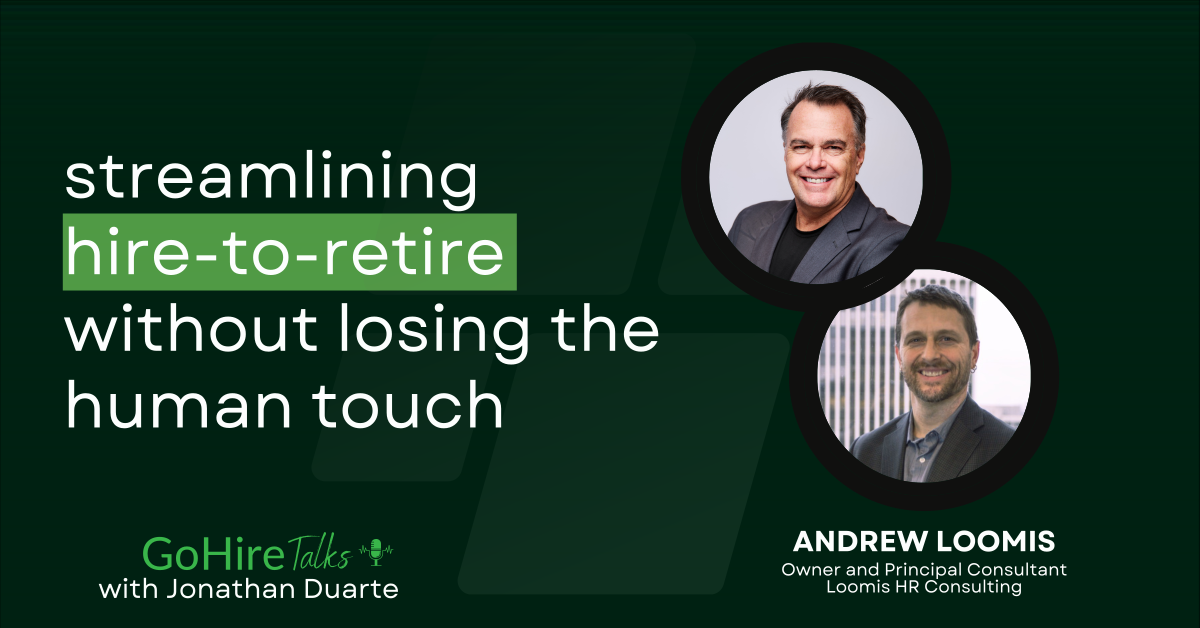
In this episode of GoHire Talks, I had the pleasure of interviewing Andrew Loomis, a veteran HR consultant for small businesses and founder of Loomis HR Consulting. With over 20 years of experience spanning manufacturing, healthcare, and service industries, Andrew has a clear-eyed view of what works in HR — and what doesn’t.
We dove deep into how AI is reshaping the hire-to-retire process, where companies can win with smarter integrations, and how leaders can preserve the human in Human Resources, even in an automated world. For founders, CHROs, or ops teams at growing companies, Andrew’s insights offer a masterclass in what modern fractional HR and outsourced HR support can deliver.

Key Insights from the Interview
- AI should improve workflows, not remove human interaction.
HR processes — especially in leave management and onboarding — are ripe for AI optimization, but employees still want real conversations when it counts. - Turnover ≠ retention.
Many leadership teams confuse the two. Turnover is a lagging metric. Retention is where your strategy lives — and it’s measurable. - Fractional HR is a force multiplier for small businesses.
You don’t need a full-time HR team to get strategic HR insights. You need the right consultant who knows how to plug in and scale. - System integrations fail when frontline needs aren’t factored in.
Andrew’s rule: if the people using the system aren’t involved in vendor selection and implementation, you’re headed for a problem. - Culture drives reputation — up or down.
A poor experience for mid-level managers or team leads will rot your internal brand faster than you think, even if the frontline is happy.
From Hire to Retire: Why You Need an HR Consultant for Small Business Scale-Ups
For small businesses trying to grow, the people piece often gets treated like a compliance afterthought. Andrew makes the case that HR should be your secret weapon — not just a cost center.
“You’re spending most of your revenue on your personnel,” he says. “But you don’t focus on it — because it’s just people.”
The problem? That mindset tanks growth. From labor laws that apply once you hit 20+ headcount to the systems you’ll need to avoid burnout, having the right HR consultant for small business success can be a game changer.
What Fractional HR Support Actually Looks Like (and Why It Works)
Most SMB leaders think they need a full HR team to unlock strategic value. Not true.
Andrew describes how his fractional HR work helps companies bridge the gap — offering support in:
- Leadership development
- Employee relations
- HR systems and compliance
- Labor relations and union negotiation
Instead of doing it all in-house, companies get experienced HR leadership development consulting without the overhead. It’s cost-effective and far more agile.
Tech Is Only Half the Answer: HR Strategy for Growing Companies
AI won’t solve HR dysfunction alone. Andrew shares that most failed system integrations happen because HR leaders don’t ask enough questions early on.
“The vendor says it works. The tech team says it works. But the people using it say, ‘Wait — I thought it was going to do this,’” Andrew explains.
The solution? Slow down early to speed up later. Include everyone impacted — from payroll to operations to line managers — and get clear on workflows before the demo.
This is what real HR strategy for growing companies looks like. It’s not sexy, but it works.
Automation Meets Empathy: Finding the Right AI Balance
Andrew uses a powerful metaphor: self-checkout lanes. They’re efficient, sure. But many people still wait in line for a cashier — because they want a human touch.
That’s where HR is heading. AI will make systems smarter and more connected, but the demand for human support — especially during sensitive moments like leaves of absence — will only increase.
Companies that balance high-tech with high-touch will win.
About the Guest
A big thanks to Andrew Loomis, a trusted HR consultant for small business leaders and the founder of Loomis HR Consulting. Andrew’s expertise spans everything from outsourced HR support and systems integration to conflict resolution and labor negotiations.
 Connect with Andrew on LinkedIn
 Visit Loomis HR Consulting
Full Episode Transcript:
[00:00:04] Jonathan Duarte: Hey, welcome everyone. Today I’ve got a special guest, 20 year expert in HR, a CHRO and a consultant in HR who has served in healthcare manufacturing service industries. I wanted to welcome Andrew Loomis to the show lots of things to talk about, labor relations, strategy, organization design, conflict resolution, and of course, the topic of the day AI.
[00:00:27] Jonathan Duarte: So welcome Andrew.
[00:00:29] Andrew Loomis: Thank you for having me, Jonathan.
[00:00:30] Jonathan Duarte: So why don’t you give a quick intro about yourself and how you got into HR, and, what fascinates you about HR today?
[00:00:40] Andrew Loomis: So I got into HR a little bit by luck.
[00:00:42] Andrew Loomis: I’d come out of college and was working some dead end jobs, starting a family. Got hit by a layoff, something people are experiencing right now. But I was young and ambitious and decided, okay, I gotta do something, longer term.
[00:00:55] Andrew Loomis: Found a temporary opening at a little company in my area. Got [00:01:00] hired in this temp job and did a good job for them. These administrative functions. Boss told me, Hey, I don’t have anything full-time, but this labor relations director next door, does, you should talk to him. So I did.
[00:01:13] Andrew Loomis: I talked to him and pestered him almost daily until he finally got frustrated and said, Hey, listen, if you can make it till July, I’ll give you the job, and that was the beginnings of it. To answer the second part of your question, what I think is interesting about HR right now is what’s always been true about HR.
[00:01:32] Andrew Loomis: There’s never a dull moment. There’s always something going on, something changing, whether you’re thinking about employee relations and employee conflict, labor relations, changing the NLRB or the big topic now which is AI and what’s that gonna do for the world.
[00:01:47] Andrew Loomis: So it’s just never ending supply of something interesting, something to think about, some new challenge.
[00:01:53] Jonathan Duarte: Knowing that you’re consulting now, what kind of projects are you working on if someone were to say, Hey, why would I [00:02:00] hire Andrew to help out in HR?
[00:02:02] Jonathan Duarte: What are the biggest areas of your experience that you’ve been helping clients with?
[00:02:07] Andrew Loomis: Most of my clients are looking at growth which is an interesting time to try and grow, given the political environment we’re in, the mass layoffs that we’ve seen, the demands to return to work or return to the office.
[00:02:19] Andrew Loomis: In the midst. All those challenges. You have small businesses all over the place that they’re still ambitious, still trying to grow, expand from their markets. But they’re not big enough to have a full scale HR team.
[00:02:32] Andrew Loomis: These are entrepreneurial people, so they’re looking for other experts to give them quality advice.
[00:02:38] Andrew Loomis: And as an HR consultant, that advice can’t just be about HR. You have to talk to them about how does HR make your business better? What does it do to either keep you out of risk areas? Keep you in compliance with the new laws that now apply to you. ’cause you went from 10 to 20 employees or 20 to a hundred.
[00:02:58] Jonathan Duarte: Yep.
[00:02:58] Andrew Loomis: As well as what are [00:03:00] the other business implications for doing this or not doing this in the employment sector. If you can provide that sort of guidance, help people understand, I’m not gonna tell you what to do, I’m gonna tell you how to get things done. So that you can actually focus on your goals, grow your business, increase your client load,
[00:03:18] Jonathan Duarte: yeah I love that strategy side of it because, there’s still so many CEOs and operations teams that don’t look at their HR team as a strategic tool. It’s. Always been more of a tactical, Hey, we need to get this thing done, so we don’t get sued and payroll gets run.
[00:03:38] Jonathan Duarte: But as a small business owner, understanding the people function is probably one of the most important parts of growing a business.
[00:03:47] Andrew Loomis: Yeah. And I think that cliche thing that we all throw out there to these business leaders is, listen, you’re spending most of your revenue on your personnel.
[00:03:58] Andrew Loomis: It’s almost always your [00:04:00] highest cost output, but you don’t focus on it because it’s just people. And if you shift your focus and start thinking about it more strategically then you’re gonna get more for those dollars you are spending. And then there’s the personnel side of it.
[00:04:14] Andrew Loomis: You spend more focused time on the people. The people will notice it too. And then you’re gonna develop this reputation as the place to go work. Yeah, it’s a small company. The pays not as great as, working for, the giant conglomerate, but you know what, they treat people right.
[00:04:32] Andrew Loomis: And so you get those kinds of balances it can be really fun.
[00:04:36] Jonathan Duarte: Yep.
[00:04:36] Andrew Loomis: Fun to help those leaders.
[00:04:37] Jonathan Duarte: Have you worked for other companies where you had, and obviously don’t wanna talk about names, but where you had bad employer brand names and you had to shift out of that?
[00:04:46] Andrew Loomis: Absolutely.
[00:04:47] Andrew Loomis: I’ve had success in some of those instances and, I’ve had my failures in some of those instances. It was with a company that had this reputation of being brutal to their mid-level [00:05:00] managers and incredibly generous to their frontline employees,
[00:05:04] Jonathan Duarte: Uhhuh.
[00:05:04] Andrew Loomis: And so they constantly getting new people wanting to work there, brand new, outta.
[00:05:10] Andrew Loomis: Trade school, high school or college. But they couldn’t keep ’em.
[00:05:13] Jonathan Duarte: Yep.
[00:05:14] Andrew Loomis: So this great industry leader in their sector, great reputation with entry level folks, but as soon as you got to team lead, supervisor, manager. It was just horrible. It was like watching a marathon that you couldn’t participate in.
[00:05:29] Andrew Loomis: People were just running away from you.
[00:05:31] Jonathan Duarte: Yeah. Or there was always, there were just, they, everyone would fail at, mile 25. They’ve just dropped.
[00:05:38] Andrew Loomis: Yeah.
[00:05:38] Jonathan Duarte: And you’re like,
[00:05:38] Andrew Loomis: yeah,
[00:05:39] Jonathan Duarte: Wait. You’re there. You could walk and they’re like,
[00:05:42] Andrew Loomis: no. Exactly.
[00:05:42] Jonathan Duarte: Desire.
[00:05:43] Andrew Loomis: The culture and the people focus was a big attractor. The challenge that organization had is there were so many people primed to enter the upper levels of either their individual contributor roles or their management roles that they just didn’t have space for everybody.
[00:05:59] Jonathan Duarte: Yeah.
[00:05:59] Andrew Loomis: [00:06:00] So they ended up having to adopt the philosophy of you’ve gotta support your folks even if they leave.
[00:06:07] Jonathan Duarte: Yeah,
[00:06:07] Andrew Loomis: because eventually what we found in that experience is they might go away as a frontline supervisor and come back to you as a director.
[00:06:15] Jonathan Duarte: I’ve seen that and talked to so many VPs of TA where if the culture’s right, the boomerang opportunities are almost endless.
[00:06:24] Andrew Loomis: Absolutely.
[00:06:25] Jonathan Duarte: Yeah. And it’s hard to put these in numbers, ‘ how do you tell the CIO or the CFO. That we’re gonna be able to drop our churn and decrease our marketing expenses in the future for recruiting because we did these things that were good for the employee that costs money today.
[00:06:45] Andrew Loomis: Yeah. I mean it’s getting that whole C-suite to understand the difference between turnover and retention. A lot of our leaders are non-HR leaders. Think of those as the same number. It’s the same metric. And it’s no, one sort of a leading [00:07:00] metric and one is a lagging metric.
[00:07:01] Andrew Loomis: Your turnover, you’ve already lost the game at that point, but your retention, you’re doing something right. So if your retention’s high, what is that doing for your organization? How is that benefiting your bottom line?
[00:07:12] Jonathan Duarte: Did you, because we had mentioned, frontline versus managerial levels in that company.
[00:07:18] Jonathan Duarte: Were you guys watching the retention on the frontline versus managerial? Was that like a KPI? ‘Cause I know there’s so many numbers you’re gonna try to track and it’s hard to get good numbers anywhere in HR in a lot of cases,
[00:07:31] Andrew Loomis: In that organization they were tracking.
[00:07:34] Andrew Loomis: Turnover, but they weren’t tracking retention.
[00:07:37] Andrew Loomis: They had very low turnover, very good retention, in that entry level role. At, but then once they got into, like I said, that team leader and supervisor area, they weren’t paying attention to it they thought, this is a manufacturing environment and everything churned on the manufacturing floor. Yeah. It’s okay, but you’re ignoring this critical linchpin role that’s also on the manufacturing floor.
[00:07:59] Jonathan Duarte: You had some [00:08:00] thoughts I wanted you to share about, the difference from your opinion, what AI is going to, cause impacts on HR. So share your thoughts on that.
[00:08:10] Andrew Loomis: I like. The AI revolution that we’re in right now. But I think we’re still at the early stages. There’s a lot more excitement than traction.
[00:08:18] Andrew Loomis: But the opportunity is there. HR is full of processes and systems. Sometimes they don’t talk to each other. Sometimes they overlap. It takes so much effort on the part of your HR team to make all those processes and systems work. And I think AI is gonna really streamline that.
[00:08:37] Andrew Loomis: Automation’s not quite the right word ’cause it’s not just making the process automatic, it’s making the process flow. From the beginning steps of hiring somebody all the way through their retirement and all the various things and the state systems and your tracking system and your HRIS that sometimes work together, but not always.
[00:08:57] Andrew Loomis: I think a lot of that’s gonna smooth out, and as that becomes [00:09:00] more automated, it’s also gonna, increase the demand from employees to talk to a person. The system’s . Gonna flow, and the employees are gonna want to know what happened? Why this? When do I get that?
[00:09:16] Andrew Loomis: And when we were in agreement, we talked about, this analogy came to me, it’s think about going to the grocery store and every time you’re in the grocery store that automatic checkout lane the no teller checkout lane, it’s fast, it’s easy, and there’s 20 people waiting in the line for the one checker.
[00:09:33] Andrew Loomis: Because they want that interaction. They want to talk to a person. And there’s something reassuring about that for us as human beings, finding the balance of those two things is gonna be the big challenge for HR teams and businesses in general.
[00:09:46] Jonathan Duarte: Yeah, and I’m a big data guy and I think you laid it out like the hire to retire process is gonna get more, the data is gonna get, better connected. I’m sure you’ve done [00:10:00] numerous of these integrations over the years. The ones that work and the ones that you’re like, what the heck?
[00:10:07] Andrew Loomis: Absolutely. One of the greatest examples of where I think this is gonna play out are things like leaves of absence.
[00:10:13] Andrew Loomis: I live in Oregon State, like I work with folks from all over, but that gives you a sense of where the challenging processes are. Oregon has one of the most challenging leave of absence processes ’cause the complexity and the laws. AI could streamline that, make that so simple. Use your data to not only help people that are in that process, but get predicted for you who’s likely to need this?
[00:10:39] Andrew Loomis: Who’s likely to use this process, who’s likely to not understand it.
[00:10:42] Andrew Loomis: But if you think about it, if you’re the person in the midst of that leave of absence because you have a family member that’s super ill, or you yourself are experiencing healthcare crisis, warm touch.
[00:10:52] Jonathan Duarte: Yep.
[00:10:52] Andrew Loomis: And so all that data streaming and all of that really excellent work has to have that finishing piece. And I think that’s where [00:11:00] the human being steps in and continues to play a role. The businesses, the organizations that can find that balance, utilize and maximize those AI tools.
[00:11:10] Andrew Loomis: And with a really focused HR team, maintain that human touch. Those are gonna be the big winners of the AI revolution, in my opinion.
[00:11:18] Jonathan Duarte: Wow. Yeah. Inter interesting. And in some, gimme a an example, again, for the audience of, learning about some of these, the integration stuff that you’ve had the goods and the bads over your 20 years in this space.
[00:11:33] Jonathan Duarte: Going through multiple integrations, what’s come down to you? Like when a vendor’s calling you or you, you know there’s something that’s broken in the team or an HR processes or across the business and you’re working with a CFO and the CIO or the C-suite.
[00:11:51] Jonathan Duarte: What have you learned about the best process for implementing HR [00:12:00] solutions?
[00:12:00] Andrew Loomis: The best thing to do is make sure you ask a lot of questions from everybody that’s gonna be affected by this thing. So every leader, and at least some of the frontline staff whose data is gonna be filtering through this big internal system.
[00:12:18] Andrew Loomis: Ask them what they think it’s gonna do. Because often what I’ve found is that when you get to implementation stage, it does everything. It says it will do the salespeople, they hype, that’s their job.
[00:12:31] Jonathan Duarte: Yep.
[00:12:32] Andrew Loomis: And then the tech guys come in and make the thing, do what they say it’s going to do.
[00:12:36] Andrew Loomis: And then about half of your team, whether it’s your ops leader or your frontline employee, whatever. Half of that team’s gonna go, I didn’t know that I thought it was gonna do this. Now you’ve gotta figure out why your HRIS system doesn’t also do scheduling for a 24 hour, seven day a week system.
[00:12:55] Jonathan Duarte: Yeah.
[00:12:55] Andrew Loomis: And why your ATS doesn’t just automatically feed information into your payroll [00:13:00] system? ‘Cause we didn’t have a patch. ‘Cause that’s what it can do that. But you didn’t ask about that. Because you didn’t ask as the CHRO, you didn’t ask payroll to tell you. What do they like, what do they don’t like?
[00:13:13] Andrew Loomis: What works, what doesn’t work? I think the best process is really start slow so that you can end fast, but a quick implementation.
[00:13:21] Andrew Loomis: Be flexible all the way through.
[00:13:24] Jonathan Duarte: Yeah. That’s interesting because having been an entrepreneur in the HR tech space for 30 years the biggest thing we always say from a vendor side, and I think it’s almost like a cop out, is that the client’s not prepared with their product with a problem.
[00:13:41] Jonathan Duarte: And it’s combo of that, but it’s also up to the vendor to understand what the problem is.
[00:13:48] Andrew Loomis: The best processes I’ve found have always been the organization pushing information to the vendor. At the same time, the vendor’s pulling information out of them.
[00:13:59] Andrew Loomis: If I’m giving [00:14:00] you all the info, here’s the data needs that I have, you’re asking about, okay, what’s your process needs? If I’m giving you process needs, you’re telling me, okay, here’s the data feeds that you need. You’ve gotta have that expectation. If the vendor’s not asking you as many questions as you’re asking them, they’re not paying attention.
[00:14:16] Andrew Loomis: It’s definitely a two way street.
[00:14:18] Jonathan Duarte: Have you used consultants before in doing HR integrations?
[00:14:21] Andrew Loomis: I’ve done ’em with and without.
[00:14:24] Jonathan Duarte: Yep. What was the, and I only ask this because I know with AI it’s gonna become a little bit more challenging because it’s not straightforward for a lot of people.
[00:14:36] Jonathan Duarte: It’s gonna get a little bit more difficult to understand what the hell a vendor’s trying to actually sell and the problem how they’re gonna solve so I’m wondering if there’s gonna be a bigger push for consultants that understand the business process as well as enough of the tech to be almost like the vendor.
[00:14:56] Jonathan Duarte: Guide to, marry the two together.
[00:14:59] Andrew Loomis: [00:15:00] Yeah. And I sit in the consultant space. The beauty of the consultant space is you’re not tied to a solution. You’re not really even tied to an outcome. You’re just being asked, help us figure out what this problem is and how to solve it.
[00:15:14] Andrew Loomis: Yep. So you go in and I think. I think consult are going to change because they’re gonna have to grow in their knowledge and expertise the same way the rest of us are around the AI models.
[00:15:25] Jonathan Duarte: Yep.
[00:15:26] Andrew Loomis: But the beauty of the consultant is they’re gonna be able to go in and ask hard questions, things that as the CHRO, you become blind to, not because you’re not paying attention, but because you’ve done it for so long.
[00:15:38] Jonathan Duarte: Done it the same way priorities on your plate that are overwhelming, that you don’t have, an extra three weeks to
[00:15:45] Andrew Loomis: the process put into this
[00:15:46] Jonathan Duarte: integration.
[00:15:47] Andrew Loomis: The process that we need, this integration to be able to address is 120 steps long.
[00:15:52] Andrew Loomis: When you talk to me as a C-H-R-O, I tell you the first step, the 13th step, and the last step, because it just flows, right?
[00:15:59] Jonathan Duarte: Yeah. [00:16:00]
[00:16:00] Andrew Loomis: Then the consultants, the one that says what do you do after that? And what do you do after that?
[00:16:05] Jonathan Duarte: Yeah.
[00:16:05] Andrew Loomis: It gets
[00:16:06] Jonathan Duarte: it step 13,
[00:16:07] Andrew Loomis: And CHRO could probably answer the question, but I haven’t had to think about it in years.
[00:16:12] Jonathan Duarte: Yeah.
[00:16:12] Andrew Loomis: So again, having that person that can come in and ask the unfiltered questions and push back on challenging assumptions is, still gonna be a valuable tool. The big consulting firms that are out there. Don’t have this right now.
[00:16:25] Andrew Loomis: So they’ll be challenged.
[00:16:27] Andrew Loomis: That’s gonna be opportunity for the next generation of consultants that are probably still in grad school or even undergraduate school, the old school consultants that know how to ask challenging questions in a way that doesn’t upset everybody.
[00:16:42] Andrew Loomis: Yep.
[00:16:42] Jonathan Duarte: So tell us about the types of customers and companies you’re working for now, what’s your focus and if someone wanted to reach out and say, I gotta get ahold of Andrew how would they do that? And give us a little pitch about the consulting you’re doing right now.
[00:16:56] Andrew Loomis: Yeah. A lot of the work I’m doing right now is helping those [00:17:00] smaller organizations. They’re starting to grow. But they don’t have. The capacity to add a whole HR team? So they need some support in a couple of different areas.
[00:17:09] Andrew Loomis: There’s a lot of administrative support stuff, but that’s quick and easy. They really start to recognize that they need some assistance is going from a business where I’m doing everything myself, I’m the owner and I do it all, everything. I’m responsible for everything.
[00:17:23] Andrew Loomis: But now I’ve got. Meet those responsibilities through delegated authority.
[00:17:28] Andrew Loomis: And so helping those leaders let go of the doing and retain the thinking and decision making and help them lead those other folks that are trying to figure out, okay, how do I get this done? What’s the right approach?
[00:17:43] Andrew Loomis: There’s a lot of leadership development. How do you help those leaders manage and lead people rather than just. Tell everybody the outcome.
[00:17:52] Jonathan Duarte: Yeah.
[00:17:52] Andrew Loomis: I think the other space that I do a lot of work in is, as soon as the company’s got three people, the third person’s complaining about the second [00:18:00] person to the first person.
[00:18:01] Andrew Loomis: So you got an employee relations issue. And those can be really thorny and tricky because they’re full of emotion, . Full of tension and things like that. Employee relations work, can also transition into more engagement work, you have a problem surface.
[00:18:15] Andrew Loomis: Okay let’s talk about how to solve that problem and then let’s talk about how to prevent that problem in the future.
[00:18:22] Jonathan Duarte: Yep.
[00:18:22] Andrew Loomis: And then the third big string of work that I do is on the labor relations front.
[00:18:27] Andrew Loomis: Lot of years in labor union environments. It gives you some unique skills, contract negotiation, contract administration, grievance processing, arbitration prep, things like that.
[00:18:38] Andrew Loomis: I will help a company that’s either new to the union environment or they’ve run into some roadblocks in that space.
[00:18:44] Jonathan Duarte: Yeah, I think that’s interesting. Even for a small business leader to have someone who understands HR but also. Knows the negotiation process it’s like having your own legal advisor as an HR person, they’ve done it [00:19:00] in big things, they’ve done it in small things, and they can understand your size and the outcomes.
[00:19:05] Jonathan Duarte: As a small business owner. You’ve gotta wear 13 hats that day. You never get enough time to do the one that’s probably your vision but if someone can come in and say, yeah, I’m hoping with HR and that and we’ll get these processes and we’ll handle these people.
[00:19:20] Jonathan Duarte: But have you ever thought about this strategy, which. There aren’t that many people can help an SMB owner on strategy who knows their business.
[00:19:32] Jonathan Duarte: That’s interesting very good. Andrew, how do people get ahold of you and your company we’ll put the notes in the description on the podcast for us too.
[00:19:40] Andrew Loomis: Yeah, absolutely. It’s, andrew@loomis-hr-consulting.com. Real straightforward. That’s the website, loomis-hr-consulting I’m available on LinkedIn Alignable and many other platforms as well.
[00:19:56] Andrew Loomis: Just look for Andrew Loomis. I’m one of the few out [00:20:00] there.
[00:20:00] Jonathan Duarte: Thank you so much for your time. This has been fantastic and I’m sure our HR following will get some tips and tricks
[00:20:07] Andrew Loomis: I enjoyed the conversation, Jonathan. Thanks.
[00:20:09] Jonathan Duarte: Thanks for spending your time here with GoHire Talks and listen to our guests. My intention has always been to create incredible content to help you in your career in recruiting and marketing, business and leadership. We appreciate all of the insights and feedback you provide. If you’ve got guests you’d like us to have on the show, please let us know.
[00:20:28] Jonathan Duarte: Again, thank you for all your support.


 05 March, 2026


