
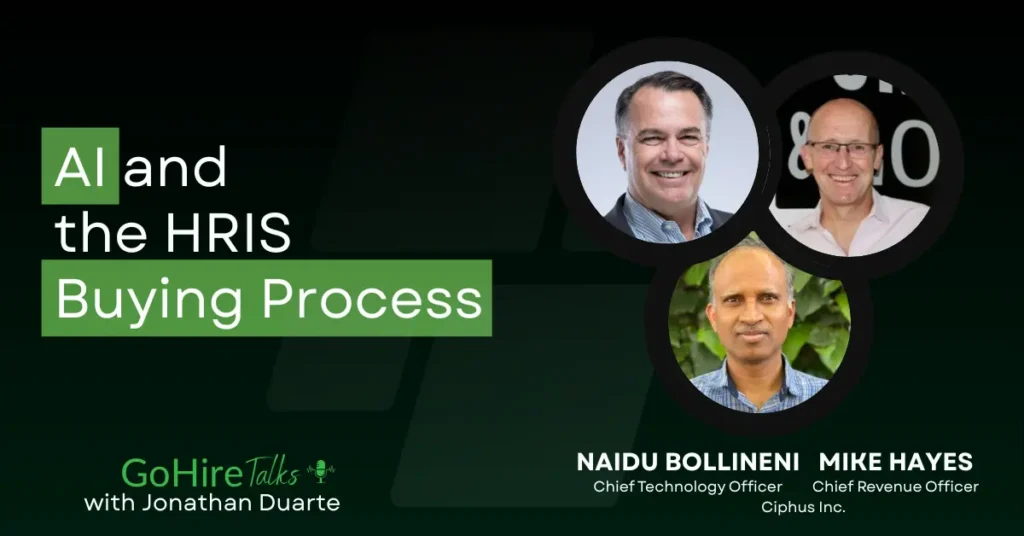
AI and the HRIS Buying Process: What Ciphus Is Building for the Midmarket
The HRIS buying process has quietly become one of the most important — and most misunderstood — decisions a CHRO or CIO will make this year. Most teams still shop for HR technology the way they did a decade ago: find the platform with the most modules, sign the contract, and spend the next twelve months (and several multiples of the sticker price) making it actually work. Mike Hayes and Naidu Bollineni of Ciphus, an AI-native HR and payroll platform, join GoHire Talks host Jonathan Duarte to unpack why that model is breaking down — and what a smarter, AI-powered HRIS buying process looks like for the 300–3,000 employee Midmarket.
Key Topics Covered in This Episode
- The “half-built car” problem with legacy HR platform implementations
- Why composable HR beats one-size-fits-all software
- How agentic AI can be deployed with real governance and guardrails — not “vibe coding”
- Solving SaaS sprawl without ripping out the systems that already work
- Deployment speed as a genuine competitive differentiator
- Data sovereignty: giving employees AI access to company data without leaking it to the public web
- Why static BI dashboards are losing to real-time, conversational operational intelligence
- Who the ideal buyer actually is — and why it’s not the Fortune 500
The “Half-Built Car” Problem in Legacy HR Platforms
Naidu Bollineni, co-founder and CTO of Ciphus, has spent more than three decades in Silicon Valley working across hardware, software, cloud operations, and data governance. That vantage point gave him a blunt way to describe what typically happens after a company signs an enterprise HR contract.
“I would compare it typically like a half-built car delivered and expecting the customer to build the rest of it — spending maybe three times the cost of that car, and eventually making use of it after six months or so.”
That experience isn’t hypothetical. It’s drawn directly from Ciphus co-founder and CEO Kavitha’s prior work coordinating half a dozen “mature” HR, finance, and operations tools inside a PE-backed firm of roughly 2,000 employees — a project that ate up close to a year and several million dollars just to get the tools working together. The fix Ciphus set out to build was the opposite motion: instead of forcing a company to bend its workflows around a rigid platform’s rules, deliver a foundation that bends around the customer.
Composable HR: Why the HRIS Buying Process Is Shifting Away From One-Size-Fits-All
Once that foundation existed, Ciphus started composing applications on top of it — HR, payroll, ticketing, project management, attendance, and leave management, all built from the same base. Naidu describes this as covering the entire employee lifecycle with a 360-degree view, with role-based access that lets an HR admin, a recruiter, or any other function see exactly what their role permits, without hand-building each configuration from scratch or hiring expensive implementation consultants.
Mike Hayes, who spent his career leading sales and marketing at HR platforms including Ascentis, PayScale, TalentSpring, and Korn before joining Ciphus, frames the shift in practical terms — most companies use only a fraction of the features in the enterprise software they’ve bought, and the rest just gets in the way of onboarding.
“It’s like Word — what percentage of Word do you actually use day to day? Maybe 5%. Enterprise applications have too many features that get in the way of efficient onboarding.”
That flexibility is also why Jonathan draws the Workday comparison directly in the conversation: Workday, Oracle Cloud, and similar enterprise systems arrive with a fixed database structure and a fixed rulebook — one that’s built to partially fit thousands of customers at once, not any single one of them completely. Straying outside those rules typically means an expensive trip to a third-party integrator.
Agentic AI With Enterprise Guardrails — Not “Vibe Coding”
A recurring theme in the conversation is the difference between AI-assisted software and AI-governed software. Mike is direct about it:
“We could be vibe coding away. The problem with that is that it doesn’t have all the guardrails… they don’t have the wrappers that you need to ensure that people get all the information they have access to based on their role, but no more.”
That’s the gap Naidu and Kavitha’s enterprise backgrounds were built to close. Ciphus’s agentic layer is designed to deliver predictable, deterministic outcomes for compliance and data governance while still giving users the flexibility and speed that agentic AI promises. For any organization evaluating vendors as part of its HRIS buying process, this is the question worth asking directly: does the AI layer have real role-based access controls, or is it a thin conversational wrapper sitting on top of ungoverned data?
Solving SaaS Sprawl Without Ripping Out What Already Works
One of the more counterintuitive parts of Ciphus’s pitch to CHROs and CIOs is that it isn’t asking anyone to rip out their existing stack. Naidu describes the typical prospect conversation this way: a company already has a tool it’s paying heavily for, and it’s still in pain.
“You don’t have to throw away your existing license. If we can connect to it, we’ll solve your most acute problem in a few weeks, maybe sooner.”
From there, the customer decides whether to run both systems side by side indefinitely or gradually migrate workflows over, eventually retiring the legacy platform once it’s no longer carrying real weight. Mike frames the underlying issue as an industry habit: the instinct is always to buy another platform to solve the next problem — which is exactly how SaaS sprawl happens in the first place.
Speed as the Real Differentiator in the HRIS Buying Process
Deployment speed comes up as a concrete, verifiable proof point rather than a marketing line. Mike references a six-week rollout of six separate HR applications — including payroll — for an airport client in the Cook Islands, after which the client had a fully agentic platform employees could interact with directly, with new feature changes measured in hours or days rather than a SaaS vendor’s release calendar. He also points to a four-tier supply chain solution built for another client in a similarly compressed timeframe. For buyers used to multi-year enterprise rollouts, this kind of timeline reframes what’s realistic to expect — and what’s worth asking any vendor to commit to before signing.
Data Sovereignty: Secure AI Access Without Leaking Company Data
Mike raises a problem most HR and IT leaders are already living with, even if it isn’t in a governance policy yet.
“Your employees are already taking data out of your systems and sharing it with the world by interacting with ChatGPT and similar tools. What you want is a system that gives them the same benefit — asking business questions of the data — without sharing it with the world.”
Ciphus’s response is to give employees that same conversational, ask-your-data experience, but pointed at a private or self-hosted model that never sends information outside the organization. Customers can choose an open-source model, a private model, or run the application fully in-house — the sovereignty decision sits with the customer, not the vendor.
Real-Time Operational Intelligence Over Static Dashboards
Jonathan and the guests spend real time contrasting today’s business intelligence dashboards — often described as backward-looking and rarely read once built — with an agentic layer that lets people ask follow-up questions of live data. Mike gives a concrete example: a manager notices payroll variance was up 18% last month and wants to know why.
“Imagine having all of that without having to export it from your systems — you just ask the questions, regardless of which SaaS application the data originally lived in.”
Who This Fits: The Ideal Buyer Profile
Ciphus isn’t positioning itself as an ERP replacement for the enterprise. The sweet spot the guests describe is organizations in the 300 to 3,000 employee range — often with hourly, frontline, clock-in-clock-out workforces such as airports, hotels, telecom providers, and logistics operations — that have outgrown generic SaaS tools but don’t need the full weight of a Workday- or Oracle-scale implementation.
HRIS Buying Process Key Takeaways
- Legacy HR platforms often arrive “half-built” — budget for years of finishing work, or ask vendors to prove otherwise upfront.
- Composable beats comprehensive: pick the HR, payroll, ticketing, and attendance features you actually need instead of paying for a platform built to fit everyone partially.
- Agentic AI needs real guardrails — role-based access and compliance controls, not “vibe coding” on top of company data.
- You don’t have to rip out an existing system to solve SaaS sprawl — connect to what you have and solve the most acute pain point first.
- Deployment speed is now a real differentiator: six-week rollouts are possible where enterprise implementations used to take a year or more.
- Data sovereignty matters — give employees the ChatGPT-style experience on a private model that never leaves the organization.
- The ideal buyer is the 300–3,000 employee Midmarket company with a frontline, clock-in-clock-out workforce — not the Fortune 500.
Interested in Recruiting AI and Recruiting Automation? View these other Recruiting AI and Automation podcast episodes.
Check out the The Recruiting AI Adoption Playbook.
Learn more about Recruiting AI and Recruiting Automation.
The GoHire Talks Interview Transcript with Mike Hayes and Naidu Bollineni
[00:00:00] Jonathan Duarte: Hey, welcome everyone. We’ve got a great and a kind of a different set of interviews today for GoHire Talks. I want to introduce Mike and Naidu from Ciphus — they’re an HR tech vendor, and we’ll get into the details. They build HRIS and payroll systems and things like that.
[00:00:20] Jonathan Duarte: But I wanted to have a talk with them, and Naidu is a friend from AI Collective, an organization we’re both members of, and talk about the buying process of HR tech — installs, the things you wish you could ask somebody on the other side, and get honest feedback from the salesperson, from the founder.
[00:00:50] Jonathan Duarte: Mike and Naidu have both been in the industry for a long time, architects and sales guys. So welcome to the show, guys. Give me a quick intro about each one of you.
[00:01:03] Mike Hayes: Naidu, why don’t you start off?
[00:01:05] Naidu Bollineni: Thank you, Mike. Thank you, Jonathan. My name is Naidu Bollineni. I’m a co-founder and CTO at Ciphus. I’ve been a technologist for the last 30-plus years in Silicon Valley — hardware, software, cloud operations, security compliance, and data privacy governance. The way we’ve seen platforms built and delivered, I would compare it typically like a half-built car delivered and expecting the customer to build the rest of it, spending maybe three times the cost of that car and eventually making use of it after six months or so.
[00:01:46] Naidu Bollineni: We wanted to flip that story on its head and say we want to deliver a technology platform that fits the customer’s needs, as opposed to force-fitting the customer into the platform’s behavior. Our co-founder and CEO Kavitha’s prior experience in HR tech — coordinating half a dozen “mature” HR, finance, and operations tools for a company of about 2,000 people — took close to a year and several million dollars, just to make those tools work together.
[00:03:51] Mike Hayes: Similar to Naidu, longtime career in technology — I moved away from coding when I’d had enough of COBOL. I moved from big systems to building companies in the Seattle area — leading sales and marketing at Ascentis, then PayScale, then TalentSpring, then Korn. What I like about Ciphus is that organizations who want the benefits of AI for their employees — so they can ask questions of their systems of record — Ciphus helps you do that, rapidly.
[00:04:57] Mike Hayes: Think of us as an AI-native, rapid application platform for organizations that have outgrown generic SaaS. Our platform lets you compose applications from proven features while providing guardrails around governance, compliance, and role-based security.
[00:05:48] Mike Hayes: We delivered a solution recently for an airport in the Cook Islands that required six different HR applications, including payroll, in six weeks. Now they have an agentic platform, and adding features becomes a matter of hours or days instead of waiting on a SaaS vendor’s roadmap.
[00:06:27] Jonathan Duarte: So for the folks who still have a Workday or Oracle Cloud implementation, or a stack split between Paylocity and ADP — you’re predominantly serving that 300 to 3,000 employee space where you don’t need the full ERP bells and whistles, but you’re leveraging AI to make it easier to build on top of and customize. Does that sound right?
[00:06:50] Mike Hayes: That’s right, to a degree — but think about expanding into other application areas, like asset management. We delivered a full supply chain solution for an organization recently — again about six weeks — and now they have four levels deep of supply insights they didn’t have before. Because it’s all one platform, you get the benefit of asking business questions across different data sources.
[00:08:16] Jonathan Duarte: What was the deciding point to build Ciphus rather than joining another HR tech company?
[00:08:42] Mike Hayes: We could be vibe coding away. The problem with that is that it doesn’t have all the guardrails. Naidu and Kavitha come from the enterprise — they understand the problems that often aren’t considered. I’ve built applications myself using vibe coding tools, but they don’t have the wrappers you need to make sure people only get the information their role allows, with no leaks in security.
[00:09:36] Naidu Bollineni: Kavitha previously worked on a platform built on top of Salesforce, and the platform’s own limitations, since it started decades ago, imposed a lot of constraints. Learning how to unblock from those shackles was one of the key thoughts behind this foundation.
[00:11:14] Naidu Bollineni: Her experience connecting “mature” tools in a prior company took such a long, painful process — that’s what pushed us to build something that does things differently. We started with agentic AI as an opportunity to tune the platform toward predictable, deterministic delivery of enterprise value while bringing in agentic capabilities.
[00:11:45] Jonathan Duarte: What does the ideal customer look like — not specific to Ciphus, but what works? I want to use this from an education standpoint for a CHRO understanding how a project gets built.
[00:12:27] Mike Hayes: People have bought multiple SaaS solutions, and there are problems at all the edges — integration becomes a real issue, or there’s a feature area they don’t have an application for. What works best is organizations with one high-impact business area they want to improve — maybe three or four applications, time management, project management, asset management, plus the core HRMS. It’s like Word — what percentage of Word do you actually use day to day? Maybe 5%.
[00:14:30] Jonathan Duarte: I wrote an article about this — you can’t implement AI like it’s Workday. Workday comes with structure, a database, and rules. Those rules are rigid, and they don’t fit 100% of any one client — they fit thousands of companies partially.
[00:16:02] Naidu Bollineni: You’ve hit the nail on the head. When a customer comes and says, “I have this great tool, but I still have this pain and I’m paying a ton of money,” that’s precisely where we say: you don’t have to throw away your existing license. If we can connect to it, we’ll solve your most acute problem in a few weeks, maybe sooner.
[00:16:54] Mike Hayes: We’re trained to think there’s always another platform to buy to solve a set of issues. Rather than buying another platform, get something that gives finance cost-movement understanding, HR headcount and overtime patterns, and operations exception identification.
[00:17:40] Jonathan Duarte: This is a new breed of technology the CIO probably knows about, but the CEO and even the CHRO often don’t. We have a legacy system with rules, and now there’s a generative layer you can put on top that gives insights and automation — an agentic layer.
[00:19:36] Mike Hayes: Your employees are already taking data out of your systems and sharing it with the world by interacting with ChatGPT and similar tools. What you want is a system that gives them the same benefit — asking business questions of the data — without sharing it with the world.
[00:20:40] Mike Hayes: We have the flexibility to use those public tools if that’s what someone wants, but we also have this concept of sovereignty — you choose where to put your AI, whether that’s an open source model or a private model, and you can even run the application in-house if necessary.
[00:21:10] Jonathan Duarte: Are there industries or company sizes where you consistently find customers — the ones where it’s a no-brainer?
[00:22:55] Mike Hayes: Often it’s organizations with workers clocking in and clocking out — that adds a lot of complexity. Organizations with just one or two modules of Sage or Workday are often paying a lot of cash for a platform that can expand to all sorts of dimensions they don’t need. We’ve implemented solutions for telecom providers, local airports, and hotel systems — that hourly, frontline workforce space.
[00:23:20] Jonathan Duarte: Where’s your client base — mostly US, or global?
[00:23:51] Mike Hayes: We have customers globally and we’re starting to pick up customers in the US now. I’m British; Naidu and Kavitha come from India, so we’ve got a lot of connections elsewhere where we’ve been able to build and implement our solutions to date.
[00:26:37] Naidu Bollineni: CHROs are typically business people who have to work with IT to get something out of their existing tool set. At the end of the day, it’s people who drive the business, the value, and the revenue. In terms of advice — pick a problem. If someone says they don’t have any problems, they’re probably disconnected from reality.
[00:27:40] Jonathan Duarte: I think that’s the biggest thing. Everyone’s been using business intelligence dashboards for two decades — graphs that look pretty but the insights are garbage because they’re not real time. That’s why nobody reads the report.
[00:29:15] Mike Hayes: Imagine having all of that without having to export it from your systems — you just ask the questions, regardless of which SaaS application the data originally lived in. It’s just data in a data lake that lets you act as if you’re using Claude, within the rules of the road for your organization.
[00:29:43] Jonathan Duarte: Well, guys, we’re going to wrap it up. How should people reach out to you?
Mike Hayes: I’m Mike H Seattle on LinkedIn, or just mikeh@cyphus.com.
Naidu Bollineni: I’m on LinkedIn — I regularly check and connect, and references and warm introductions are the best way to reach us. We also have a contact form on our website — worst case, reach out to info@cyphus.com.
Jonathan Duarte: Awesome. Thanks, guys — we’ll wrap the show here.
Connect with Mike Hayes on LinkedIn: linkedin.com/in/mikehayesseattle
Connect with Naidu Bollineni on LinkedIn: linkedin.com/in/naidubollineni
