
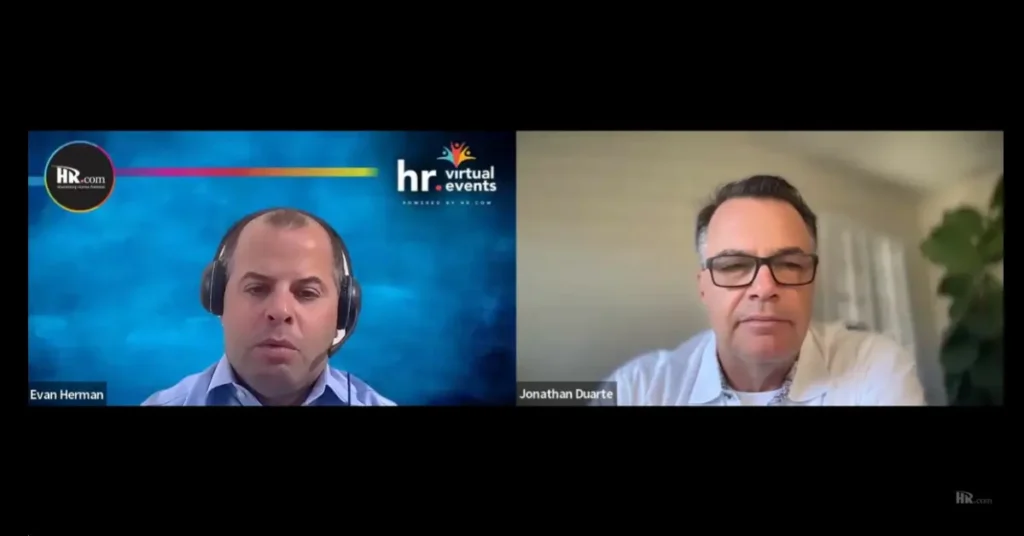
Evan Herman and Jonathan "JD" Duarte, founder and CEO of GoHire, did a podcast for HR.com to discuss recruiting automation strategies and the state of high-volume recruiting. What followed was one of the most data-rich conversations in GoHire's history — covering candidate ghosting, deskless workforce communication, pre-screening automation, and why the team that responds first wins.
Whether you run a team of three or three hundred, the dynamics of high volume recruiting expose the same structural failure that slows down every TA organization: candidates apply, recruiters try to reach them, and almost nobody actually connects. This page captures the key insights from that conversation and maps them to actionable recruiting automation strategies.
The New Recruiting Reality: "Do More With Less" Is Now the Default
Herman opened the session with a framing statement that has become the defining mandate for talent acquisition teams globally: do more with less. Budget pressures, leaner teams, and rising candidate expectations have collided into a moment where recruiting professionals need speed, scale, and precision — simultaneously.
"A lot can be learned from high volume hiring and recruiting organizations," Herman observed, "because unlike almost any other industry and sector of recruiting, they're relying on speed, volume, scale — or just overt ROI — more so than any other field in Talent Acquisition."
The insight here isn't that high-volume recruiting teams have it figured out. It's that their constraints — fill rates, cost-per-hire, ghosting rates, application drop-off — are so extreme that they've been forced to innovate faster than any other sector. Recruiting automation isn't a nice-to-have in frontline worker environments; it's the only path to survival.
This mirrors what GoHire sees across its customer base. The workflows that frontline employers build out of necessity — automated pre-screening, text recruiting, instant interview scheduling — are the same workflows that mid-market and enterprise TA teams are now actively seeking. The difference is urgency. For frontline employers, these aren't optimizations. They're table stakes.
Why Recruiting Automation Starts With the Deskless Workforce Problem
Before GoHire existed, JD Duarte watched a seismic shift unfold from his vantage point inside a background screening company called GoodHire. One of his clients was Uber. At the 2016 SHRM conference in Orlando, Uber quietly launched in that city — and then Las Vegas — and over the following six months hired 600,000 drivers across 26 cities. The channel they used exclusively: text messaging.
"That's the largest private recruiting event, as far as I know, on record," Duarte told Herman. "And it's the shift that we now see that is commonplace among hourly workers and shift gig workers — the shift from forcing a candidate through a web page on a mobile phone."
The structural reality driving this shift is stark: approximately 80% of the global workforce has no computer at home. In manufacturing, construction, retail, hospitality, and healthcare — the industries that represent the largest share of jobs in the U.S. economy — the candidate's primary computing device is their phone. Not a laptop. Not a tablet. A phone they use primarily for calls and text messages.
The consequence for recruiting is brutal. Standard ATS applications — designed for desktop browsers, requiring resume uploads, multi-step forms, account creation — are nearly impossible to complete on a smartphone. "Since 85% of the workforce doesn't have a resume on their phone, they don't complete your applications on your ATS because it's nearly impossible," Duarte noted. This is why text-to-apply isn't just a convenience feature. It's a fundamental accessibility requirement for deskless workforce hiring.
The Real Problem in Recruiting: 80% of Applicants Never Get a Real Response
Here is the number that should stop every TA leader cold: when a candidate submits an application — on Indeed, through an ATS, on a career site — 80% of those candidates are never meaningfully communicated with, despite the recruiting team's best efforts to reach them.
This isn't a recruiting failure. It's a communication failure. Recruiters are trying. They're calling. They're emailing. But the candidate isn't picking up an unknown number at 2pm while operating a forklift. They're not opening a recruiting email in their cluttered inbox. The channel mismatch between how recruiters communicate and how candidates actually communicate has created a silent, systemic breakdown at the top of every talent pipeline.
The downstream cost of this gap is enormous. Recruiters and HR teams spend roughly 20% of their working hours — an entire business day each week — on outreach attempts that never land. That's time that could be spent on interviews, onboarding, retention work, or strategic TA initiatives. Instead, it evaporates into voicemails nobody listens to and emails nobody opens.
Pre-screening automation powered by text messaging solves this at the channel level. Instead of a call from an unknown number, a candidate receives a text message from the company they just applied to. They can respond in two seconds. The system does the rest.
GoHire's Text Invite automation moves candidates from application to scheduled interview — fully automated, no recruiter involvement required.
Request a Live Demo
How Recruiting Automation Fixes the Pre-Screen Bottleneck
The mechanics of GoHire's recruiting automation are designed to mirror what a high-performing recruiter does manually — but at scale, at speed, and without the communication drop-off that plagues phone and email outreach. The core workflow looks like this:
- A candidate applies or creates an account in the ATS.
- GoHire automatically sends a personalized text message: "Hi [First Name], I noticed you applied for [Role] at [Company]. Are you still interested? Reply YES and I'll send some available times."
- The candidate responds YES. The platform pulls available interview slots from the hiring manager's calendar and texts them back — no recruiter in the loop yet.
- The candidate selects a slot by replying with the option number.
- A confirmation text goes out. A reminder fires four hours before the scheduled time.
- If the candidate doesn't respond within a set window, an automated follow-up goes out — just like a recruiter would do manually, but without consuming any recruiter bandwidth.
This is what JD Duarte calls the Text Invite — GoHire's flagship feature for interview scheduling automation. It's not just a text message. It's a full virtual assistant workflow embedded into the recruiting process.
The power is in what the recruiter doesn't have to do. No phone tag. No email follow-up. No manual calendar coordination. The candidate moves from application to confirmed interview without a single recruiter action — freeing the team to focus on the conversations that actually require human judgment.
Text Invites in Action: From 20% Pre-Screen Rate to 80% in 24 Hours
The most compelling proof point in JD Duarte's conversation with Herman comes from a real GoHire customer: a large hospitality conference center in Texas. Before implementing GoHire, they operated with a traditional outreach model — phone calls, email follow-ups, manual scheduling. The result was a pre-screen rate of roughly 20%, even with an aggressive and persistent recruiting team.
"The most important part is not just sending a text — it's implementing it into your system as a virtual assistant for your team," Duarte emphasized. The technology alone doesn't drive the result. The workflow integration does. When the Text Invite fires automatically at the right moment in the candidate journey, and the responses feed back into the ATS, the entire recruiting machine accelerates.
For roles like laundry workers, bellhops, and sous chefs — where the candidate pool is active, mobile-first, and evaluating multiple opportunities simultaneously — speed is the only sustainable competitive advantage. 75% or more of candidates will take the first offer they receive, provided it meets their wage criteria. The team that pre-screens first wins the candidate.
Candidate Re-Engagement: Recovering the Applications That Would Have Been Lost
One of the most underappreciated applications of recruiting automation is re-engagement: reaching back out to candidates who started an application but never completed it. This problem is far larger than most TA leaders realize.
During the conversation, JD Duarte challenged the hospitality client to check how many incomplete applications were sitting in their ATS from a job posted just 24 hours earlier. The answer: four candidates had created accounts. Three had not attached themselves to the job. The one who completed the application wasn't qualified. Net result: 24 hours in, $350 spent on job distribution, and zero viable candidates in the pipeline.
GoHire's automated re-engagement sequence changes the math entirely. The workflow runs without any recruiter action:
- 4 hours after an incomplete application: Automated text to the candidate — "Hi [Name], I noticed you hadn't completed your application yet. We're still interested — here's a link to come back."
- 8 hours later, if still incomplete: Recruiter-attributed text — "Hey [Name], this is Mary, a recruiter at [Company]. I saw you started an application. Could you answer a couple of pre-screening questions? I'll get you scheduled with a recruiter from there."
- If they qualify on pre-screening: Schedule them immediately. Send the application link as a post-scheduling follow-up — completion rates skyrocket once there's a committed interview time.
"Because if you don't have a resume on your phone, you can't complete a Workday application without pulling your own teeth," Duarte noted. The solution isn't a better application form. It's removing the resume requirement from the first engagement entirely — pre-screen with three questions, schedule the interview, then collect the paperwork.
Recruiting Automation Beyond TA: Employee Engagement, Retention, and HR Workflows
One of the most significant expansions in the GoHire platform — and in Duarte's strategic vision — is the application of text messaging automation well beyond candidate acquisition. The same infrastructure that drives text recruiting can power employee engagement, HR compliance, and retention programs at scale.
Herman's reaction during the interview was candid: "Oh, that's great — so it's not just external recruiting, it's internal employee engagement and pure HR stuff too. Not just a TA functionality." Duarte's response: it goes even further than that, into active retention.
Open Enrollment and HR Communications
In manufacturing and healthcare environments, employees often don't have regular access to corporate email. Open enrollment deadlines, policy updates, and benefit change windows get communicated through posters in breakrooms and messages passed down through managers — two of the least reliable channels in any organization. Text messaging reaches the employee directly, on their personal device, with a 98% open rate. "In the same amount of time it takes to write a sign," Duarte observed, "you could text all your employees with a link."
Call-Out and Absence Reporting
GoHire built a specific application for shift worker call-outs: an employee texts a dedicated number to report an absence, the system asks two or three structured questions, and routes the response directly to the relevant manager. The manager gets the information they need. The employee doesn't have to navigate a phone tree or find the right contact. The interaction that used to take 10 minutes gets done in 30 seconds.
New Employee Onboarding and Retention Messaging
The most creative use case Duarte shared involves early-tenure retention — arguably the most expensive unsolved problem in high-volume hiring. One GoHire customer, a fast food brand, sends new employees a coupon on their fifth day: "Welcome to your fifth day! Bring your friends and family and you'll all get 20% off." The goal is to get the employee past day seven — statistically the highest-risk period for early attrition — by building an emotional connection between the employee and the brand.
This is the strategic reframe that separates GoHire's approach from a simple texting tool: Talent Acquisition doesn't have to be a cost center. When automation drives engagement, retention, and referrals — all from a single text thread — the ROI compounds in ways that traditional ATS reporting never captures.
Solving Candidate Ghosting With Recruiting Automation
Candidate ghosting — applying and then disappearing, scheduling an interview and never showing — has become one of the defining frustrations of modern talent acquisition. Herman coined a playful label for JD Duarte during their conversation: "the Ghostbuster of HR Tech." The label fits.
The core mechanism behind ghosting is the same communication breakdown we've discussed throughout this page. A candidate schedules an interview through a web portal, gets a calendar invite to an email address they don't check, and forgets about it entirely. There's no friction in not showing up because there was no real human connection in the scheduling process.
GoHire attacks ghosting through commitment mechanics and automated reminders. When a candidate schedules through a Text Invite, they respond in the same thread where the conversation started — on their personal phone, with their own words. That moment of reply creates a micro-commitment that calendar invites never do. The automated reminder four hours before the interview reinforces it. The result is that no-show rates fall significantly across every GoHire customer who implements Text Invite workflows.
Job fairs are an equally compelling use case. "If you put a sign up saying 'We have a job fair,' no one cares," Duarte noted. "But if you get candidates to schedule a time with a recruiter at the job fair — which is simply a text message saying 'Hey, would you like to schedule time?' — and you get their first name, last name, and a commitment to a time, people are actually showing up. You don't get ghosted as much."
The Road Map: Recruiting Automation Built for Individual Practitioners
Industry analyst Josh Bersin has noted that roughly 75% of HR technology purchased by organizations is never fully used. This adoption gap is one of the most stubborn problems in the HR Tech market — and one that JD Duarte named explicitly as the next frontier for GoHire.
"The biggest thing — across all of HR, not just HR Tech — it's the actual adherence and usage of solutions," Duarte told Herman. The most powerful recruiting automation software in the world delivers zero value if the practitioner on the ground can't figure out how to use it on a Tuesday morning.
GoHire's roadmap is oriented around a specific persona: the single HR manager sitting at a metal desk inside a manufacturing facility, managing recruiting and employee communications without an HR coordinator or IT support. The platform is being built to be purchased month-to-month, implemented without IT, and producing results within hours — not weeks.
This time-to-value story — first text sent, first interview scheduled, all in under three minutes — is what distinguishes GoHire from enterprise platforms built for six-month implementation cycles. The future of recruiting automation isn't just more powerful. It's more accessible.
Key Takeaways: What Every Recruiting Team Should Implement Now
Whether you're running high volume recruiting for a healthcare network, a hospitality chain, a manufacturing operation — or a professional services firm that never thought it needed to think like a frontline employer — the principles from this conversation are immediately actionable.
- Audit your apply-to-offer time. If it's longer than 72 hours for hourly roles, you are losing candidates to employers who move faster. 75% of candidates take the first qualifying offer.
- Measure your communication reach rate. What percentage of applicants who enter your ATS have an actual conversation with your team within 24 hours? If it's below 50%, you have a channel problem — not a recruiter performance problem.
- Implement Text Invite workflows. Start with a single role or requisition. Send the first automated text message the same day a candidate applies. Measure your pre-screen rate at 24 hours and 72 hours.
- Re-engage incomplete applications. Set up an automated sequence for candidates who create an account but don't complete the application. This is recovered pipeline with zero additional sourcing spend.
- Extend text messaging into HR workflows. Open enrollment, call-outs, onboarding milestone messages — every repetitive communication your team sends by email or phone is a candidate for automation.
Frequently Asked Questions: Recruiting Automation & Text-to-Apply
What is recruiting automation and how does it differ from a standard ATS?
Why is text messaging more effective than email and phone for candidate outreach?
What is a Text Invite and how does it work in high-volume hiring?
How does text-to-apply technology reduce candidate ghosting?
What industries get the most value from recruiting automation software?
Can text messaging automation be used for employee engagement, not just recruiting?
What is apply-to-offer time and why does it matter more than time-to-fill?
See exactly how GoHire's Text Invite automation and pre-screening workflows work — live, with your own job requisitions.
Request a Demo Explore Text Recruiting
