

HR Career Advice: Why SMBs Beat Big Logos in the AI Era
The best HR career advice in the AI era might surprise you — and 35-year HR veteran Robin Schooling isn’t sugarcoating it. In this episode of GoHire Talks, Robin sits down with GoHire CEO Jonathan Duarte for a wide-ranging conversation that spans the birth of mobile recruiting, the coming wave of enterprise HR layoffs, and why the smartest HR and TA professionals are quietly pivoting away from big-brand employers toward small and mid-sized businesses.
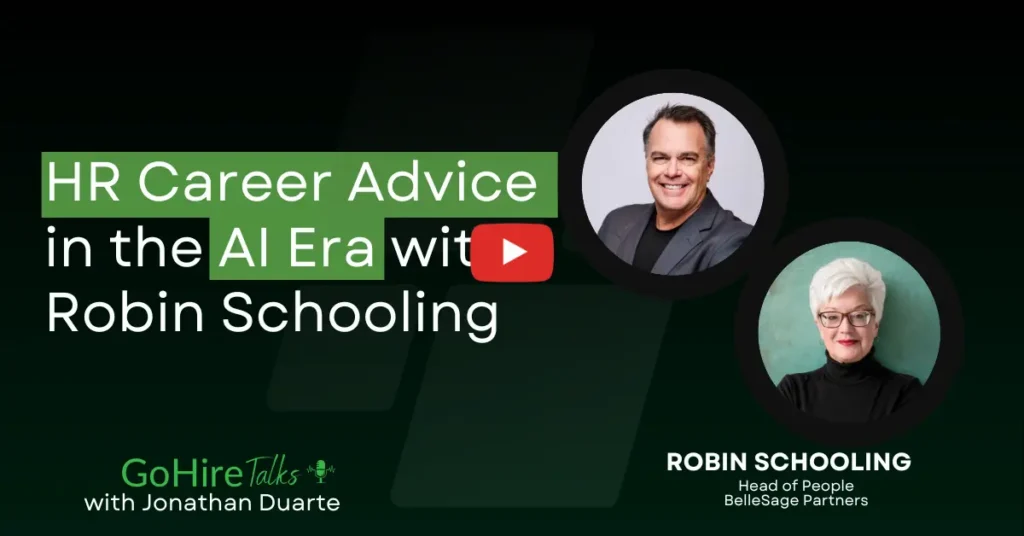
Key Topics: HR Career Advice in the AI Era with Robin Schooling
- Why enterprise HR is the most vulnerable to AI-driven job cuts
- Why SMBs are where HR practitioners will have the most impact going forward
- How Robin and Jonathan built one of the earliest SMS-based recruiting chatbots — before the VC world caught up
- The lesson every HR team should take from that experiment: don’t wait for a vendor
- Why resume volume is up but actual qualified candidates aren’t — and what to do about it
- Grassroots recruiting tactics that still outperform job boards
- The referral hiring advantage and why candidates are 9.7x more likely to get hired that way
- What Robin looks for in her next role — and why mission beats logo every time
HR Career Advice in the AI Era: Stop Chasing the Enterprise Logo
Here’s Robin’s take, delivered without any corporate fluff: “Your future as an HR practitioner or a TA practitioner — where you can do the best work and have the most impact — is no longer at those enterprise companies. Stop chasing that logo.”
The reason? AI automation is being fast-tracked into the largest organizations first. Enterprise HR departments with hundreds of HR business partners — many spending 10 to 15 hours a week on administrative tasks — are exactly where consolidation is coming. When those tasks get automated, the headcount follows. Robin is direct: the jobs tied to that admin work aren’t disappearing overnight, but the number of people needed to do what’s left is going to shrink.
For HR professionals searching for real HR career advice in the AI era, the signal is clear. The enterprise logo on your resume may not be worth what it used to be — and AI is accelerating that shift right now.
Why SMBs Are the Real Opportunity for HR and TA Professionals
While enterprise teams brace for enterprise HR layoffs driven by AI task automation, smaller organizations tell a very different story. Robin is emphatic on this point: at SMBs, AI doesn’t eliminate jobs — it finally frees people up to do the strategic work they were always too buried to get to.
“If I’m in an SMB and I’ve got an HR department of let’s say three people — that’s where AI is truly gonna come in and free up my time. This becomes: okay, free up my time and let me work on strategic stuff.”
SMB HR teams have historically been highly administrative out of sheer necessity. Manual interview scheduling. Walk-in applications. Phone tags and email chains for every step of the process. AI and automation tools — including candidate screening automation — are dismantling that backlog. That means smaller teams can finally operate at the level the business always needed them to. The SMB recruiting strategy conversation has shifted from “how do we keep up?” to “how do we get ahead?”
The HR Career in the SMB AI Era Started With a Text Message and a Casino
Long before “AI in recruiting” became a conference theme, Robin and Jonathan were running a scrappy experiment at Hollywood Casino that would prove the power of mobile recruiting for hourly workers. The existing ATS — a desktop-only iCIMS system — was generating two candidates for a security guard opening. Workers applying at 11pm after a second shift weren’t going to navigate a desktop application form on their phone. They just abandoned it.
Jonathan’s hypothesis: post the same job on Craigslist with a QR code and a “text JOBS to this number” call to action. The result? Roughly 30 to 70+ candidates in 48 hours.
“We needed to make it fast. We needed to make it quick. We needed to make it easy for these people who were running from one job to the next or picking up their kids.”
The SMS flow included built-in candidate screening automation — basic screening questions that helped candidates self-select out based on shift availability, age requirements, and more. The high volume hiring problem wasn’t solved by adding more staff. It was solved by removing friction. That experiment predated the entire conversational recruiting industry by nearly a decade.
Don’t Wait for the Vendor — Build It Yourself
The biggest lesson Robin took from that early mobile recruiting experiment isn’t about technology. It’s about mindset. HR and TA teams don’t need to wait for a software vendor to solve their problems. The tools available today — generative AI, no-code platforms, workflow automation — make it more possible than ever to experiment, build, and iterate on your own.
“You don’t have to wait for a vendor to build this sort of thing for you. Do it yourself. Find a way to do it yourself.”
When Robin and Jonathan ran their SMS experiment, the technology that later became Paradox (eventually acquired by Workday) didn’t exist yet. They built the concept themselves. The same spirit applies today to every HR team sitting on a problem they’re waiting for a product to solve.
Resume Inflation Is Real — And AI in Recruiting Has to Catch Up
One of the sharper observations in this conversation: AI-assisted applications are flooding inboxes with polished, well-formatted resumes that look impressive — but the actual pool of qualified candidates hasn’t grown to match. More applications, same number of genuinely qualified people. That makes the job of AI in recruiting harder, not easier, at least in the short term.
Robin points out that SMBs are having active conversations about how to filter fake candidates and add meaningful screening steps without creating a process that drives real candidates away. The candidate screening automation tools available today need to work smarter, not just faster. And that conversation — happening in real time at small recruiting teams — is driving real innovation from the ground up.
There’s also a counterintuitive correction emerging on the candidate side. As applications become frictionless and plentiful, standing out requires the opposite. One young marketing professional mailed a physical resume and portfolio to a hiring manager. The hiring manager didn’t have a role for her — but was so struck by the gesture that she walked it to a colleague in another firm. That colleague hired her. Everything old is new again.
Grassroots Recruiting and the Referral Advantage
Robin’s casino-era SMB recruiting strategy went well beyond digital channels. She printed business cards with a simple message: you’re exactly the type of person we’d love serving our guests. Managers carried them and handed them to standout servers, bartenders, and retail workers. Jonathan’s teams distributed similar cards in coffee shops and community centers near manufacturing facilities. Someone even hung flyers in a dive bar near a plant.
“That is your cheapest marketing that you could probably do. It costs less than posting one job on Indeed.”
This grassroots approach connects directly to the referral hiring advantage. Jonathan cites data showing candidates are 9.7 times more likely to get hired through a referral than through a job board. Yet most job seekers — and most employers — underinvest here. The key for candidates: don’t lead with your resume. Ask for 15 minutes. Learn about the company. Let the relationship do the work that the application never could.
What Robin Looks for in Her Next Chapter
After 35 years in HR across banking, casinos, healthcare, tech, nonprofits, and more, Robin isn’t chasing titles or logos. She’s looking for mission. The organizations where she found the most meaning were the ones where stated values actually drove decisions — where leadership sat in a board meeting and referenced the values before making a call.
“What the business is almost less important. There could be a deep mission with somebody making vegan donuts, just as there is with we take care of widows and orphans.”
It’s a fitting close to a conversation full of sharp, actionable HR career advice in the AI era. The path that leads to the most meaningful work isn’t the one with the biggest logo. It’s the one with the clearest purpose.
Interested in Recruiting AI and Recruiting Automation? View these other Recruiting AI and Automation podcast episodes.
Check out the The Recruiting AI Adoption Playbook.
Learn more about Recruiting AI and Recruiting Automation.
The GoHire Talks Interview Transcript with Robin Schooling
[00:00:00] Jonathan Duarte: Hey everyone. I’ve got one of my favorite people in HR on today. Lucky for me, Robin Schooling has been actually one of my mentors in the HR space since we built, believe it or not, one of the first chatbots — I guess we went live in 2017 or right around there.
[00:00:31] Jonathan Duarte: Robin, great to have you on the show. Why don’t you give a little quick intro — what you’ve been up to and all your experience.
[00:00:55] Robin Schooling: Yeah, I am delighted to be here. I feel like I’ve been around in HR forever, and when I do the math, I’ve literally been working in HR for 35 years. It’s ridiculous. Always in HR or on the peripheries of it — lots of in-house HR roles, variety of industries over the years. I started in banking — very buttoned up, had to wear suits. Then several casinos and the lottery, healthcare, some tech and consulting firms. I love that variety. Lots of frontline work with frontline staff in manufacturing and the hospitality world at the casinos.
[00:01:50] Robin Schooling: I’ve been a longtime blogger — writing my blog since 2010. My first book came out last year, called Real HR. Podcasting over at Drive Thru HR — that podcast has been running since 2010 as well. And currently I’ve hung my shingle up. It’s called Velvet Cubicle. Working with some organizations and individuals on projects, but really looking to get back somewhere in-house HR.
[00:02:34] Jonathan Duarte: So tell me about one of the ways we met back in the casino days.
[00:02:42] Robin Schooling: It was Hollywood Casino.
[00:02:44] Jonathan Duarte: Hollywood. Yep. And we built one of the first texting chatbots together. My hypothesis: I said, hey Robin, let’s figure this thing out. I think this thing might work. I asked her for a role — it was a security guard role you’d posted on iCIMS. You got two candidates through iCIMS. Then I said, why don’t we put the same job on Craigslist with a QR code and “text JOBS to this phone number.” And I don’t remember the exact number, but it was something like 30 candidates in 48 hours.
[00:05:02] Robin Schooling: Yeah. I loved when we did that because I was looking to solve the problem that my team was living with every day. And you were looking to solve the problem on the bigger scheme of things. It was a perfect test of what could be.
[00:05:35] Robin Schooling: We were high-volume hiring — between 40 and 50 new hires every month, new hire orientation twice a month. Three of us on the HR staff. Very manual. People were job searching at 11 o’clock at night when they got off their second shift job, and they’d get to the application and just abandon it. We needed to make it fast. We needed to make it easy.
[00:07:13] Robin Schooling: It was 70-plus over a couple of days. We’d built screening questions through the texting that got people to self-select out — shift availability, age requirements. They could leave their phone number, their email. We could communicate right back with them. It upped the speed. It was responsive to these candidates. It just changed the game.
[00:08:18] Robin Schooling: Here’s the greatest lesson out of that — it applies today for HR and recruiting teams. You don’t have to wait for a vendor to build this sort of thing for you. Do it yourself. Find a way to do it yourself. When I see the generative AI tools available now — pick your Claude, your Gemini, whoever — play around with this stuff. Find ways to build these things yourself.
[00:09:34] Jonathan Duarte: I’ve been building AI systems in the enterprise for over 10 years and it’s phenomenal what you can do.
[00:10:44] Jonathan Duarte: What are you hearing in the market these days? One guest told me: we have a new role, I looked at the candidates and thought, wow, great candidates. Then he looks at every single one and says — no. Great resumes. Same number of qualified candidates.
[00:11:40] Robin Schooling: There’s very much this divide in HR and TA between enterprise and everybody else. Let’s say over 5,000 employees — folks that work in HR and TA at that level start to look down on everybody else. There’s always been this desire among a lot of HR people to go work for a big-name, well-known company. But here’s my career prediction for HR folks and recruiters: your future as an HR practitioner or TA practitioner — where you can do the best work and have the most impact — is no longer at those enterprise companies. Stop chasing that logo.
[00:13:50] Robin Schooling: Those enterprise companies are where AI automation is fast-tracked in. Those HR departments with 300 HR business partners spending 10, 15 hours a week on admin work that can be taken over and optimized — that’s happening right now. When those tasks are gone, those jobs are gone. The remaining tasks get deployed among fewer people.
[00:14:28] Robin Schooling: Those SMBs under 1,000 employees — especially under a couple hundred — they’re using AI, learning about tech, bringing it in-house. But their jobs are not going away. If I’m in an SMB with an HR department of three people, that’s where AI truly frees up my time. It becomes: free up my time and let me work on strategic stuff. These are the people who have been highly administrative out of necessity.
[00:15:27] Robin Schooling: The resume flood? That’ll settle down. We’re in that cycle right now. But SMBs are having conversations about fake candidates, about how to mitigate wasting time, about what steps to add. Those conversations are being had and there’s real learning coming from that.
[00:16:33] Robin Schooling: A 25, 27-year-old marketing professional applied online like everybody else — but also printed her resume, put it in an envelope with a stamp, and mailed it to the hiring manager. That hiring manager got it. It stood out because nobody gets that anymore. The person wasn’t right for the role, but the hiring manager walked it upstairs and gave it to a colleague at another firm. That firm hired her.
[00:17:33] Jonathan Duarte: You have to put skin in the game. Candidates used to apply to fewer jobs because it was a pain. We might be going back to that. You’re 9.7 times more likely to get hired as a referral. You’re going in the crowded door when you could go around it. The referral process: don’t say “here’s my resume.” Ask for 15 minutes. Ask to learn about the company. You’re not asking for a job.
[00:20:35] Robin Schooling: When I was at the casino, I made business cards that said on one side: “You’re exactly the type of person we’d love providing service to our guests at Hollywood Casino.” On the other side: our career page URL and career hotline. I gave them to all our managers and asked them to leave one when they got great service at a restaurant or bar. Trying to organically build referrals from getting great service. Old school. But it worked.
[00:22:08] Jonathan Duarte: We’ve had clients put business cards in coffee shops around their manufacturing facilities. What does it take — 30 minutes a week, driving around? That is your cheapest marketing. It costs less than posting one job on Indeed.
[00:22:43] Robin Schooling: I hung flyers in a dive bar that a bunch of my guys from one of the plants all hung out at. I had one of them take the flyers and hang them there. I would get applicants off of that. It was fantastic.
[00:24:03] Robin Schooling: For what I’m looking for next — it’s not necessarily an industry. It’s more: what are they about? What’s their mission, their goals, their values? The places I enjoyed working the most were nonprofits — extremely mission-driven, where we lived it. In one case it was a hundred-year-old organization. We had values that had been in place for a hundred years and still resonated. At every executive leadership or board meeting, if we were making a decision, we referenced the values. That’s the kind of organization I like.
[00:25:24] Robin Schooling: What the business is almost less important. There could be a deep mission with somebody making vegan donuts, just as there is with “we take care of widows and orphans.” That’s what resonates with me: what are they about? Who are they serving?
[00:26:15] Robin Schooling: I love a good process and I will come in and clean up and eliminate the waste. Why are we doing it that way? If it doesn’t serve a purpose anymore, let’s get rid of it. Clean that garbage out so that I can go and do the people work I want to do.
[00:26:30] Jonathan Duarte: How can someone find you?
[00:26:32] Robin Schooling: I’m infinitely Googleable. Robinschooling.com — that’s the blog that’s been around forever, and that takes people anywhere to find me.
[00:27:20] Jonathan Duarte: Great to catch up, Robin. Great to reminisce about our old days. Thank you so much.
[00:27:34] Robin Schooling: Fantastic. Thank you, Jonathan.
Connect with Robin Schooling on LinkedIn: linkedin.com/in/robinschooling
